[pageLogInLogOut]

#Nonwovens / Technical Textiles

Lightweight material for a difficult task
In view of the many different conflict situations worldwide, the need for personal protective equipment for security forces is increasing.
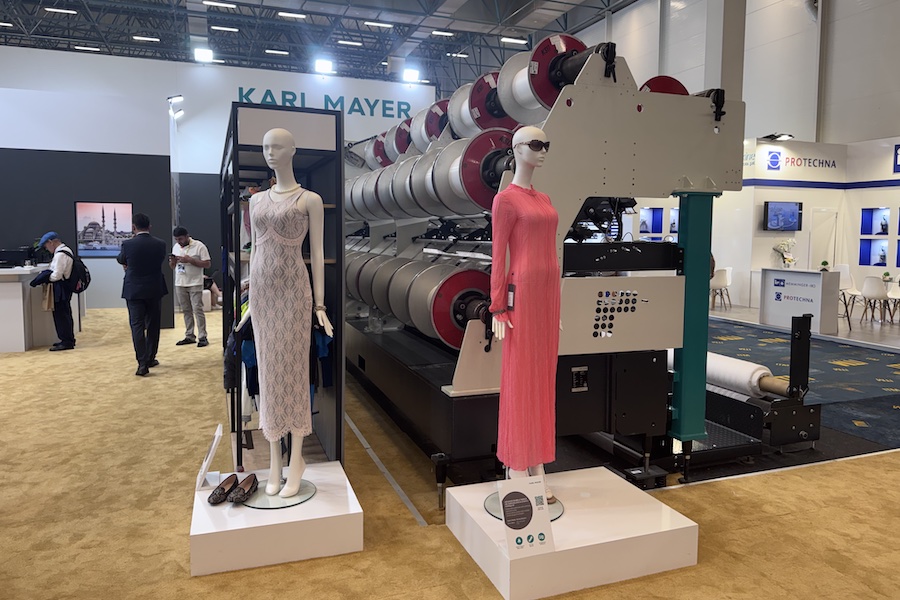
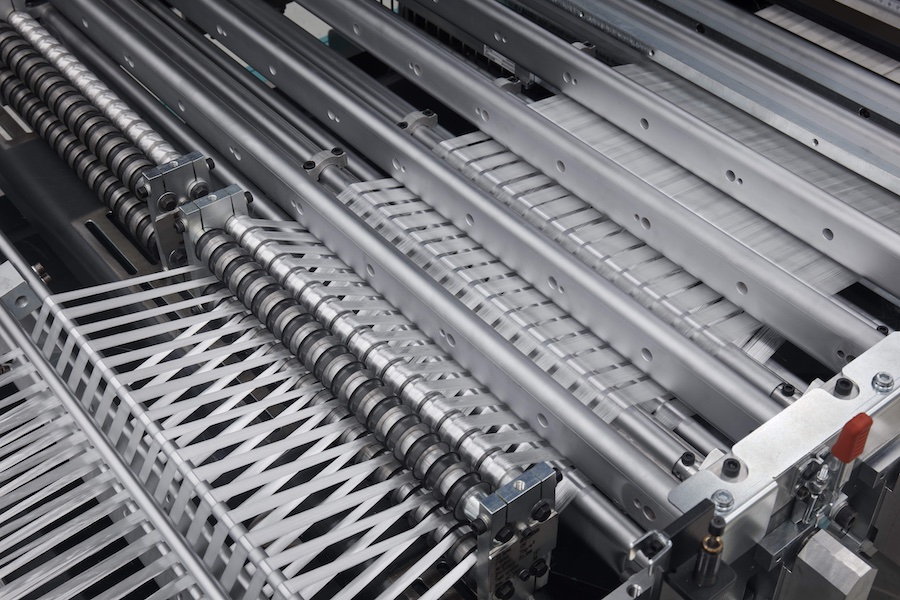
UD 700 fibre spreading machine © 2025 KARL MAYER


Production of UHMWPE non-crimp structures for personal protective equipment using KARL MAYER composite machines

“We are receiving more and more enquiries from Europe about bulletproof protective waistcoats,” says Dr Jürgen Tröltzsch, Special Specification Project Manager at KARL MAYER's Technical Textiles business unit.

He and his team have already been successfully developing solutions for the production of extremely high-performance yet lightweight multiaxial non-cromp fabrics for textile protective applications for several years. A low weight is important for the wearing comfort of protective equipment. Products made from aramid fibres, a high-strength polyamide, are already established on the market. These fibres are spread into thin tapes using the UD 700 fibre spreading machine, fed to the COP MAX 5 multiaxial warp knitting machine at constant tension in a two-stage process and consolidated into high-quality fabrics by means of stitch-bonding. The process already enabled individual layer weights of just 90 g/m².

The experts at KARL MAYER found that it was still too heavy, as up to 70 layers of tape are combined at different angles depending on the protection class.

In another project, ultra-high molecular weight polyethylene (UHMWPE) fibres were used. Compared to aramid, these fibres have a lower density and a high tensile strength of over 3.5 GPa. Despite their lower material usage and weight, UHMWPE fibres offer the same energy absorption when hit by bullets and other projectiles as aramid /1/.

Production of extremely light fibre layers

The process for manufacturing UHMWPE tapes is similar to that for aramid processing. In a first step, the fibres are spread into single-layer tapes using the capabilities of the UD 700 fibre spreading system. The spreading tests at KARL MAYER were extremely promising. Due to its good spreading behaviour, the UHMWPE fibre can be used in high count and still be spread into extremely thin, lightweight layers.

“We have produced layers with a thickness of just 40 to 50 µm and a maximum of two individual filaments on top of each other. This makes weights per unit area of less than 30 g/m² per layer possible,” says Jürgen Tröltzsch, delighted with the success.
Jürgen Tröltzsch © 2025 KARL MAYER


Due to the low weights per unit area, the filaments must be fixed in position directly after the spreading process so that no lanes are created during further processing. Laying lanes are break-in points for the projectile and are therefore an exclusion criterion. A wafer-thin polymer film, 10 µm thick, was laminated onto one side of the unidirectional single-layer tapes made from spread fibers as a fixing material. This allows the strength potential of the fibres to be used to the maximum in order to do justice to the price of the yarns.

A module for film feeding and heating was integrated into fiber spreading machine for the required connection of fibre layer and film. The tests for this also delivered encouraging results.

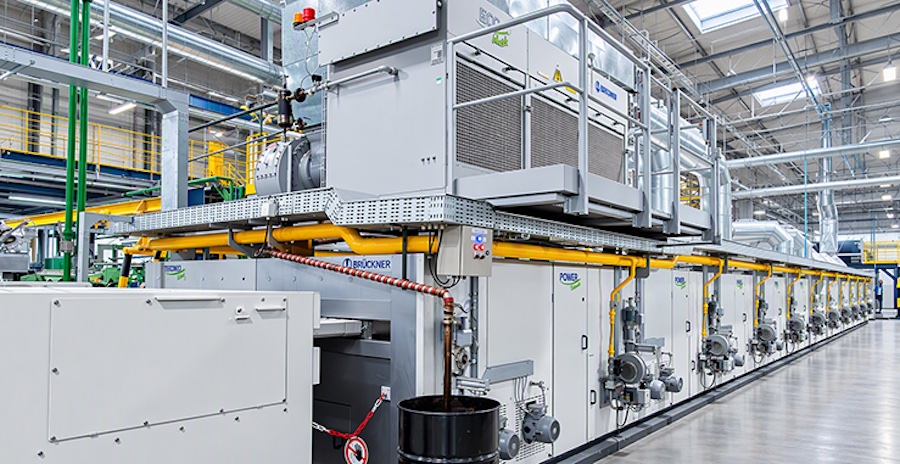
In a second step, the unidirectional single-layer tapes are joined in 0° and 90° angle layers on the COP MAX 5 to form layer stacks, so-called cross-plies, and bonded using the wrap knitting technique, as has already been tried and tested in aramid processing. Up to six layers can be stacked automatically. In particular, the system for automatic stacking of layers in different angular orientations has already impressed customers who visited KARL MAYER to find out about the possibilities of multiaxial technology for use in the protective equipment sector. In practice, the layer stacks are still often created manually.
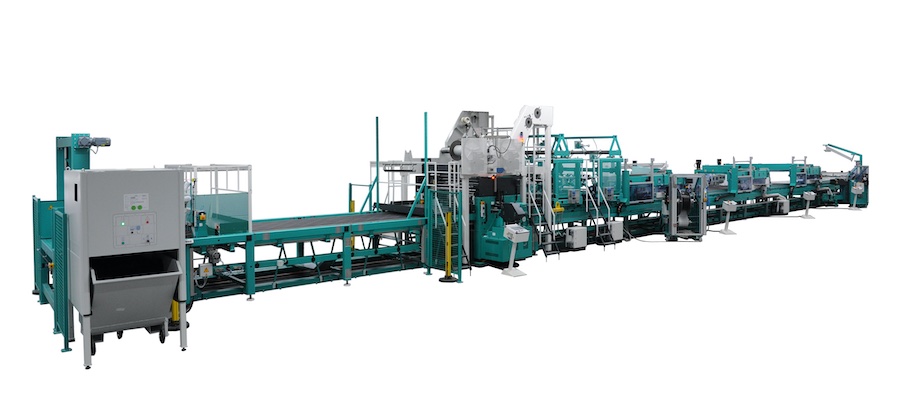
COP MAX 5 line © 2025 KARL MAYER


Successful tests

Cross-plies made from UHMWPE fibres were already comprehensively tested in 2021 by the Mellrichstadt State Procurement Office in accordance with the internationally used US NIJ Standard 0101.06. The tape layer package had a total weight of 6,000 g/m² and an angular arrangement of the fibre layers of 0°/90°. The perforation and backface signature test was successfully passed.

The advantages of KARL MAYER fibre spreading technology for the production of protective textile layers at a glance

+ sophisticated fiber spreading technology for highly aligned and homogeneous fiber orientation

+ use of higher yarn counts possible

         + lower material costs per kg

         + creel with less bobbin positions, less space requirement, less yarn loading effort

+ material combination of fibres and film:

         +  no liquid chemicals required for embedding the fibres

         + no energy consumption to evaporate water
/1/ https://de.impact-fibers.com/info/uhmwpe-vs-aramid-in-the-field-of-bulletproof-a-84211424.html


More News from KARL MAYER Textilmaschinenfabrik GmbH

#Knitting & Hosiery

The newcomers HKS 3-M EL ECO and HKS 4-M EL ECO set new standards in the tricot market

Short development cycles, frequent pattern changes, and maximum efficiency – even with small batch sizes: Today's global fashion and apparel market demands more flexibility than ever before. High-performance warp knitting machines with compound needles (HKS) and EL pattern drive are KARL MAYER's answer to this challenge.

#Knitting & Hosiery

KARL MAYER celebrates 35 years of EL pattern drive

KARL MAYER is celebrating an anniversary this year: on 30 November 1990, the first warp knitting machine with electronic guide bar control, the KS 4 EL, was delivered – another milestone for patterning. As early as 1980, the SU gearbox with the MRS42SU had initiated the transition from mechanical chains to digital data.

#ITMA Asia + CITME Singapore 2025

India becomes growth engine for the warp knitting industry

ITMA ASIA 2025 exceeded all expectations for KARL MAYER – above all thanks to the strong interest from India: around 30% of the qualified discussions were held with partners from this traditional textile country. The response underlines the growing importance of the Indian market, which could become the second largest sales region for KARL MAYER after China. The warp knitting industry in particular is developing dynamically.

#Weaving

Solution for lower energy consumption proves itself in practice

Getzner Textil is one of KARL MAYER’s first customers to use PROSIZE with CASCADE. The innovative weaving specialist has tested the steam and condensation system by KARL MAYER and determined the energy savings it achieves. Karl-Heinz Vaaßen, Head of Textile Drying at KARL MAYER, assisted Getzner Textil’s production specialists both with the tests and with all questions relating to CASCADE. In a conversation with Werner Egger, Head of Weaving, and Thomas Rossi, Head of Warp Preparation at Getzner Textil, he learnt more about the system’s benefits for his customer.

More News on Nonwovens / Technical Textiles

#ITMA Asia + CITME Singapore 2025

ANDRITZ sets focus on textile recycling and durable nonwoven production technologies at ITMA Asia 2025

International technology Group ANDRITZ will be presenting its innovative nonwovens production and textile solutions at ITMA ASIA + CITME 2025 in Singapore, from October 28 to 31, 2025 (Hall 2, D106). ANDRITZ will showcase its MMCF production plants, textile sorting and recycling, bast fiber processing, needlepunch, airlay, and life-cycle service technologies, with a focus on sustainable solutions. Discover how these innovations can grow your business opportunities and support a greener future.

#ITMA Asia + CITME Singapore 2025

Dilo Group at ITMA ASIA Singapore 2025

At ITMA ASIA Singapore, the Dilo Group will exhibit at Booth No. H2 – D202. Together with Kansan Materials, Izmir, the company will present its latest developments and looks forward to welcoming visitors to exchange ideas and explore innovations in needling technology.

#Nonwovens

OUTLOOK™ 2025: Charting a sustainable and innovative future for the Nonwovens Industry

EDANA concluded its flagship event, OUTLOOK™ 2025, last week, marking it as a major success and addressing the biggest questions facing the industry. The three-day conference highlighted the urgent need for a unified approach to sustainability, regulation, and innovation in the absorbent hygiene and wipes sectors.

#Nonwovens

Global Nonwovens Alliance unveils Inaugural Board, advancing collaboration and growth worldwide

The Global Nonwovens Alliance (GNA), a tax-exempt federation jointly founded by INDA, the Association of the Nonwoven Fabrics Industry, and EDANA, the Voice of Nonwovens, announces the appointment of its founding Board of Directors. This group of leaders represents some of the most influential executives across the nonwovens value chain and reflects GNA’s mission to foster global collaboration, innovation, and growth in the industry.

Latest News

#Natural Fibers

38th International Cotton Conference Bremen: Let´s Talk about Cotton!

The 38th International Cotton Conference Bremen, to be held on 25-27 March 2026 in Bremen’s parliament building on market square, once again sends a powerful signal for professional excellence and international dialogue. The focus is on the latest market trends and technical innovations throughout the entire value chain – from agriculture and quality assurance to processing and the circular economy. With its high-calibre speakers, the conference remains an indispensable forum for anyone involved in shaping the cotton industry scientifically, technically, or economically.

#Recycled_Fibers

Leading fashion brands step up to unlock the next chapter of Circulose

Since 2024, under new ownership and leadership, Circulose has set a renewed strategic direction focused on securing long-term commitments with partner brands to bring CIRCULOSE® back to market at scale. This strategy has proven successful.

#Research & Development

More safety and comfort for protective clothing thanks to auxetic fabrics

When everyday materials are pulled, they stretch or elongate in the direction of the pull and become narrower in cross-section. We can also observe this property in two-dimensional textiles. Auxetic structures behave differently here. They have the striking property of not changing under tensile stress or even increasing their width or thickness. These properties are advantageous, for example, in protective textiles or textile filter media. The DITF are researching auxetic fabrics for various applications.

#Recycled_Fibers

Recycling mixed-fibre garments becomes a reality: RadiciGroup, The LYCRA Company and Triumph take circular fashion a step forward

The process, which is both economically and environmentally sustainable, has enabled the production of an underwear set made from 100% recycled nylon and LYCRA® fibre in a closed-loop system.

TOP