#Nonwovens / Technical Textiles
Prototype-scale laboratory facilities for the cost-effective, rapid introduction of biopolymers: decarbonisation without loss of performance
The demand to reduce CO2 emissions, globally, includes those generated from polymer production, nonwoven fabric production, converting and product assembly processes, and end of product life concerns. There is a growing obligation for manufacturers to focus on a range of production factors. Raw materials’ selection, the shift to renewables and a reduction in overall energy usage are critical concerns. Equally, pre-consumer waste handling during the manufacturing process, together with a drive to cut down on water-intensive processes and better handle waste water management are pressing production issues. Alongside production, manufacturers are increasingly obliged to consider the longer-term product lifecycle, including reuse; recycling and returning materials back into the production cycle, or returning materials to the natural ecosystem.
In this context, the shift away from fossil fuel-derived materials to alternative materials is leading a transformation in nonwovens but comes with a range of challenges - whether adapting novel materials to conventional processing techniques or adapting current processing techniques to novel materials. The growth and development of biopolymers represents a clear alternative to fossil fuel-derived plastics, applicable across a whole host of sectors. In their natural form, biopolymers have been in use throughout history: natural fibres and binders, largely animal-, plant- or mineral-based. But looking at alternative biopolymers, for fibre / filament formation, there are currently a range of options available, including:
- Reconstituted / regenerated polymers from agri resources (starch: starch binders; cellulose: viscose rayon, lyocell, modal)
- Polymers from microbial production: PHA, PHBV
- Polymers synthesised from agri resources into biopolymers: PLA, PCL, PBAT, PBS, PGA
- Polymers synthesised from bio-resources into conventional polymers: bioPET, bioPP, bioPE, bioPA
The web formation technology appropriate for each of these options varies, e.g. carding, airlaying, wetlaying, meltblowing and spunbonding. While these are all well-established processes, there are major challenges involved in introducing new materials into any sector or product line. To achieve trouble-free processing and conversion of novel materials using conventional equipment is one such challenge. The current alternative approach is to adapt conventional equipment to achieve trouble-free processing. Whichever route is pursued, for novel materials to be commercially viable they must meet the specifications and performance demands of the materials and products they are to replace.
Combining materials with the required properties into a blend that combines the best of both materials is one option to overcome such challenges and obtain the desired performance. Alternatively, process or performance additives can be added either during raw material preparation or during processing. Blending can be done in the polymer preparation stage (compounding), by mixing different fibre types prior to carding, airlaying or wetlaying. In wetlaying, process additives can be added to the fibre slurry, while performance enhancers in non-fibrous forms such as powders can be added during the fibre laydown process or into the formed webs.
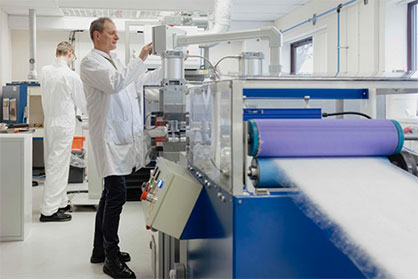
Looking at these process options, Steven highlights the importance of NIRI’s investment in laboratory technology,
“NIRI’s laboratories are uniquely equipped with prototyping-scale equipment to assess processability, explore polymer combinations with processing and performance additives, and to optimise process conditions for biopolymer extrusion into filaments, spunbound, and meltblown nonwoven fabrics. Equally, the demand to match the specification and performance properties of novel materials to conventional fabrics and products can be met. Laboratory-scale prototyping machines allow for cost-effective and time-effective changes to be made to the prototypes. This means we can make a rapid succession of adaptations, less intensive in material use, leading to effective optimisation to provide confidence before more costly pilot and production trials take place.”
Once nonwoven webs are successfully formed, they require bonding. Carded, airlaid and wetlaid webs from novel biopolymers can be assessed for bonding using NIRI’s extensive range of bonding techniques, including mechanical (which requires no additional materials to consolidate webs into fabrics), thermal, and chemical. The most common form of bonding agents in thermal bonding are bicomponent fibres. NIRI’s experts work with clients on a range of trials to coextrude combinations of biopolymers into biocomponent fibre form, make assessment of adhesion to fibres, and determine behaviour during thermal bonding and bonding performance. In chemical bonding, binders are applied onto the formed fibre webs, forming chemical bonds and aiding fabric strength. The main requirements for binders are their compatibility with diverse application methods - including spraying, coating, printing, and saturation - affinity to fibres, and bonding strength.
Steven Neill, Chief Technology Officer at NIRI notes the continued importance of prototyping-scale laboratory equipment for bonding,
“As in the case of fibre and web formation, NIRI’s prototyping-scale bonding equipment is ideal for assessing the binder’s processability, exploring polymer combinations, and optimising process conditions for bicomponent biopolymer extrusion into filaments, as well as the implementation of bonding techniques. The specifications and performance properties of the biopolymer prototypes can be tested according to industry standards using NIRI’s analytical facility. The outcomes of testing can be quickly communicated to the prototyping team, adjustments can be made, and optimised prototypes formed and tested again. Through these processes and using prototyping-scale equipment, NIRI’s experts determine the parameters and performance of biopolymer-based materials and the resulting fabrics. Similarly, clients can utilise NIRI’s facilities and expertise to implement low energy and less water-intensive processes, assessing their impact on the parameters and performance of the alternative fabrics and conducting rapid optimisation. Again, at the manufacturing stage, managing waste reintroduction into production - pre-consumer waste - can be explored, and impact assessment made.”
One final, but increasingly important, consideration relates to end of life. Nonwovens are rarely designed to be reused, mainly being classified as durable (e.g. floor coverings); semi-durable (e.g. air filters and upholstery fabrics), or disposable (including hygiene and medical products). End of life strategies differ depending on the application, and material composition is as great a factor as production methods. Mechanical recycling is long-established and widely used in the nonwovens sector, and existing infrastructure can currently manage the collection and recycling of conventional polymers such as PET, PP, PE, and PA, and can also deal with the biobased alternatives. As the use of biopolymers grows across multiple sectors, the waste collection and recycling infrastructure will need to expand - thus extending products’ service life into recycled, reused materials before end-of-life degradation.
Considering the future of bioplastics, Steven concludes,
“As an emerging technology, chemical recycling should secure the true circularity of polymeric materials, reintroducing them into the same extrusion processes as their virgin equivalents. As with mechanical recycling, this is a technology which is reasonably developed for conventional polymers such as PET and PP, but the drive to recycle and reuse materials indicates that chemical recycling should be expanded to include biopolymers for a more sustainable future. Given the critical need to decarbonise, and with sustainability as a driving force in nonwovens, NIRI’s expertise and facilities present a compelling package. Manufacturers can explore novel materials cost-effectively and quickly, ensuring that they meet the specification and performance of existing products, and addressing vital aspects of the journey to Net Zero.”