#Market Analysis & Forecasts
Global 3D Woven Fabrics Market Report 2023: Sector is expected to reach $266.3 Billion by 2028 at a CAGR of 14.1%
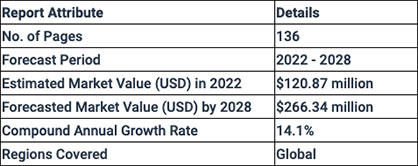
The 3D woven fabrics market size is expected to grow from US$ 120.87 million in 2022 to US$ 266.34 million by 2028; it is estimated to grow at a CAGR of 14.1% from 2022 to 2028. ??3D woven fabrics are made with three-dimensional structures that are produced by interlacing yarns or fibers in three directions (x, y, and z). These fabrics have a unique and complex structure, which makes them useful in a wide range of applications, such as aerospace, automotive, building and construction, and other industries.
The woven process of 3D woven fabrics involves interlacing two sets of yarns or fibers at right angles to each other, forming a two-dimensional plane. Then, a third set of yarns or fibers is woven through this plane at a 90-degree angle to create the third dimension.
This creates a solid, stable structure with excellent mechanical properties. The global 3D woven fabrics market is mainly driven by the increasing demand for 3D woven fabrics from automotive and aircraft industry. Moreover, the market growth is fueled by a rise in the utilization of carbon fiber in various end-use industries. The higher utilization rate of carbon fiber in end-use industries such as aerospace, automotive, building and construction, and defense and military has broadened the scope of carbon fiber 3D woven fabrics.
Automotive is one of the fastest-growing sectors across the globe and will expand rapidly in the coming years. Rise in preference of lightweight vehicles to improve efficiency and fuel economy is boosting the sector. Further, the increasing use of 3D woven fabrics in the automotive sector is expected to offer lucrative opportunities for the 3D woven fabrics market growth during the forecast period.
Based on application, the 3D woven fabrics market is segmented into ballistics, aircraft, transportation, building & construction, and others. The aircraft segment registered a larger share of the 3D woven fabrics market in 2022. 3D woven components exhibit high strength and wear capabilities compared to aluminum and steel alternatives. They allow weight reduction in existing airframe and structural components and have the ability to weave complex 3D shapes, such as turbine blades, without any worry about delamination.
The adoption of 3D woven fabrics in aerospace manufacturing is increasing globally. Constant cross-section 3D Pi structures in the fabrics have been developed over the last decade and are being used in current developments worldwide. Solid 3D structures are being considered and developed for more technical aerospace applications where their interlaminar sheer properties are expected to improve composite performance further.
In 2022, Europe held the largest revenue share of the global 3D woven fabrics market. Various advantages of using 3D woven fabrics over other alternatives are driving the 3D woven fabrics market growth in the region. The rise in R&D activities to develop 3D woven fabrics in Europe has the potential to create opportunities for business, export, and advanced manufacturing applications for aerospace and automotive industries in the region.
In 2022, Biteam AB established 3D Noodles International AB - a company specializing in producing triangular cross-sectional 3D woven fabrics. In 2022, Carbon ThreeSixty Ltd received funding of US$ 45.5 thousand from Niche Vehicle Network for Project Configurable Higher Density Energy Storage (CHiDEs), which utilizes of 3D woven carbon fiber for the production of a range of reinforced pocketed structures.
Key Attributes:
Market Dynamics
Drivers
• Increasing Demand for 3D Woven Fabrics from Aircraft Industry
• Growing Focus on Eco-Friendly and Sustainable Products
Restraints
• Hygroscopicity of 3D Woven Fabrics
Opportunities
• Applications of 3D Woven Fabrics in Sporting Goods Applications
Future Trends
• Development of Natural/Synthetic Fiber-Based Hybrid Composites
Companies Mentioned
• Textum OPCO LLC
• Tex Tech Industries Inc
• Sigmatex (UK) Ltd
• 3D Weaving SaRL
• Tantra Composite Technologies Pvt Ltd
• U-Long High Tech Textile Co Ltd
• TEAM Inc
• Changzhou Bolong Three Dimensional Composites Co Ltd
• Topweaving New Material Tech Co Ltd
• China Beihai Fiberglass Co Ltd.
For more information about this report visit:
https://www.researchandmarkets.com/r/58lhn0