[pageLogInLogOut]

#Market Analysis & Forecasts

Smart textiles market to reach USD 16.51 Billion by 2030 due to advancements in material science and technology | by SNS insider

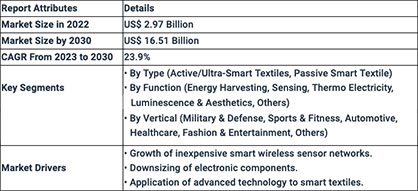
Based on SNS Insider analysis, the smart textiles market is expected to grow rapidly in the coming years due to the increasing demand for wearable technology, sports and fitness applications, medical applications, advancements in material science and technology, and government initiatives and funding. SNS Insider reported that the Smart Textiles Market had a valuation of USD 2.97 billion in 2022, and is projected to achieve a market size of USD 16.51 billion by 2030, with a compound annual growth rate (CAGR) of 23.9% during the forecast period spanning from 2023 to 2030.

Smart Textiles Market Scope & Segmentation By Type, By Function, By Vertical, By Regions | Global Forecast 2023-2030

Smart textiles represent an exciting area of research and development that has the potential to revolutionize various industries. Their integration of technology and textiles provides endless possibilities for innovation and creativity, and we can expect to see more groundbreaking applications of smart textiles in the future. 


Market Analysis

The growth in the smart textiles market is expected to continue in the coming years. Smart textiles have a wide range of applications, including healthcare, sports and fitness, military, and fashion. Advances in technology and materials science are making it possible to create ever-more sophisticated textiles that can perform a wider range of functions. As the population continues to age and the demand for healthcare services grows, smart textiles are likely to play an increasingly important role in improving patient outcomes and reducing healthcare costs.


Impact of Russia-Ukraine Conflict

The impact of the Russia-Ukraine conflict on the market is complex and multifaceted. While supply chain disruptions and decreased consumer demand are certainly challenges for the industry, there may also be new opportunities for growth in certain sectors. As the conflict continues to evolve, it will be important for smart textiles companies to stay informed and adapt to changing market conditions. 


Key Regional Development

Advancements in technology are playing a significant role in driving growth in the North American smart textiles market. Emerging technologies such as wearable sensors, smart fabrics, and conductive materials are creating new opportunities for innovation in the market, and are helping to drive demand for smart textiles-based products and services. Another factor contributing to the growth of the North American market is the region's high rates of food consumption. This has led to an increased demand for smart textiles-based food packaging and preservation solutions that can help to extend the shelf life of perishable products and reduce food waste.


Key Takeaway from Smart Textiles Market Study

In recent years, the passive smart textile segment has dominated the market, and it is anticipated to continue its reign in the forecast period. Passive smart textiles are designed to respond to external stimuli such as temperature, light, and pressure.

The energy harvesting segment is gaining popularity due to its potential to reduce the dependence on conventional energy sources, which are not only finite but also harmful to the environment. Additionally, energy harvesting technology enables the development of self-powered and sustainable smart textile solutions.

Recent Developments Related to Smart Textiles Market

Microsoft has recently made significant progress in the field of smart fabric technology by developing a fabric that can detect objects and gestures. This innovation is a result of the company's relentless efforts to explore the potential of textile-based sensors and bring new dimensions to the world of wearable.

Researchers at Louisiana State University have developed a new type of smart textile that can detect fever in infants. This innovative technology is expected to revolutionize the way healthcare professionals monitor the health of newborns and young children. These sensors can detect changes in body temperature and alert caregivers to potential signs of fever in infants.


Buy Exclusive PDF Copy of the Research Report along With ME Sheet:

https://www.snsinsider.com/checkout/2096


More News from TEXDATA International

#People

Happy Holidays!

Dear reader, the year 2025 is drawing to a close. We are entering what we hope will be a peaceful holiday season, spending time with our families and taking a moment to pause and reflect. We hope we have been able to support you once again this year with relevant news and articles, and we look forward to surprising you with many innovations in the coming year. Enjoy the festive season, stay healthy, and we wish you a happy and joyful holiday season.

#Recycling / Circular Economy

textile.4U publishes special edition “Top 100 Textile Recycling Companies 2025”

With a comprehensive 176-page special edition, textile.4U is dedicating its latest issue entirely to one of the most dynamic and influential topics in today’s textile industry: textile recycling. The new issue, published exclusively in high-quality print, presents the Top 100 textile recycling companies researched and selected by TexData – organizations that already play a key role in the transition to circular textiles or are expected to have a significant impact in the near future.

#Recycling / Circular Economy

Responsible Textile Recovery Act of 2024 signed by Governor

Senator Josh Newman (D-Fullerton) is proud to announce that Senate Bill 707 (SB 707), the Responsible Textile Recovery Act of 2024, has been signed into law by the Governor of California, Gavin Newsom. This groundbreaking legislation establishes the country’s first Extended Producer Responsibility (EPR) textile recycling program, marking a significant step forward in the state’s efforts to combat waste and promote sustainability.

#Textiles & Apparel / Garment

Modtissimo promotes sustainability with 28 coordinates in the Green Circle

Modtissimo is proving more and more to be a textile and clothing show that delivers the latest innovations in the area of sustainability, with the iTechStyle Green Circle being the main showcase for companies' creations. In this 60+4 edition, taking place on 12 and 13 September, 28 coordinates will be exhibited in a section organised by CITEVE and curated by Paulo Gomes.

More News on Market Analysis & Forecasts

Latest News

#Weaving

Lindauer Dornier announces leadership transition in weaving machine business

After more than ten successful years at Lindauer DORNIER GmbH, Mr Wolfgang Schöffl will leave the family-owned company at the end of the year to enter well-deserved retirement.

#Heimtextil 2026

Texpertise Focus AI: Messe Frankfurt puts Artificial Intelligence centre stage at its international textile and apparel trade fairs

Under the banner 'Texpertise Focus AI, Messe Frankfurt will place a strong emphasis on Artificial Intelligence (AI) across its international textile and apparel trade fairs from 2026 onwards, setting a future-shaping signal for the industry. The initiative highlights the responsible use of AI along the entire textile value chain, from fibre production to the point of sale. The programme will launch at Heimtextil in Frankfurt in January 2026.

#Technical Textiles

Autoneum and Polestar set new benchmarks for passenger experience and sustainability

As the global market leader in sustainable acoustic and thermal management, Autoneum is a key supplier of interior and exterior components for the highly anticipated Polestar 5 model. The successful collaboration between Autoneum and Polestar marks a significant milestone in sustainable automotive engineering: the electric grand tourer sports car features several innovations in lightweight, fully recyclable polyester-based components that ensure a superior driving experience. Polestar 5 was revealed at the IAA Mobility 2025 in Munich and is available in 24 markets.

#Natural Fibers

Cashmere producers stress the importance of The Good Cashmere Standard®

At the invitation of the Aid by Trade Foundation (AbTF), over 70 experts from the cashmere production and supply chain, as well as other specialists, met at the GCS Unit Meeting in Shanghai, China to discuss the progress and new objectives of The Good Cashmere Standard (GCS). The meeting focused on implementation and verification of the standard, important aspects of animal welfare and the importance of the standard in the global textile market.

TOP