[pageLogInLogOut]

#Knitting & Hosiery

Oxman’s Silk Pavilion II arrives at Integral

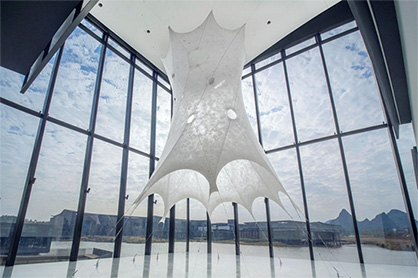
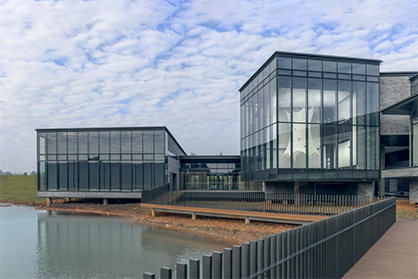
Esquel proudly presents Silk Pavilion II from the Mediated Matter Group at the MIT Media Lab. The centerpiece of the project is on display from November 2020 in the Learning Center at Integral.

Exhibited at the Museum of Modern Art (MoMa) in New York earlier in 2020, Silk Pavilion II is one of the most recent iconic works of Neri Oxman, award-winning architect, designer, inventor and professor of media arts and sciences at the MIT Media Lab.

Exploration, as part of the eCulture, prompts us to stay curious and to always keep learning and innovating. Silk Pavilion II is here to serve as a conspicuous reminder that disruptive technologies are constantly knocking on our door, and we shall never get complacent with the status quo. Blurring the boundaries of engineering, biology, art and computer science, Oxman’s project aims not only to take our breath away with the astounding construction, but also leave us inspired by what can be achieved from cross-disciplinary innovations.

Through her work, Oxman offers a version of future where architecture and manufacturing can work synergistically with nature rather than dominating over it. This makes the scenic campus of Integral a perfect home to the masterpiece. It accentuates Esquel’s commitment to sustainability as embodied in the development model of Integral. The goal to also create value for the environment in our pursuit of business growth and industry leadership is firmly embedded in Esquel’s (hardware), operations, products and people.
© 2021 Esquel Group
© 2021 Esquel Group


More about Silk Pavilion II

In the Silk Pavilion II project, Neri Oxman asks what may be the radically sustainable methods for knitting, making and building in the age of the Anthropocene, and how humankind and other species like silkworms may collaborate in the construction of objects, products and buildings. Standing six meters tall and five meters wide, Silk Pavilion II offers insights into these questions by combining kinetic manufacturing with biological construction, uniting the built and the grown, fusing technology and biology.


It is comprised of three interrelated layers – firstly the innermost one-dimensional steel cable system, secondly a two-dimensional soluble knitted fabric scaffold, and thirdly a three-dimensional structure biologically spun with the output of 17,532 Italian silkworms sourced from one of the most extensive silkworm rearing facilities in Europe.
© 2021 Esquel Group
© 2021 Esquel Group


The structure was produced horizontally, with a jig to enable constant clockwise rotation that facilitated the silkworms’ upward spinning motion. Structural forces were biochemically influenced according to local environmental factors. The final appearance, including the holes and the variations in thickness, paints a metabolic canvas of the silkworms’ behaviors.

Traditional silk harvesting involves boiling the cocoon and killing the larva. The project demonstrates that man-made engineering setup can be used to guide the silkworms’ movement and silk deposition, so that the silkworms can still mature and reproduce after the fabrication process.

Silk Pavilion II was Neri Oxman’s centerpiece of her solo exhibition at the Museum of Modern Art (MoMA) in New York from February to October 2020. It is a sequel to Silk Pavilion, which Oxman created in 2013 on the ground floor of MIT Media Lab with a swarm of 6,500 silkworms.
More News from TEXDATA International

#ITM 2026

ITM 2026: The new geography of textile production

New production hubs are emerging across North Africa and Central Asia, while Türkiye is accelerating its transformation toward higher-value, technology-driven and more sustainable textile manufacturing.

#Research & Development

“Production is a product”

From technical textiles and AI-driven robotics to the limitations of textile circularity: Professor Dr Thomas Gries looks back on more than two decades of development at ITA Aachen. In the interview, he explains why production technology remains a decisive success factor, discusses international collaborations and innovation ecosystems, and shares his views on the transformation of production landscapes and the challenges facing an increasingly regulated industry.

#Knitting & Hosiery

“We need to move away from the price trap and return to a value-driven mindset.”

With its new Textile Innovation Center, KARL MAYER is sending a strong signal for innovation, collaboration, and the future of textile applications. In this interview, Karl Josef Mayer discusses new opportunities in warp knitting, the processing of staple fibres, recycling, the changing role of machinery manufacturers, and why the textile industry must once again focus more strongly on the value of textiles. by Oliver Schmidt

#Associations

“Innovation, resilience and international experience remain the great strengths of the Swiss textile machinery industry”

Geopolitical uncertainty, growing competitive pressure from China, new free trade agreements and the shift towards a circular economy are currently reshaping the global textile industry. In this interview, Cornelia Buchwalder discusses the current mood within the Swiss textile machinery sector, the industry’s distinctive innovative strength, new market opportunities in India and Asia, and the technological trends that could shape the upcoming trade fair cycle leading up to ITMA 2027.

More News on Knitting & Hosiery

#Knitting & Hosiery

KARL MAYER's HKS 2-SE Expands Possibilities for Premium Stretch WARP KNITS

Warp knitted fabrics with a woven look are more in demand than ever in the fashion and apparel industries. Stretch WARP KNITS, in particular, impress with their freedom of movement, breathability, and virtually wrinkle-free wear – thereby opening up new style worlds such as smart casual or business casual. When it comes to the highly efficient production of premium-quality stretch WARP KNITS, the HKS 2-SE has long been the machine of choice. KARL MAYER’s best-selling tricot machine produces standard elastic fabrics characterized by high gauges, smooth, delicate surfaces, and a soft hand feel.

#Knitting & Hosiery

Footwear innovation enabled by warp knitting technology– insights from New Balance

The future of the athletic shoe is increasingly being shaped on warp knitting machines. For KARL MAYER, the footwear industry is one of the most important growth markets – and one of the sectors where innovative textiles can realize their full potential. In his keynote address at the opening of KARL MAYER’s TEXTILE INNOVATION CENTER in Obertshausen in April, Vishnu Prakash Muthusamy, Senior Textile and Materials Engineer at New Balance, explained the opportunities that warp knitting technology opens up for performance, sustainability, and faster development processes, and why textile manufacturers are transitioning from suppliers to development partners.

#ITM 2026

ITM 2026: Mayer & Cie. Global presents itself successfully at international industry trade fair

Mayer & Cie. Global has used ITM 2026 in Istanbul for its first major international appearance since the restart. Together with the Turkish representative Mayer Mümessillik, the company presented its premium circular knitting machines "Made in Germany", explained its future positioning within the group of companies and held talks with customers and representatives from numerous markets. The response to the restart was positive. The clear orientation of the company, the reliable worldwide network of representatives and the resumption of service and spare parts supply were welcomed by customers.

#ITM 2026

Positive market signals for KARL MAYER at ITM 2026

KARL MAYER is pleased with its participation as an exhibitor at ITM 2026. Faced with the challenges of rising domestic costs and fierce competition from low-priced Asian markets, the industry leader had traveled to Istanbul with mixed feelings – yet still draws a really positive conclusion.

Latest News

#Research & Development

ALADIN paves the way for circular and demand-driven textile production in Europe

Textile production can be organized sustainably by utilizing short supply chains and preventing overproduction. This can already be achieved today by intelligently connecting and efficiently utilizing existing infrastructure. At the same time, production becomes circular when innovative technologies and materials are used that enable high-quality recycling. The ALADIN research project, launched in May 2026 and co-funded with five million euros under the EU Horizon Europe program, is creating the conditions for this.

#Nonwovens

Katharina Obergruber appointed to the Management Board of Sandler AG

The Supervisory Board of Sandler AG has appointed Katharina Obergruber to the company’s Management Board. Effective September 1, 2026, the Board will consist of Philipp Ebbinghaus (CEO), Dr. Ulrich Hornfeck (currently CCO, future COO), and Katharina Obergruber (CCO). Katharina Obergruber, currently Chief Sales Officer Hygiene and member of the Management Team of Sandler AG, will assume responsibility for all sales activities as Chief Commercial Officer. She will assume this role from Dr. Ulrich Hornfeck, who will focus primarily on production and supply chain topics.

#Recycling / Circular Economy

Ence and ShareTex begin initial testing of the ATENEA innovation project to promote textile recycling in Spain

Ence and ShareTex are making progress on the Atenea R&D project, which aims to develop a complete value chain for textile recycling in Spain. Specifically, the goal of the ATENEA project—which is funded by the Center for Technological Development and Innovation (CDTI)—is to connect all the necessary stages for the recovery of textile waste, from collection and management, through recycling and transformation into new raw materials, to their incorporation into new textile products.

#Recycling / Circular Economy

DePoly Inaugurates its Showcase Plant in Monthey Switzerland

What if used plastic bottles, PET packaging material and polyester textiles could become raw materials just as high performing as virgin resources? That is the ambition of DePoly, a circular materials company based in Sion, Switzerland which inaugurated its Showcase Plant in Monthey on July 6th & 7th. The first depolymerization facility of its kind and scale in Switzerland, this industrial Showcase Plant represents a major milestone in the company's growth and its journey toward commercialization.

TOP