[pageLogInLogOut]

#Natural Fibers

Better Cotton Conference marks new phase
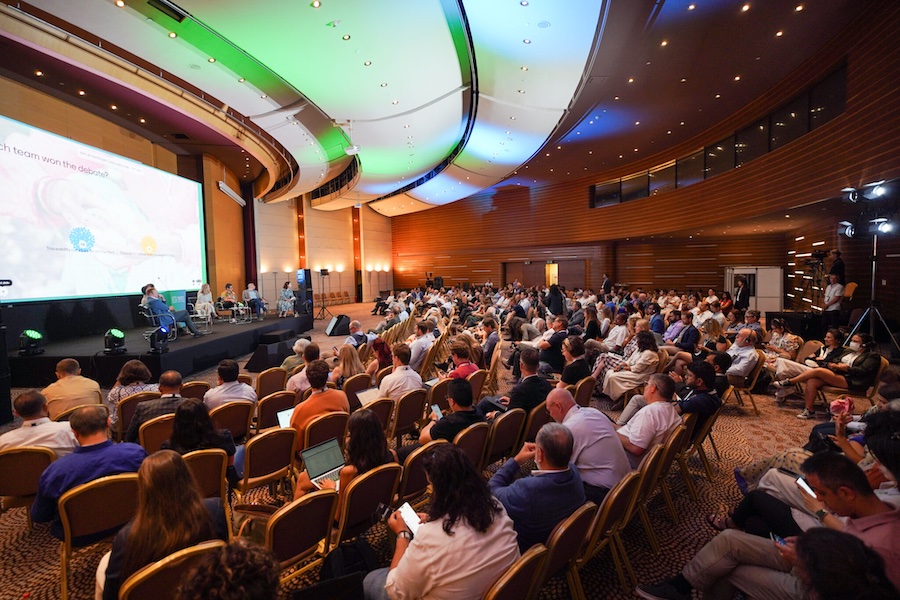
The 2025 annual conference of Better Cotton, the world’s largest cotton sustainability initiative, marked a new phase for the organisation, with the introduction of its new CEO, the announcement that it will become a regenerative standard, and the initial snapshot of its first US Impact Report.
Photo credit: Better Cotton/Evronas. Location: ?zmir, Türkiye, 2025. Description: Better Cotton Conference 2025 participants attend a session on traceability.


Held in ?zmir, Türkiye, on 18 and 19 of June, the event welcomed more than 370 attendees from over 20 countries, sparking conversation and debate on topics ranging from gender equality and climate finance to traceability and cross-commodity collaboration.

Better Cotton’s outgoing CEO, Alan McClay, bid farewell to the organisation’s vast network after a decade at the helm. “We need to take our place more loudly and explicitly and authoritatively in the broader community,” he said. “For too many years we’ve been doing our own thing almost under the radar to the extent that some legislation now gets passed without even knowing the constraints and the opportunities, the conditions and the impact that this can have on several hundreds of millions of farmers around the world.”

McClay welcomed his successor, Nick Weatherill, a former Executive Director of the International Cocoa Initiative, who joined him on stage. “You are leaving a very powerful legacy, and I am inheriting a very precious lifeforce. You have my word that I will look after it,” Weatherill told his predecessor.

From Protecting to Restoring Landscapes

At a session focused on regenerative practices, Better Cotton announced that it will become a regenerative standard within the next year. “It is increasingly clear that we need approaches that don’t simply mitigate or reduce harm, but that actively restore the environment,” said Better Cotton’s Senior Director of Demand and Engagement, Eva Benavidez Clayton. “While Better Cotton’s field level standard is already recognised to cover many of the core tenets of regenerative agriculture, this move will further ensure that farmers who meet our standard are adopting the most commonly agreed regenerative practices.”

Better Cotton also presented a snapshot of its first ever United States Impact Report, which reflects on the past decade (2014-2024) of Better Cotton’s progress and presence in the country. The report introduces the US programme and its partners, provides a general picture of large-scale cotton farming in the US, and paints a more complete picture of the US cotton landscape. 

Introducing the report, Benavidez Clayton said: “Better Cotton is a global standard, but we firmly believe in local application. [The report] does have key data on acreage, production, practice adoption, water, and input usage. Since storytelling is so important, and making things real for people, there are also profiles on farmers and projects that really bring the work to life.”

Farmers Front and Centre

The 2025 Better Cotton Conference placed cotton farmers and field-level organisations front and centre to capture the event’s theme: ‘It Starts with Farmers’.

Cotton farmers and field-level partners from different parts of the world participated at the conference, representing countries such as Brazil, Côte d’Ivoire, India, Pakistan, the US, and Uzbekistan.

Alan McClay said: “While it takes all of us to create lasting change, real progress must start with farmers. That is increasingly the framing that will drive all of Better Cotton’s work moving forward.”

One of the event’s sessions asked a provocative question, as part of a speculative debate, with arguments and counterarguments: “Can Traceability Prove Beneficial to Farmers?” With Better Cotton representation on both sides, the discussion highlighted the many opportunities and challenges that surround traceability as it relates to farming communities, and explored ways in which solutions involving farmers can be deployed. The audience cast their votes, with a verdict in favour of traceability being capable of benefitting farmers.


More News from Better Cotton

More News on Natural Fibers

#Raw Materials

ICAC’s 84th Plenary Meeting to be held March 24-26, 2027, in Alexandria, Egypt

Registration will soon be open for the International Cotton Advisory Committee’s 84th Plenary Meeting, to be held March 24-26, 2027, in Alexandria, Egypt. The local Organizing Committee in Egypt has chosen “Building a Resilient and Competitive Future for Cotton and Textiles” as the theme for the event, which will be held at the Rixos Montaza Alexandria Resort.

#Raw Materials

Cotton Brazil Dialogues 2026 concludes with 50 international participants immersed in Brazilian cotton production

The Cotton Brazil Dialogues concludes its 2026 edition after a series of technical visits to farms, cotton gins and reference centers, as well as workshops focused on Brazilian cotton production. A total of 50 participants from 14 countries took part in the field trips. The initiative is led by the Brazilian Association of Cotton Growers (Abrapa) and the National Association of Cotton Exporters (Anea), with support from the Brazilian Trade and Investment Promotion Agency (ApexBrasil).

#Raw Materials

Global cotton production projected to outpace consumption, but risks remain

Global cotton production is projected to reach 26.2 million tonnes in the 2026/27 season, marginally outpacing estimated consumption of 25.9 million tonnes. However, early-season production risks — including weather volatility and pest pressures — could narrow that buffer as the crop progresses, according to the September 2026 issue of Cotton This Month, published by the International Cotton Advisory Committee (ICAC).

#Natural Fibers

Global garment trade nears USD 550 billion as competition intensifies

The global garment industry has undergone a dramatic transformation over the past two decades, with knit and woven garments together accounting for nearly 60% of world textile exports in 2025, according to the August 2026 issue of The Textiles Observer, a free publication from the International Cotton Advisory Committee (ICAC).

Latest News

#Recycled Fibers

RE&UP’s Next-Gen Cotton fibers power Zalando private label t-shirt collection crafted from innovative recycled textiles

RE&UP Recycling Technologies’ Next-Gen Cotton powers a new collection from Zalando’s private labels, marking a step forward in bringing textile-to-textile recycled fibers into commercial fashion production. Launching on Zalando in August, the collection comprises five t-shirts across YOURTURN by Zalando and Even&Odd by Zalando, made from a circular-knit fabric blending 80% organic cotton with 20% RE&UP Next-Gen Cotton — textile-to-textile recycled fiber produced from textile waste. This is the first time RE&UP's recycled fibers feature in Zalando's private label assortment.

#Heimtextil 2027

Heimtextil Trends 27/28: ‘Home-Maxxing’ between performance and respite

Sleep better, recover faster, live more efficiently: the desire for optimisation has long since reached our homes. Under the title ‘Home-Maxxing – The Performance of Everyday Living’, Heimtextil Trends 27/28 show how our relationship with efficiency-driven thinking and technology is influencing the design of spaces and textiles. The more sleep, wellness, routines, materials and spaces are optimised, the stronger the desire for a home that does not demand even more of us.

#Recycled Fibers

Driving circularity with Uster Recycled Fiber Matrix

The textile industry’s commitment to circularity continues to accelerate, and mechanical recycling is viewed as a targeted approach to cutting textile waste and its environmental impact. At the forefront of this drive, Uster has developed the Recycled Fiber Matrix, a two-dimensional assessment of mechanically recycled fibers to guide optimum processing and end-uses.

#Digital Printing

Mimaki advances DTF productivity and stability with new TxF330-800

Mimaki Europe, a leading manufacturer of industrial inkjet printers and cutting plotters, announces the TxF330-800, its new direct-to-film (DTF) printer. Designed to support stable, high-quality garment decoration in demanding print environments, the system combines automated maintenance, expanded white ink capacity and advanced production capabilities to streamline workflow.

TOP