[pageLogInLogOut]

#Industry 4.0 / Digitalization

Automation progresses along the laundry sector
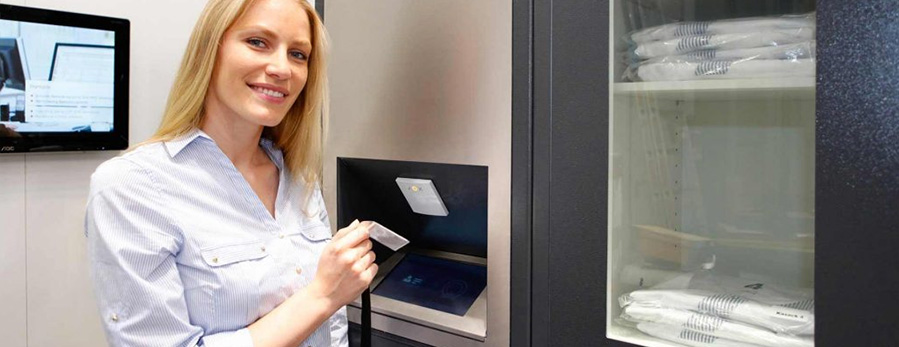
(c) 2020 Messe Frankfurt / Jens Liebchen
The productivity of a laundry depends on unbroken process flows and transparent commodity streams. Thanks to increasing digitalisation and consistent integration of data, the through-put of textiles in laundries is being continually improved. The solutions required for automation in the sector are therefore a high priority at Texcare International, from 20 to 24 June in Frankfurt am Main.

The be-all and end-all for the laundry sector is the ability to monitor the quantity, quality and storage location of the textiles that are circulating on site, at all times. The data collected form the basis for precise price calculations, throw up any weak points in the system and serve to provide documentation for third parties. But it is only when all the machinery and plant involved in a given textile service are interlinked on a single network that the logistics of the laundry service run seamlessly, with minimal down-time of the machinery, reduced quantities in circulation and the resultant increase in productivity that is closely associated with it.

Transparent tracking for each individual laundry item

Automation in the processing of workwear is already well advanced. As the dirty laundry is sorted on arrival, each item is recorded using an identification system such as a barcode or RFID technology. From this moment on, all the stages that the textiles undergo are controlled. ‘Readers’ or ‘gates’ on the premises enable each item to be recorded as it progresses through the system, right up to the point of order picking; and they monitor whether an item is sent to a repair station or directed into storage. In addition, high-frequency transponders (UHF tags) can monitor the movements of laundry items outside of the laundry: in hospitals, for instance, identification systems have been installed, which record the despatch and return of apparel and enable an extensive process of textile management via data transfer procedures.

Robots for the soiled laundry area

This already high degree of automation in a workwear laundry facility is, however, capable of still further refinement. Artificial intelligence can simplify the ‘dirty’ work in the reception area: robots separate and sort the soiled clothing and x-ray machines, cameras and metal detectors are used to identify any foreign bodies. The advantages of such systems are particularly in evidence in hospital laundries: medical instruments, which regularly find their way into the laundry bags, are automatically separated from the clothing, thus minimising damage to the items themselves and to the machinery. The useful life of the textiles is extended and costs are reduced. Moreover, there is no danger of infection for the staff.

Real-time laundry processes

Whilst individual control and traceability are already widespread in the professional treatment of work apparel, when it comes to flat linen, often only generalisations about quantity, quality and storage location for the textiles are possible. “In order to assess a business’s efficiency, calculate prices and efficiently control processes and procedures, laundries need reliable figures […],” observes Martin Rauch*, CSO of the Jensen Group, who operate on a worldwide basis.

In the pursuit of automated production, ultra-modern information and communications technologies assume a key role. They synchronise the machines involved in a given production process and facilitate communication and cooperation between plant, product and the human being. This way, you get self-organising, flexible production with unbroken processes and high levels of utilisation of equipment. With the synchronisation of commodity streams and information flow in the laundry, all items arrive at the right processing station at the appropriate time. A central database controls all the processes in the entire laundry, regulates the machinery and the linked sub-systems, chooses the correct processing programmes and optimises machine use.


Data accompanies the laundry throughout

“Trolleys of laundry standing around, waiting times at the machines, excessive buffering and time spent searching for items are all lost capital […],” says Matthias Schäfer*, who is responsible for product management, laundry logistics / smart laundry at Kannengiesser (Vlotho).

When data and goods flows are successfully synchronised throughout a flat-linen laundry, each washing station contributes its information along with that of other stations, right from the initial sorting of the soiled linen through to the folding machines. The laundry can, therefore, be monitored throughout the entire operation, as the information from each station is sent on with the item, either automatically or – after the drier – in the form of bar-coded labels. (“Stabilisation of production through the synchronisation of material and production flows.”) RFID identification systems do indeed enable complete transparency to be built into the passage of goods through the various stages, as each chip or tag carries the necessary information for each individual item. In view of the high cost of the transponders, ‘chipping’ of flat linen is, however, currently an option for only very few laundries. So the textile care sector is waiting on more economical, more functionally reliable solutions from the machinery and plant manufacturers.

Smart to the very end of the chain

Further potential for automation resides in the picking and packaging. Collecting together items for delivery manually is subject to error and that leads to customer complaints. With intelligent storage facilities and transport solutions, smart stacking management and the networking of equipment with the laundry’s information system, order picking becomes simpler, quicker and more reliable. To ensure that the integration can function, modern machines are equipped with interfaces, so that each new installation can be linked seamlessly into a laundry’s existing system. The same goes for accessory machines, which exchange all the important information relating to preparation and repair online.

User friendly apps

Digital developments are not only large scale: they are to be found on a smaller scale as well. For launderettes, too, apps provide important information on the status of the equipment, enable operators to see what is going on, even at considerable distances, as well as being able to provide digital payment models. Moreover, in heavily used laundry facilities, they can take on the entire job of time management, as Andreas Barduna*, Head of Business Management, Miele Professional (Gütersloh) is very aware.

At Texcare International, from 20 to 24 June 2020, machinery and plant manufacturers from all over the world will be presenting their smart solutions for the laundries of tomorrow. The focus will be very much on artificial intelligence and smart information systems, which will help maximise the degree of automation within the sector. As well as Texcare International, Messe Frankfurt organises specialist trade fairs and conferences for textile care in all the economically most important regions of the world.
More News from Messe Frankfurt (HK) Ltd.

#Home Textiles

Intertextile Shanghai Home Textiles – Spring Edition 2026 returns to meet market demand with innovative bedding solutions

Returning in 2026, Intertextile Shanghai Home Textiles – Spring Edition will take place from 11 to 13 March at the National Exhibition and Convention Center in Shanghai. With rising daily pressures and increasing sleep disorders, demand for high-quality, functional, and sustainable bedding solutions is surging. The fair will spotlight innovative bedding products and technologies designed to meet these evolving consumer needs within this expanding market. Last year’s edition welcomed over 25,000 visitors from 85 countries and regions, reflecting a 7.5% increase in attendance and broader global participation.

#Techtextil 2026

From concept to stage: Submit presentations for the Techtextil Forum and Texprocess Forum 2026 now

Anyone who wants to contribute to shaping the future of the textile industry can submit a presentation for the Techtextil and Texprocess Forum by 15 December 2025. Both stages represent innovation and practical solutions and promote exchange between research and industry. An international Programme Committee selects the contributions and curates a programme on key future topics in the textile sector. From 21 to 24 April 2026, the two leading trade fairs will once again be the centre of global business dialogue in Frankfurt.

#Yarns

Yarn Expo Spring 2026 spotlights industry transformation

Taking place 11 – 13 March 2026 at the National Exhibition and Convention Center in Shanghai, Yarn Expo Spring 2026 is set to build on the exceptional success of the 2025 edition, which attracted nearly 24,000 visitors from 123 countries and regions. The show set a record with over 560 exhibitors showcasing their latest innovations. Notably, regenerated fibres and yarns drew the highest interest among visitors, with 57% sourcing in that category. Reflecting growing industry momentum, Yarn Expo Spring 2026 will continue to serve as a key global platform for driving sustainable development within the yarn and fibre sectors.

#CINTE Techtextil China 2025

Cinte Techtextil China 2025 opens this week with new products, innovation-focused exhibitors and fringe events

International and domestic exhibitors are relishing the chance to present their curated products at Cinte Techtextil China, when the fair opens from 3 to 5 September 2025, spanning three halls and 32,000 sqm at the Shanghai New International Expo Centre.

More News on Industry 4.0 / Digitalization

#Industry 4.0 / Digitalization

Suzhou Tianyuan boosts costing accuracy to 98% with Coats Digital’s GSDCost

Coats Digital is delighted to announce that Suzhou Tianyuan Garments Co., Ltd., a leading manufacturer of high-quality sportswear and functional apparel for global brands such as Adidas, FILA, ANTA, and The North Face, has achieved remarkable productivity and cost management improvements following the implementation of Coats Digital’s award-winning method-time-cost optimisation solution, GSDCost.

#Industry 4.0 / Digitalization

Lenze receives IEC 62443-4-1 certification: TÜV Rheinland confirms cyber-secure development process

Lenze SE has been certified according to IEC 62443-4-1 since November 2025. TÜV Rheinland thus confirms that Lenze meets the requirements of this internationally recognized standard for a secure development process for industrial automation and drive products. The certification is an important milestone on the way to implementing the EU Cyber Resilience Act (CRA), which will become mandatory for machine manufacturers and their suppliers from December 2027.

#Industry 4.0 / Digitalization

Mango joins TextileGenesis pioneering traceability solution, a Lectra company, for a transparent value chain

Mango, one of the leading international fashion groups, has joined TextileGenesis, the pioneering traceability solution for the fashion and textile industries, to trace their natural and animal fibers, synthetics, man-made cellulosic fibers and leather. TextileGenesis, a Lectra company, offers a complete and secure cutting-edge technology with its six-dimensional (6D) offering and unique “fiber forwards” approach. Mango, has long been committed to maintaining a fully transparent supply chain, and TextileGenesis will reinforce this commitment.

#Sustainability

Cascale’s Higg FEM 2025 update unlocks new data-driven insights

Refreshed Higg FEM 2025 delivers data-driven insights, sharper emission metrics, and enhanced verification to accelerate industry-wide progress.

Latest News

#People

Happy Holidays!

Dear reader, the year 2025 is drawing to a close. We are entering what we hope will be a peaceful holiday season, spending time with our families and taking a moment to pause and reflect. We hope we have been able to support you once again this year with relevant news and articles, and we look forward to surprising you with many innovations in the coming year. Enjoy the festive season, stay healthy, and we wish you a happy and joyful holiday season.

#Weaving

Lindauer Dornier announces leadership transition in weaving machine business

After more than ten successful years at Lindauer DORNIER GmbH, Mr Wolfgang Schöffl will leave the family-owned company at the end of the year to enter well-deserved retirement.

#Heimtextil 2026

Texpertise Focus AI: Messe Frankfurt puts Artificial Intelligence centre stage at its international textile and apparel trade fairs

Under the banner 'Texpertise Focus AI, Messe Frankfurt will place a strong emphasis on Artificial Intelligence (AI) across its international textile and apparel trade fairs from 2026 onwards, setting a future-shaping signal for the industry. The initiative highlights the responsible use of AI along the entire textile value chain, from fibre production to the point of sale. The programme will launch at Heimtextil in Frankfurt in January 2026.

#Technical Textiles

Autoneum and Polestar set new benchmarks for passenger experience and sustainability

As the global market leader in sustainable acoustic and thermal management, Autoneum is a key supplier of interior and exterior components for the highly anticipated Polestar 5 model. The successful collaboration between Autoneum and Polestar marks a significant milestone in sustainable automotive engineering: the electric grand tourer sports car features several innovations in lightweight, fully recyclable polyester-based components that ensure a superior driving experience. Polestar 5 was revealed at the IAA Mobility 2025 in Munich and is available in 24 markets.

TOP