[pageLogInLogOut]

#Industry 4.0 / Digitalization

SABIC launches pilot blockchain project to advance emissions tracking & reductions across value chains

SABIC, a global leader in the chemicals industry, has launched a pilot project with Circularise, a blockchain software provider, to evaluate the use of their technology in tracing the carbon footprint of specific material streams from end to end.

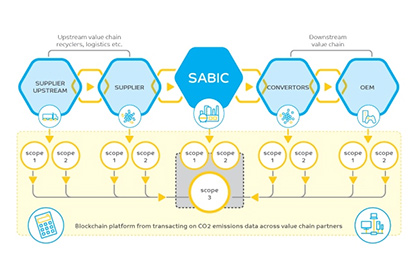
Generating and reporting Scope 3 emissions is notably complex and confronted by challenges with availability of reliable data. Accurate data on a company’s carbon footprint requires collaboration and data sharing across multiple value chain partners. Blockchain technology has emerged as a potentially efficient solution to improve the process that can bolster transparency and accountability while minimizing risk across supply chains. 

SABIC’s project will employ Circularise’s technology to capture emissions across the value chain by deploying a consistent methodological and reporting framework accepted by the industry. Scope 1 and Scope 2 data captured at the material level can be used to generate Scope 3 CO2 emissions for the full value chain of targeted industries. In addition to increased transparency, the use of Circularise’s Smart Questioning technology will benefit SABIC’s entire value chain by reducing the administrative efforts associated with the data collection and providing access to upstream and downstream data provided by value chain participants, from recyclers to converters to original equipment manufacturers, among others.

“This blockchain pilot project reaffirms SABIC’s dedication to accelerating the sustainable transformation of our industry through strategic partnerships and innovative new technologies,” said Waleed Al-Shalfan, Vice President of Polymers Technology & Innovation at SABIC. “Accurately mapping emissions, especially Scope 3 emissions, will allow SABIC and others to identify and minimize hot spots along the value chain, a critical tool in our pathways to decarbonization. We encourage other upstream and downstream partners to join and consider how this technology can unlock sustainable growth at every level moving forward.”

“We're proud to collaborate with SABIC in tackling the pivotal challenges of Scope 1, 2, and 3 emissions accounting, which encompass issues like information accessibility, confidentiality, and scalability of data sharing among suppliers,” said Mesbah Sabur, Founder of Circularise. “As part of this project, Circularise aims to pilot blockchain-powered digital product passports and help businesses to track product emissions on a large scale and over time, generating comprehensive product life cycle emission reports."


This project marks another way in which SABIC is leveraging innovative partnerships to reduce emissions and help meet its commitment of becoming carbon neutral by 2050. Earlier this year, SABIC joined Together for Sustainability (TfS), a procurement-driven initiative created by chemical companies with the goal of assessing, auditing, and improving sustainability practices within their supply chains. As a member of TfS, SABIC will foster collaboration around increasing transparency in upstream value chains to support further reductions in Scope 3 greenhouse emissions.
© 2023 Sabic
© 2023 Sabic


This collaboration with Circularise also marks SABIC’s second blockchain application project. Last year, SABIC launched a pilot project with Finboot, Plastic Energy, and Intraplás to evaluate the use of blockchain technology in supporting end-to-end digital traceability of circular feedstock in customer products.

More News from SABIC

More News on Industry 4.0 / Digitalization

#Dyeing, Drying, Finishing

Monforts unveils interactive digital platform for textile finishers

Monforts has launched a new digital platform designed to give textile manufacturers faster, more intuitive access to the company’s finishing technologies, technical expertise and aftersales support worldwide.

#Spinning

Barmag presents the next generation of POY production – energy-efficient and partial-automated

With POY 2.0, Barmag is introducing a completely redesigned spinning concept that takes the production of partially oriented yarn (POY) to a new level in terms of technology and economy. The solution, which was presented to a selected audience of experts for the first time at ITMA Asia + CITME 2025, was met with great enthusiasm: several yarn producers worldwide immediately expressed their interest in a pilot plant.

#Sustainability

OEKO-TEX® chooses TextileGenesis to advance digital traceability for organic cotton

OEKO-TEX® today announced a full collaboration with TextileGenesis, a Lectra company, to digitally trace and authenticate organic cotton, strengthening fraud prevention across the supply chain. This announcement follows a successful pilot and brings together OEKO-TEX®’s certification expertise and closed testing system with TextileGenesis’ digital traceability platform to deliver a secure, end-to-end solution for managing certified organic cotton flows.

#Research & Development

Kick-off for the Textile Production of the Future: Establishment of a Textile Technology and Development Centre in Mönchengladbach, Germany

The Institut für Textiltechnik (ITA) of RWTH Aachen University, together with its partners, is pleased to announce that it has received approval for its joint initiative, ‘Textile Factory 7.0’. The goal of the project is the establishment of a technology and development centre for the textile industry in Mönchengladbach.

Latest News

#Raw Materials

Lenzing Group positions bio‑based materials as a strategic asset for Europe’s economic security

The Lenzing Group, a leading supplier of regenerated cellulose fibers for the textile and nonwovens industries, hosted a high‑level roundtable in Brussels to discuss how bio‑based materials can strengthen Europe’s economic security and support the shift toward a fossil‑free future. Organized in cooperation with Euractiv, the event brought together representatives of the European Commission, the UK Mission to the EU, academia, civil society, and industry.

#Natural Fibers

Beyond Cotton: Natural Fibres in the Spotlight at the Bremen Cotton Conference - Branded by DNFI

Climate targets, fragile supply chains, and rising regulatory requirements are fundamentally changing the perspective of the textile industry - the focus is increasingly shifting toward the base material. Not only cotton, but natural fibres are gaining significant importance: they stand out not only because of their outstanding functional properties, but also because they make a valuable contribution to the bioeconomy and responsible product development.

#Textiles & Apparel / Garment

Coats to showcase innovative reinforcement and filler materials for leather goods and accessories at APLF 2026

Coats, a world-class Tier 2 manufacturer and trusted partner for the apparel and footwear industries, will be promoting four advanced materials from its ‘Lifestyle Solutions’ portfolio at APLF 2026 in Hong Kong in March. Each innovation has been specifically engineered to help luxury and premium brands elevate the craft, durability, sustainability and creative expression required in the manufacturing of handbags, purses, and other high-end designer accessories.

#Textiles & Apparel / Garment

Design, innovation and sustainability propel VIATT 2026’s expanding role in ASEAN textile sourcing

At its third edition, the Vietnam International Trade Fair for Apparel, Textiles, and Textile Technologies (VIATT) further reinforced its role as a key sourcing and business platform for ASEAN’s textile industry. The three-day fair welcomed over 17,000 visits from 54 countries and regions, and featured over 460 exhibitors from 21 countries and regions across 18,000 sqm. The 2026 edition was marked by the introduction of new international pavilions and zones, broadening the fair’s sourcing scope across new geographies and product categories. The fringe programme, headlined by the debut Trend Forum, further distinguished VIATT as the region’s most integrated textile trade platform – uniquely spanning the entire value chain.

TOP



