[pageLogInLogOut]

#ITMA 2023

Tecnorama: Innovating the textile dyeing industry with mechatronics

Tecnorama is specialized in designing and producing mechatronic systems for the automatic handling of chemicals and dyestuffs used in the dyeing processes of all textile materials.

Focused on automation, Tecnorama aims to increase reproducibility between laboratory and production recipes and optimize the dyeing processes. DOS&DYE® is an automatic laboratory dosing and dyeing system with a great worldwide reputation. It is the first and the only one system developing the right recipe for bulk dyeing machines, in order to avoid correction and re-dyeing in production with considerable time and resource savings. Composed of a Dosorama dispensing machine and one or more robotized dyeing modules, the DOS&DYE® works independently for 24 hours a day and 7 days a week. It automatically performs the whole dye-bath process without any operator intervention and matches the features complying with Industry 4.0.

The DOS&DYE® system has been adopted by leading textile companies around the world for its accuracy, efficiency and reliability.
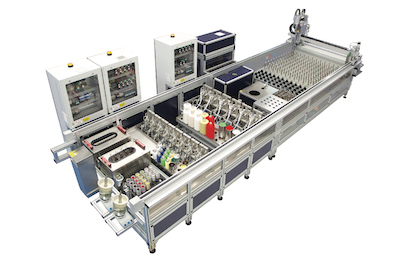
Tecnorama Dose&Dye (c) 2023 Tecnorama


At ITMA 2023, the world’s largest textile technology exhibition, Tecnorama will present its latest innovations for laboratory, to be fully integrated in the DOS&DYE® system, including:

  • DOSORAMA MASTER: the best performing dispensing machine, evolution of the DOSORAMA WS
  • DYRAMA 4R/1000: yarn dyeing module with 1 kg capacity
  • ROTODYRAMA 6R/20: dyeing module for small pieces of fabric and knit
  • DOSORAMA CLEVER: the fully automatic dispensing machine with multi-pipette mono-plunger system combined to a SHAKERAMA dyeing module


Noteworthy also the following new solutions developed for bulk:

ASV - VERTICAL AUTOSTORAGE: an automatic warehouse for storing and handling boxes of dye-stuff powders for production

APV - VERTICAL AUTOPARK with DLP dissolving unit: vertical parking system for storage and automatic handling of stainless steel buckets containing the dispensed recipes


Tecnorama is committed to provide the textile industry with state-of-the-art automation technology. These innovations will enable the textile companies to optimize productivity, minimize wastes and reduce labour costs but maintaining high quality and perfect reproducibility.

The DOS&DYE® system has already revolutionized the dye-house working method.

With its innovative and automated technologies, Tecnorama has been a leader in the sector for many years.

Discover the Tecnorama world al ITMA trade fair in Milan (June 8-14) stand H11 B102 !


More News from TEXDATA International

#ITM 2026

ITM 2026: The new geography of textile production

New production hubs are emerging across North Africa and Central Asia, while Türkiye is accelerating its transformation toward higher-value, technology-driven and more sustainable textile manufacturing.

#Research & Development

“Production is a product”

From technical textiles and AI-driven robotics to the limitations of textile circularity: Professor Dr Thomas Gries looks back on more than two decades of development at ITA Aachen. In the interview, he explains why production technology remains a decisive success factor, discusses international collaborations and innovation ecosystems, and shares his views on the transformation of production landscapes and the challenges facing an increasingly regulated industry.

#Knitting & Hosiery

“We need to move away from the price trap and return to a value-driven mindset.”

With its new Textile Innovation Center, KARL MAYER is sending a strong signal for innovation, collaboration, and the future of textile applications. In this interview, Karl Josef Mayer discusses new opportunities in warp knitting, the processing of staple fibres, recycling, the changing role of machinery manufacturers, and why the textile industry must once again focus more strongly on the value of textiles. by Oliver Schmidt

#Associations

“Innovation, resilience and international experience remain the great strengths of the Swiss textile machinery industry”

Geopolitical uncertainty, growing competitive pressure from China, new free trade agreements and the shift towards a circular economy are currently reshaping the global textile industry. In this interview, Cornelia Buchwalder discusses the current mood within the Swiss textile machinery sector, the industry’s distinctive innovative strength, new market opportunities in India and Asia, and the technological trends that could shape the upcoming trade fair cycle leading up to ITMA 2027.

More News on ITMA 2023

Latest News

#Industry 4.0 / Digitalization

Coats Digital launches AI-powered GSD RealMotion for motion analysis

Coats Digital has launched GSD RealMotion, an AI-powered solution designed to provide apparel manufacturers with greater visibility into factory-floor operations. By analysing shop-floor video and applying Coats Digital’s GSD methodology, the solution turns video recordings into structured, motion-by-motion method studies.

#Textile chemistry

Archroma and Lameirinho partner in pioneering deployment of InOneGO single-step dyeing

Archroma, a global leader in specialty chemicals, and Lameirinho, a leading home textiles manufacturer based in Portugal, are collaborating to bring InOneGO by Archroma, a new single-step dyeing process, into commercial production. Lameirinho’s first InOneGo bedlinens collection is now available worldwide.

#Knitting & Hosiery

KARL MAYER launches extra-wide HKS 3-M EL for increased productivity

KARL MAYER has launched a new extra-wide version of its HKS 3-M EL tricot machine, designed to increase productivity particularly in the manufacture of textiles for sports, activewear and athleisure applications.

#Research & Development

Reducing development times for technical textiles by accelerated thermo-oxidative aging in a high-pressure autoclave

Synthetic polymers used in technical textiles can be effectively protected against degradation caused by heat, oxygen, and water through the use of stabilizer systems. This enables service lives of several decades, extending to more than 50 years. As the use of durable technical textiles continues to grow, so does the demand for reliable methods to predict their service life within economically feasible testing periods. For the first time the German Institutes of Textile and Fiber Research Denkendorf (DITF) developed methods for robust service life prediction for textiles in an IGF research project.

TOP