#ITMA 2023
Starlinger presents new FXa 6.0 at ITMA 2023
For over 50 years, Starlinger has been a leader in the technological development of circular looms for the production of woven sacks from plastic tapes. With the new six-shuttle circular loom FXa 6.0, the company is introducing an even more efficient and user-friendly machine that produces polypropylene tape fabric of highest quality.
"With the new FXa 6.0, we offer a circular loom with significantly reduced energy requirements and a low noise level," said Harald Neumüller, CSO of Starlinger. "At the same time, longer spare parts lifetime ensures significant cost savings. By investing in new processes and innovative manufacturing methods for our in-house production we have been able to significantly minimise quality fluctuations in shuttle roller production and increase their service life." Regarding machine control, a 7-inch touchscreen display and a high-performance CPU ensure convenient operation.
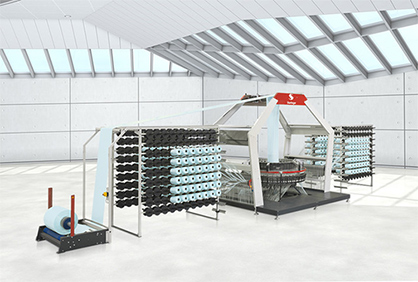
"The FXa 6.0 also features a so-called IQ of 350. This means that on average there is only one warp tape break every 350 metres – an immense advantage in terms of machine downtime and work for the machine operators," Neumüller added.
The FXa 6.0 circular loom achieves a production speed of up to 1200 picks per minute and is designed for the gentle and energy-efficient production of light tape fabrics from 45 g/m² to 140 g/m². The circular loom will be shown in operation at the stand of Starlinger textile packaging in Hall 3.
Closed packaging loops for woven bags made of PP and PET
The use of recycled materials has become one of the leading topics in the packaging industry. In this respect, Starlinger is a pioneer when it comes to woven plastic packaging. With its "Circular Packaging" concept, the company has developed a closed packaging cycle for big bags, in which used big bags are turned into new big bags again. "As part of our "Circular Packaging" concept, big bags made of polypropylene fabric are equipped with a material passport that allows to trace their life cycle from production to use to return and recycling," explains Neumüller. "This means that used big bags can be recycled without significant loss of quality and the regranulate used for producing new big bags – the packaging cycle is closed." Fabric for big bags produced on Starlinger equipment with high shares of recycled polypropylene has the same specifications as fabric produced from virgin material and has been tested with standardised test procedures.
With the technology for the production of tape fabric from PET and rPET, Starlinger has harnessed the great advantage of this material for woven packaging. Correctly processed, PET recyclate has properties like virgin material and can be recycled repeatedly. PET tape fabric is strong, food-safe, has excellent creep resistance and can be made from 100% recycled material. As with bottle-to-bottle recycling, "bag-to-bag" recycling is possible in this case to close the packaging loop. This not only reduces raw material requirements, but also CO2 emissions and energy consumption. Both PET and rPET tape fabric are already being used successfully in the production of big bags.
Post-consumer rPET for textile applications
Starlinger recycling technology will be present at ITMA with its own stand in Hall 9, providing information on recycling solutions for fibre and filament production. In addition to recycling production waste, Starlinger also offers solutions for the use of recycled post-consumer plastics such as rPET in textile production. In order to be able to use recycled PET for the production of polyester filaments and fibres, it must meet the highest quality standards – any foreign particles and polymers must be removed before extrusion. In order to optimally clean the melt in the recycling process, Starlinger has developed a special cartridge filter for fibre applications, the so-called Rapid Sleeve Changer (RSC). It guarantees finest filtration of the melt down to 15 ?m and achieves a throughput of up to 2000 kg per hour. The filter elements can be changed without interrupting production, which significantly reduces melt loss and machine downtime.
For PET bottle-to-bottle recycling applications, Starlinger offers the new recoSTAR PET art, an energy-efficient and user-friendly recycling system. It achieves 15% more output with less maintenance and space requirements than the previous model and saves around 21% in production costs.
Starlinger textile packaging: Hall 3, B103
Starlinger recycling technology: Hall 9, C315