[pageLogInLogOut]

#ITMA 2019

Mayer & Cie. presents most productive mattress machine in the market

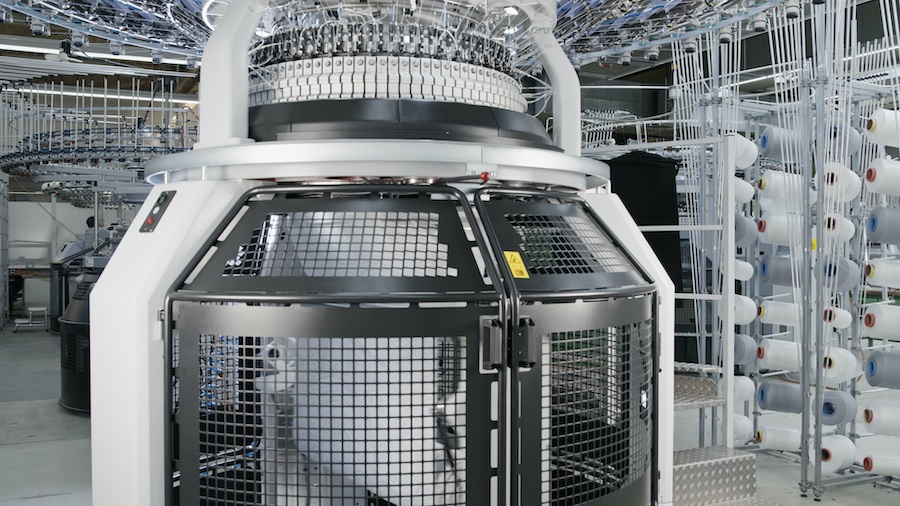
The most productive machine in the market, the OVJA 2.4 EM’s selling points are productivity, ease of use and a wide range of patterns. (c) 2019 Mayer & Cie
At this year’s ITMA Mayer & Cie. is presenting its new OVJA 2.4 EM mattress machine. Fully electronic, it produces up to 30 kilograms of fabric per hour, which demonstrably makes it the most productive machine of its kind in the world. It also scores points for ease of use and the variety of patterns it can produce. The highly productive mattress machine is a perfect match for this year’s Mayer & Cie. ITMA focus on sport. To be at the top in the long term you need to strike a balance between peaks of physical performance and phases of regenerative recovery.

Achieve peak performance with the OVJA 2.4 EM

The star among mattress machines: the OVJA 2.4 EM

The OVJA 2.4 EM is a new Mayer & Cie. development that is specially geared to recent changing requirements in the manufacture of mattress cover fabrics. Its focus is on maximising output, which it achieves by means of a combination of a larger number of knitting systems and a higher rotation speed. “With a system density of 2.4 the OVJA 2.4 EM tallies precisely with the current trend toward higher system densities that make higher productivity possible,” explains Thomas Zizmann, area sales manager at Mayer & Cie. “The OVJA 2.4 E,” he says, “produces up to 30 kilograms of fabric per hour. That makes it demonstrably the most productive machine of its kind in the world, as shown by its speed factor of 950.” In addition to high productivity the OVJA 2.4 EM’s impressive features include ease of use and a wide range of patterns. The horizontal weft yarn guide on each cylinder segment ensures even, easy operation, short changeover times and a high level of reliability. Thanks to the improved thread guide and the air-controlled thread fluctuation control system the thread tension remains constant even at high speeds. That keeps thread vibration to a minimum and the thread is transported safely to the needles. Despite the high productivity the especially gentle needle guidance ensures an unusually low level of needle wear and tear. At the same time the OVJA 2.4 EM offers a wide range of designs that can be changed very quickly thanks to electronic single needle selection in the cylinder.

Pioneering work by Mayer & Cie.: Circular knitting captures the mattress market

Until the late 1990s all mattress cover fabrics were woven. When Mayer & Cie. developed the first electronic machine with a 38-inch diameter and an E 20 gauge in 1997, circular-knitted fabrics began to capture the mattress cover market. In just 20 years the share of circular-knitted fabrics in this segment has risen from zero to over 50 per cent and Mayer & Cie. has become the leading manufacturer. That is mainly because circular knits, in contrast to woven fabrics, are much more stretchable and flexible. That makes them easier to handle and their elasticity enables them to adapt much better to the contours of the mattress, which in turn makes them ideally suitable for flexible, spot-elastic mattresses.


The most important markets for Mayer & Cie. in this segment are Belgium and the USA, but Mayer & Cie. machines also make mattress cover fabrics in Italy, Turkey and Asia, especially China and Indonesia. “What our customers particularly appreciate about our mattress machines is the combination of great flexibility and high productivity,” says Thomas Zizmann. “In Canada and Belgium we have customers in this segment who use only Mayer & Cie. machines.”

The trend toward circular knitting in the mattress market continues, rising slightly, but a level of saturation has been reached and competition has increased. “Sadly, there is now a trend toward less expensive covers and mattresses that are being pushed strongly in advertising,” Zizmann says, describing the current situation. “That is naturally a serious challenge for our customers, who are mainly premium manufacturers. We aim to countervail this trend by increasing the production output of our mattress machines.”

Mattress specialists: the fully electronic OVJA machines from Mayer & Cie.

For the production of high-quality mattress cover fabrics Mayer & Cie. has a range of purpose-built machines. Pattern variety, ease of use and productivity are the key factors. Mattress patterns are among the most complicated that are manufactured and the fully electronic circular knitting machines in Mayer & Cie.’s OVJA range deliver precisely these benefits.

The OVJA 1.6 E has proved its worth for many years as an extraordinarily flexible jacquard machine that is highly productive and thanks to its electronic needle selection does the topstitching in a single operation. Mayer & Cie. continued to develop the OVJA 1.6 E for making mattress covers, leading to the appearance of the OVJA 1.6 EM, a highly productive electronic jacquard machine. The OVJA 1.6 EM HS, a double-knit jacquard machine with electronic single needle selection, is ideally suited by virtue of its flexibility and productivity for the manufacture of mattress cover fabrics. The OVJA 1.6 EE comes with a further increase in numbers of patterns and structures. Electronic single needle selection in both the cylinder and the rib dial opens up many new options. The OVJA 2.4 E, also an electronic jacquard machine designed mainly for production of mattress cover fabrics, knits all known structures including relief and combines high productivity and ease of operation.

In the OVJA 2.4 EM Mayer & Cie. now presents a mattress machine that outperforms all previous machines in its segment for productivity, is decidedly user-friendly with a wide range of patterns.
More News from Mayer & Cie. GmbH & Co.

#Knitting & Hosiery

Huixing acquires insolvent Mayer & Cie.

Insolvency proceedings for the circular knitting and braiding machine manufacturer Mayer & Cie. were opened on December 1, 2025. Immediately following the opening of proceedings, the complete cessation of business operations was initiated. Most employees were subsequently given notice effective the end of February 2026. The production of the remaining orders in the circular knitting segment is expected to be completed by the end of the month. As early as December 2025, Mayer & Cie.’s braiding machine division was sold to an Italian investor.

#Knitting & Hosiery

Mayer & Cie. to shut down after failed search for investor – 270 jobs affected

Mayer & Cie., the long-established German manufacturer of circular knitting and braiding machines, will cease operations after its international search for an investor ended without success. The company, based in Albstadt-Tailfingen, had been undergoing insolvency proceedings in self-administration since its filing on 23 September 2025. As Schwarzwälder Bote reports, the insolvency court has now formally opened the proceedings, triggering the decision to wind down the business in an orderly process.

#Knitting & Hosiery

Mayer & Cie. files for insolvency under self-administration

On 23 September 2025, Mayer & Cie., a manufacturer of circular knitting and braiding machines in Albstadt, filed an application for the opening of insolvency proceedings in self-administration at the Hechingen District Court.

#ITMA Asia + CITME Singapore 2025

Mayer & Cie. at ITMA Asia

Mayer & Cie. will participate in ITMA Asia from October 28 to 31, 2025, which takes place in Singapore. Visitors will find the manufacturer of circular knitting machines and braiding machines in Hall 5, Stand D 301. At its booth, the company will be showing a new circular knitting for jacquard fabrics - the OVJA 2.4 EC II - and will provide an overview of its digital and smart solutions. Another focus is on the machines of Mayer & Cie's "Performance Line": circular knitting machines, which are the most efficient solution in their respective classes.

More News on ITMA 2019

Latest News

#Techtextil 2026

AI, Start-ups, Research: Techtextil and Texprocess bring together players in the textile industry

From start-ups to universities and research institutes: at Techtextil and Texprocess, the world’s leading innovation trade fairs in Frankfurt am Main, exhibitors present future-oriented concepts for the global textile industry. With the international Campus & Research area, a strong participation from start-ups and the latest AI applications for textile processing, both trade fairs showcase current developments in the textile industry. By bringing together innovation, research and application, they enable new partnerships across the textile value chain.

#Techtextil 2026

IVGT joint stand brings innovation and networking to Techtextil 2026

At Techtextil 2026 and the parallel Texprocess 2026, key transformation topics such as artificial intelligence, digitalisation, sustainability, recycling and the circular economy will be reflected across the show. Against this backdrop, the IVGT, together with 16 member companies, will present its joint stand in Hall 12.1 (Stand D62) as a platform for exchange and networking.

#Man-Made Fibers

Indorama Ventures supports Southeast Asia’s textile customers with reliable regional supply and global innovative portfolio

Indorama Ventures, one of the leading global polyester fiber and filament yarn suppliers globally, will participate in Indo Intertex 2026 in Jakarta this April, making its diverse global portfolio available to apparel, home textile, and hygiene customers across Southeast Asia.

#Raw Materials

New study shows low environmental impact by Cotton made in Africa Organic Cotton from Tanzania

Today, the Aid by Trade Foundation (AbTF) is announcing the results of a comprehensive life-cycle analysis (LCA) for cotton produced in Tanzania under the Cotton made in Africa Organic (CmiA Organic) standard. The study emphasises the small ecological footprint of CmiA Organic verified cotton. This can largely be traced back to the absence of synthetic pesticides, artificial fertilisers, and artificial irrigation. Consequently, CmiA Organic cotton can help the textile industry meet regulatory requirements as well as science-based targets. The results also show that the consequences of climate change threaten the livelihoods of these cotton farmers, even though the type of agriculture they practise barely contributes to climate change.

TOP