[pageLogInLogOut]

#Sustainability

VAUDE eliminates PFAS from all products

High-performance weather protection without harmful forever chemicals
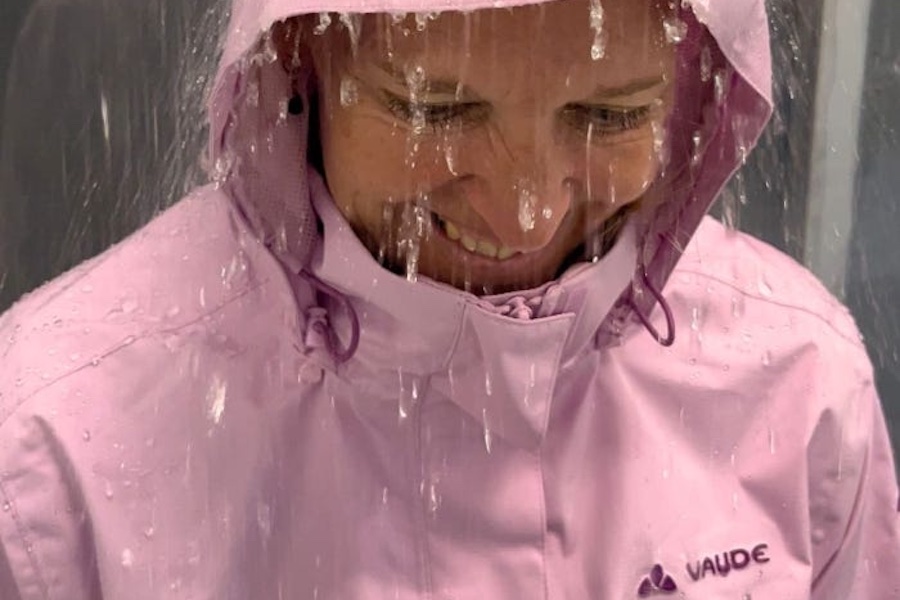
Vaude's Antje von Dewitz takes a shower to demonstrate a PFAS free rain jacket © 2026 Laude
PFAS (per- and polyfluoroalkyl substances) are now detectable worldwide – in drinking water, soil and the human body. These so-called “forever chemicals” are considered hazardous to health and potentially carcinogenic, as they do not break down and remain in the environment permanently. Despite these risks, PFAS are still used in a wide range of products. More than 15 years ago, VAUDE made a strategic decision to gradually eliminate PFAS from all product categories.

With the Spring/Summer 2025 collection, this transformation is complete: VAUDE now fully avoids PFAS – from weather protection apparel to backpacks, sleeping bags, footwear and waterproof tents.

This complete phase-out required many years of intensive development. For a long time, PFAS were considered the technical standard for waterproof performance in the outdoor industry. High-performing alternatives were initially very limited. VAUDE therefore invested specifically in materials research, collaborated with innovative partners and conducted extensive lab and field testing to ensure that the high functional requirements could also be met without PFAS. 

Strategic PFAS phase-out – consistently implemented 

“Phasing out PFAS was a strategic business decision, not a communications move,” says Dr. Antje von Dewitz, CEO of VAUDE. “It shows that high-performance weather protection is possible without relying on harmful forever chemicals. Reaching this milestone is a major achievement for VAUDE – and the result of close collaboration and strong commitment from many colleagues and partners.” 

A key role was played by VAUDE’s chemicals management system, which has been working systematically for years to identify and implement alternatives to fluorinated chemistry. All product categories were converted step by step – including technically demanding components such as waterproof zips and tent fabrics. 

How can PFAS-free solutions become the industry standard?

VAUDE’s successful transition shows: high-performing PFAS-free solutions are technically available today. A clear EU-wide regulatory framework would significantly accelerate the widespread adoption of these alternatives across the industry. Binding requirements would create a level playing field and provide planning security for companies that choose to invest early and take responsibility. 


More News from VAUDE Sport GmbH & Co. KG

More News on Sustainability

#Associations

Results of the 38th ITMF Global Textile Industry Survey

The global textile industry appears to be turning a corner, but this is more likely a fragile and possibly temporary improvement than the start of a durable recovery. According to the 38th ITMF Global Textile Industry Survey, conducted worldwide during the second half of May 2026, business sentiment, order intake, order backlogs and capacity utilization all improved versus March — yet every indicator remains weak by historical standards, and rising costs cast doubt on how long the upturn can last.

#Sustainability

Closing the Footwear Loop reveals challenges and opportunities for circular footwear

The footwear industry faces one of the most complex circularity challenges in the fashion sector. A new Phase 1 report from the Fashion for Good initiative Closing the Footwear Loop, developed together with Circle Economy, provides new insights into the composition, condition and recycling potential of post-consumer footwear waste.

#Man-Made Fibers

The updated poster on biodegradable Polymers in various environments has been released

As part of the PerPlacsBio project, nova-Institute has updated its popular poster on the biodegradability of polymers in different environments. The updated version reflects current standards, certifications and the latest scientific findings. The poster can be used to assess biodegradable alternatives for use in agriculture and forestry, and it is now available in German for the first time.

#Sustainability

A new standard to combat plastic waste in forests

With DIN SPEC 35808 “Tree Shelter for Forestry Applications,” the testing and research service provider Hohenstein, in collaboration with Rottenburg University of Forestry, as well as forestry authorities and industry partners, has established a clear framework for bio-based and fully biodegradable tree shelters. The pre-standard defines requirements and practical testing methods designed to reduce plastic waste in forests and strengthen the long-term protection of soil and the environment.

Latest News

#Spinning

"We will become a recycling powerhouse"

The textile industry is now in its fourth consecutive year of crisis, while automation, artificial intelligence and recycling are reshaping the rules of the game. In this interview, Rieter CEO Thomas Oetterli discusses the first signs of a market recovery, reflects on his first three years at the helm of the company, explains the integration of Barmag, outlines Rieter’s vision of the fully automated spinning mill and highlights the strategic importance of recycling. In doing so, he explains why the new Rieter Group aims to play a leading role in transforming the textile value chain into a circular economy.

#Man-Made Fibers

ROICA™ launches new global brand identity and digital experience

ROICA™, the premium stretch fiber developed by Asahi Kasei, today announced the launch of its new global brand identity, including a new key visual and a fully redesigned website. This milestone initiative marks the beginning of a new phase in ROICA™’s evolution as a global brand.

#Nonwovens

EDANA launches landmark continence report to mark the start of the World Continence Week

Today marks the official commencement of the World Continence Week. To honour this global awareness initiative, EDANA has published a comprehensive report titled "The Central Role of Absorbent Hygiene Products in the Management of Adult Urinary Incontinence: Benefits, Costs and Environmental Impact." The World Continence Week (WCW) is an annual global initiative dedicated to raising public awareness about incontinence and bladder or bowel health issues. Traditionally held in June, this awareness week aims to shed light on a condition that affects millions of people worldwide but is frequently kept secret due to widespread social stigma, embarrassment, and taboo.

#Associations

Mario Jorge Machado re-elected President of EURATEX

The EURATEX General Assembly has re-elected Mario Jorge Machado as President of EURATEX, renewing its confidence in his leadership at a crucial moment for the European textile and clothing industry. The sector is facing rising costs, global competitive pressure and an increasingly challenging transition towards sustainability and digitalisation.

TOP