[pageLogInLogOut]

#Functional Fabrics

“Action helps us change what we do!”
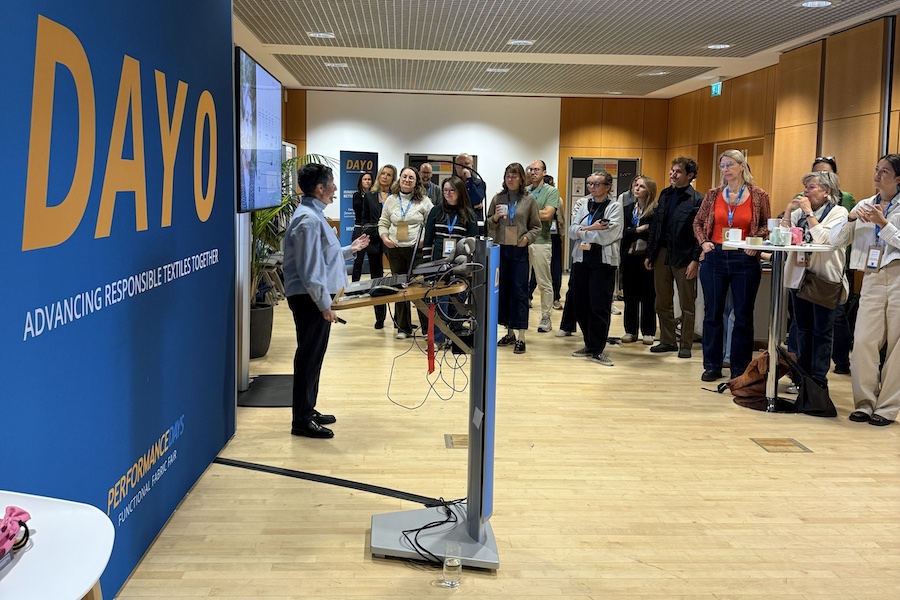
Bowie Miles speaking at DAY 0 © 2026 PERFORMANCE DAYS
DAY 0 takes place deliberately before PERFORMANCE DAYS begins. It is conceived as a space for reflection, dialogue and active engagement — a moment to pause before the fair, rethink established systems and address sustainability not as a trend, but as a fundamental transformation challenge. Under the guiding metaphor “Turn the Tap Off”, DAY 0 focuses on root causes rather than symptoms, systemic change rather than isolated solutions, and collective responsibility rather than individual silos.

In this conversation, Bowie Miles, who is guiding through this interactive workshop-experience in March again, reflects on why transformation must start upstream, why participation matters more than presentations, and how real change can move from ambition into action.

A conversation about rethinking sustainability, circularity and real impact in the textile industry

Why is DAY 0 positioned before PERFORMANCE DAYS?

Bowie Miles: The exact timing matters less than the connection. DAY 0 should not feel like an add-on, but as an integral part of the PERFORMANCE DAYS experience. Its messages need to flow into the fair itself — through visibility, communication, and continuity. A stronger bridge between DAY 0 and PERFORMANCE DAYS would increase relevance, impact, and long-term value.

Why do we need collaborative spaces instead of traditional listening formats?

Bowie: Because knowledge already exists — the real value lies in shared learning and connections. Active participation creates deeper engagement. People connect on a deeper level when they are part of the process rather than passive listeners. Co-creation leads to commitment, action, and long-term impact.

What does “Turn the Tap Off” represent for the textile industry?

Bowie: It represents the need to stop uncontrolled resource extraction. If we don’t consciously turn the tap off, it will eventually run dry. The metaphor highlights a shift from managing consequences to addressing root causes — from extraction to regeneration, from footprint to handprint. Real change starts at the source, not at the overflow. And at the end – we all should understand, that having a shower is more efficient.

Why does sustainability still focus so much on end-of-life solutions?

Bowie: Because they are easier to grab and fit existing business models. End-of-life solutions manage the symptoms but often depend on the problem continuing to exist. Real transformation requires addressing the source of the problem — slowing down, controlling, or turning off the flow rather than managing the overflow.

Where are the biggest leverage points for change upstream?

Bowie: In controlling production volumes. The industry must return to a needs-based model — producing what is needed, not what can be sold. Designing durable, long-lasting products reduces consumption, waste, and overstock. Business models must shift from volume growth to quality, longevity, and responsible production.

How does understanding material flows change circularity?

Bowie: It shifts the focus from isolated actions to the full value chain. The biggest impacts happen upstream — in raw materials, fiber, yarn, dyeing, and processing. When brands understand these flows, they can make better decisions early in the process, where real leverage exists.

Why is hands-on work essential for sustainability?

Bowie: Because it makes sustainability tangible and real. Active participation creates understanding that lasts. When people map systems themselves, learning becomes personal, practical, and transformative — not theoretical. I am sure: “Action helps us change what we do!”

What should participants take away from DAY 0?

Bowie: A mindset shift. Sustainability is not a job role or working-hours topic — it’s a lifestyle responsibility. Change starts with awareness, small actions, and personal accountability. Small wins create momentum.

Why must individual responsibility connect with industry change?

Bowie: Because sustainability is shared responsibility. Systems are shaped by people, and real change happens when personal values align with organizational action. Long-term resilience depends on collective accountability.

How do we move sustainability from ambition into real-world action?

Bowie: Through engagement, dialogue, and our experiences. Sustainability must be felt, understood, and internalized — not just written into strategies. Only then does it become embedded and authentic.

What role does honesty play?

Bowie: Honesty enables real connections. Without openness and vulnerability, conversations remain superficial. Honest dialogue allows industries to move beyond roles and titles toward shared responsibility and real progress.

What must change in the next 5–10 years?

Bowie: The industry must stop repeating the same discussions without action. Overproduction, resource scarcity, and social pressures make the current model unsustainable. The future depends on conscious decisions: producing less, producing better, and aligning business with planetary limits.

What gives you hope that transformation is possible?

Bowie: Human adaptability. Crises show that people can change quickly. Hope lies in compassion, connection, and a shift in values — away from accumulation and toward experience, relationships, and meaning.

Why should people join DAY 0 — even if they already know a lot about sustainability?

Bowie: Even for those who already have a strong understanding of sustainability, DAY 0 offers a different kind of value. It creates a space for openness, honesty, and reflection—allowing participants to engage with complex and sometimes uncomfortable topics in a way that goes beyond theory. Rather than relying on passive listening, DAY ZERO emphasizes active participation and shared experience. Being involved in the process encourages reflection, accountability, and action, even if those actions begin with small steps. This hands-on approach helps translate knowledge into behavior and supports meaningful change. By working together, participants can inspire one another and build a sense of positive accountability. In this way, DAY ZERO is not about learning more facts, but about reconnecting with purpose, perspective, and the practical steps needed to move forward.


DAY 0:

DAY 0 takes place intentionally before PERFORMANCE DAYS as a moment to pause, reflect, and reset. It creates space to step back from business as usual and address sustainability at its roots—before products, strategies, and decisions take shape. Rather than focusing on trends or end-of-life solutions, DAY 0 invites participants to engage with systemic change, shared responsibility, and practical action. It is a starting point for honest dialogue, collaboration, and a shift from ambition to real-world impact.

BOWIE MILES:

Bowie Miles has been responsible for DAY 0 since the Autumn edition of PERFORMANCE DAYS and leads the workshop with a strong focus on dialogue, participation, and real-world impact. With a deep understanding of sustainability, material flows, and systemic change, she brings both strategic insight and personal conviction to the format. Her approach connects industry expertise with hands-on engagement, creating a space where complex topics can be addressed openly and translated into meaningful action.

Learn more about the complete schedule of DAY 0 here:

https://www.performancedays.com/the-fair/day-0-conference/tickets-and-program.html


More News from PERFORMANCE DAYS ® functional fabrics fair

#Functional Fabrics

PERFORMANCE DAYS proves its relevance as the industry’s key meeting point

Held on March 18–19, 2026, PERFORMANCE DAYS once again confirmed its position as a leading international platform for functional textiles. A total of 3.366 trade visitors and around 560 exhibitors gathered in Munich, with the event already kicking off successfully on DAY 0, which received highly positive feedback for its interactive format. Despite challenging conditions caused by the public transport strike in Munich, the event saw strong attendance and a consistently high level of activity across both exhibition days.

#Functional Fabrics

PERFORMANCE DAYS: Focus topic shifts to the beginning of the value chain

Following the last Focus Topic in October 2025, which placed Textile-to-Textile Recycling at its core, PERFORMANCE DAYS continues to drive the conversation around circularity – this time with an expanded and more upstream perspective. The upcoming Focus Topic, “Textile to Textile: The Role of Collectors and Sorters,” presented during the spring edition on March 18–19, will spotlight one of the most essential yet often overlooked components of a functioning circular textile system: the efficient collection and sorting of post-consumer textiles.

#Functional Fabrics

PERFORMANCE DAYS sets benchmarks with record attendance & strong industry presence

With around 4,500 professional visitors and 515 exhibitors, PERFORMANCE DAYS closed its doors on October 30, 2025, after two highly successful days in Munich. Expanded show areas, an international audience, a top-class Expert Talks program, and an inspiring DAY 0 Conference with an innovative concept underlined one thing clearly: PERFORMANCE DAYS has become the leading business platform for the functional textile industry.

#Technical Textiles

PERFORMANCE DAYS Autumn Fair 2025: full house in Munich

On October, 29–30, 2025, PERFORMANCE DAYS opens its doors in Munich – fully booked, with bustling halls, top-tier exhibitors, and a diverse supporting program, the leading trade fair for functional fabrics and sustainable textile innovations once again confirms its relevance for the industry. Visitors can look forward to a varied program with high-profile exhibitors, new areas, inspiring Trend Forums, the current Focus Topic, and an expanded Footwear Area. Another highlight: the Innovation Hub by FFE, a curated area in cooperation with the Future Fabrics Expo.

More News on Functional Fabrics

#Textiles & Apparel / Garment

Carrington Textiles publishes third Sustainability Report

Carrington Textiles has announced the publication of the third Sustainability Report from the RTS Textiles Group, highlighting another year of progress towards more responsible manufacturing across its global operations. The report outlines continued investment in technologies and initiatives designed to improve environmental performance and support long-term business resilience across the Group’s manufacturing facilities in the UK, Portugal and Pakistan.

#Functional Fabrics

Ahlstrom launches breathable ChemoGard BVB fabric to enhance protection and comfort in chemotherapy handling

Ahlstrom, a global leader in fiber-based specialty materials, announces today the launch of ChemoGard BVB, a breathable protective apparel fabric designed for chemotherapy drug handling in clinical, laboratory, and operating room environments.

#Functional Fabrics

CovationBio introduces two new bio-based innovations at Functional Fabric Fair New York

Covation Biomaterials LLC (“CovationBio®”) is showcasing its two new bio-based innovations, Xatryx® and Sorona® elasterell-p fiber, at this year’s Functional Fabric Fair in New York City, July 7–9, 2026. Attendees can visit CovationBio at Booth #404 to explore this next generation of bio-based performance materials.

#Techtextil 2026

Lenzing unveils three-tier cellulosic fiber portfolio for next generation protective wear

The Lenzing Group, a leading supplier of regenerated cellulosic fibers for the textile and nonwovens industries, today introduces Lenzing Solutions for Protective Wear. This integrated three-tier portfolio is anchored by LENZING™ FR fibers at the highest protection tier for inherent flame resistance and brings together complementary solutions including TENCEL™ Lyocell fibers, both EU Ecolabel-certified² and derived from certified or controlled wood sources³, within a unified protective wear architecture for the first time. The launch marks the most significant expansion of Lenzing’s protective wear business since the company pioneered inherently flame-resistant cellulosic fiber in 1977, and comes as the global personal protective equipment (PPE) market accelerates toward an estimated USD 130 billion by 2033⁴.

Latest News

#Spinning

Rieter sees Barmag integration on track as orders and sales rise

The first half of 2026 was shaped by the successful completion of the largest acquisition in Rieter’s history. The Man-Made Fiber Division enables entry into the growth segment of man-made fibers and sustainably strengthens Rieter’s market position in the Asia region. The expanded Group is now the world’s leading system supplier for the processing of natural and man-made fibers. In the first half of the year, initial cost savings in material costs and operating expenses have already been realized. The targeted synergies are expected to amount to at least CHF 20 million by the end of the 2028 financial year. Due to the completion of the acquisition on February 2, 2026, the first half of the year for the Man-Made Fiber Division only amounts to five months.

#Knitting & Hosiery

Groz-Beckert at Igatex 2026

From October 15 to 18, 2026, Groz-Beckert will present its latest innovations and solutions across the product areas of Knitting, Weaving, Sewing and Spinning at Igatex in Pakistan (Hall 1, Booth A-1-08).

#Natural Fibers

Better Cotton Initiative multistakeholder event in US unpacks regenerative agriculture potential

The Better Cotton Initiative (BCI), in collaboration with Texas-based partner, Quarterway Cotton Growers, will expand upon its annual US field event to relay the vast potential of regenerative agriculture through an immersive experience of tours and demonstrations.

#Sustainability

bluesign appoints Hanane Taidi as CEO to lead next phase of global impact

bluesign, which partners with the textile industry to reduce adverse impact across the value chain, appoints Hanane Taidi as Chief Executive Officer, marking a pivotal moment as the company builds on its leadership amid rapid industry change.

TOP