#Knitting & Hosiery
Innovations of today for the generations of tomorrow
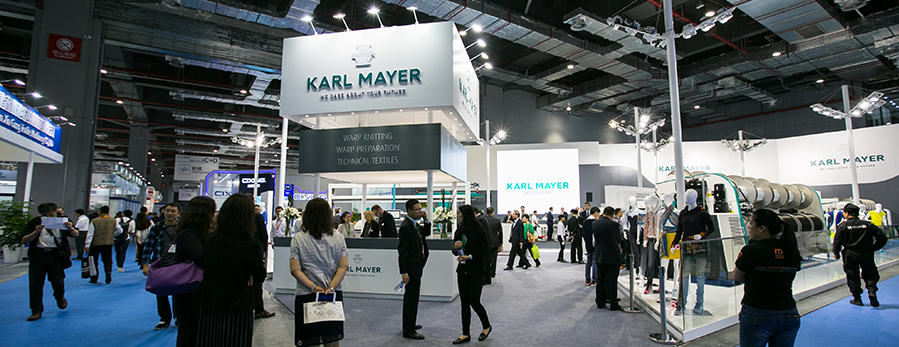
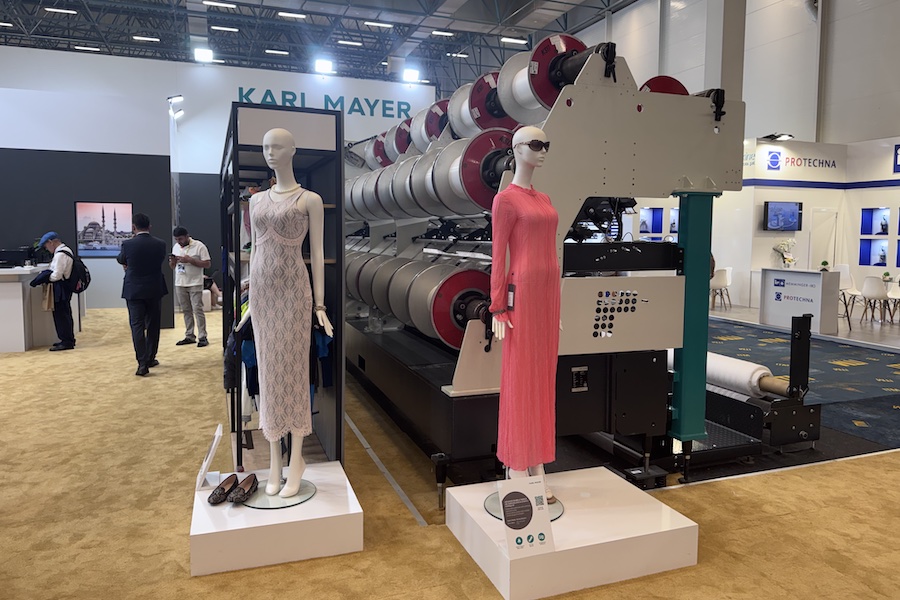
KARL MAYER was once again exhibiting at ITMA ASIA + CITME 2016 as a world market leader with a profound sense of responsibility. This manufacturer always considers future generations in all its activities. We care about your future – this is KARL MAYER’s commitment to promoting the concepts of sustainability and digitisation when dealing with its customers and throughout its entire operations.
KARL MAYER is upbeat following the ITMA ASIA + CITME 2016 Show, held 21.–25.10.2016 This world market leader was demonstrating how it is focusing on the challenges of our times by holding two presentations simultaneously to mark ITMA ASIA + CITME 2016. The first was on its impressive stand at the National Exhibition and Convention Centre (NECC) in Shanghai, and the second was at an in-house show held at KARL MAYER (China) in Wujin, Changzhou. Both of these presentations were extremely successful. The company’s representatives had more than 600 meaningful conversations at the trade fair. Most of the interested visitors (about 56%) came from China, but also from India, Taiwan, Korea, Bangladesh, Indonesia and Turkey. “For us, ITMA ASIA + CITME 2016 was an international fair providing many important impulses for our future business,” concluded Arno Gärtner, the Managing Director. During the in-house show in Wujin, Changzhou, he and his team were able to welcome roughly 340 visitors – a record number for one of the company’s own in-house events. The nationalities of the visitors here were similar to those at the NECC. As well as the neighbouring Asian countries, there was considerable interest from Turkey. Some customers even travelled from as far afield as the USA and eastern Europe. Committed to topical issues KARL MAYER’s presentations at the NECC and in Wujin, Changzhou, both focused on the future. For example, features such as technical solutions concentrating on sustainability, such as the LEO® Low Energy Option for warp knitting machines and the materials-conserving HSB-PW Size Box for warp preparation, as well as textile applications having ecological implications in the field of multiaxial technology attracted a great deal of attention at the show. “Our developments and concepts for conserving resources and protecting the environment were very well received by our visitors in Shanghai,” explained Arno Gärtner. “What is more, many visitors were enthusiastic about trying out our new digital communication systems. Since ITMA 2015, we have been going in a new direction, thanks to smart phones and tablets. We have been incredibly successful here.” The latest digital innovations include the KARL MAYER CONNECT and KARL MAYER CHECK PARTS apps and the SPARE PARTS WEBSHOP.
They complement the 360° service provided by KARL MAYER, and guarantee efficient communication with the company’s own technical support staff. They also ensure that the machines operate more economically. The new KAMCOS® 2 automation platform is the basis for this innovative link between network communication and the machine technology, and also for solutions for integrating systems. KARL MAYER’s media presentation at the NECC also focused on digital technology: large displays showing striking images attracted the attention of the visitors from some distance away, and sent out the message: “Innovation is at home here”. The products on show were demonstrating their high level of innovation, in terms of both their technology and appearance. In the tricot machine sector, KARL MAYER was presenting two HKS models of the next generation in Shanghai. Their modern design clearly sets them apart from other machines on the market. The visitors were full of enthusiasm for the new design. “Our customers can see that the design is a real competitive advantage, and are eagerly awaiting the rollout of more models like this,” said Jan Rundshagen, the CSO of KARL MAYER’s agent, ILLIES. The new OJ 59/1 B for the lace sector was on display at the in-house show in Wujin, Changzhou. With its unique level of productivity, it is revolutionising the production of lace. This first representative of the new LACE.EXPRESS series created quite a stir at the fair.Some new developments in shoe fabric production and an innovative warp preparation machine for warp knitting rounded off the presentation at the in-house show at KARL MAYER (China).