[pageLogInLogOut]

#INDIA ITME 2022

Does the Pareto Principle work in spinning?

Profitability is obviously a basic requirement for spinners – so how might they benefit from applying wider economic ideas alongside established ways of improving mill productivity? This article examines contamination-controlled spinning from the viewpoint of one such well-known concept – the Pareto Principle – and assesses its validity in a yarn production environment.

Assessing its role with Uster contamination control in yarn production

In the late 19th Century, Italian economist Vilfredo Pareto made the initial observations on which the Pareto Principle is based. Also known as the 80-20 rule, it suggests that in many cases only 20% of the effort put in will account for 80% of the result. This imbalance between input and output has been used in business to choose priorities and focus on the most effective areas to bring the greatest reward. Although not a hard and fast rule, the Pareto Principle can help to increase productivity and efficiency in industrial settings.
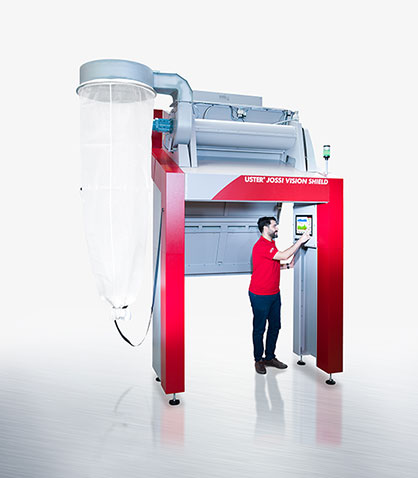
Jossi Vision Shield © 2022 Uster


Specifically, it can be applied to determine ‘best practice’ in some elements of spinning when focused on contamination control.

Small effort, big effect

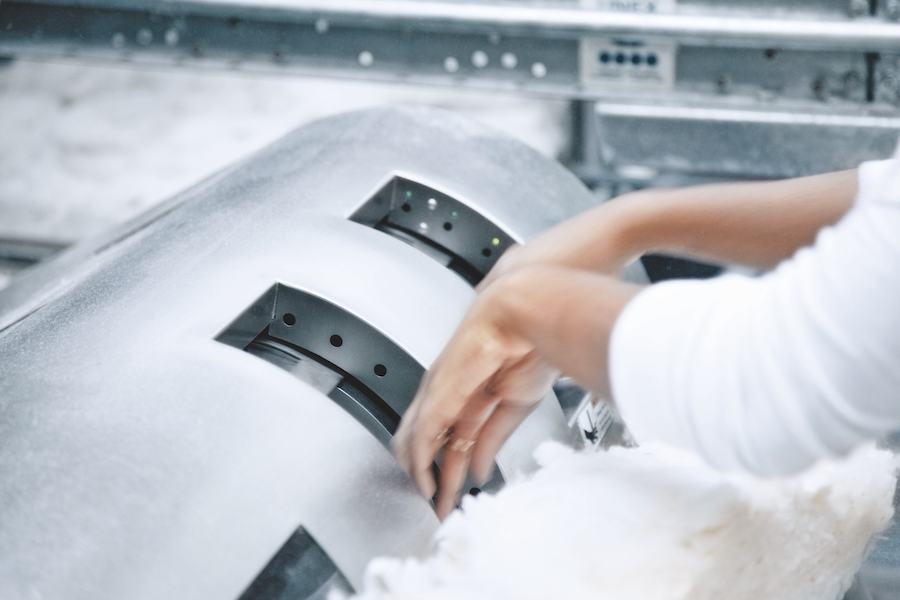
Experienced spinners know that contamination control in the blowroom exactly follows this principle. Correct positioning of the fiber cleaning system – at the point where the fibers are most open – is crucial. Contaminants might otherwise be hidden inside bigger tufts, but not with Uster Jossi Vision Shield at the fiber opening stage.

Uster Jossi Vision Shield is backed by 20 years’ experience. Conventional camera-based systems cannot match its performance. Operating across a much greater wavelength, Uster’s spectroscopes can find contamination even within the ‘invisible’ range of IR and UV light. Fragments of contamination in light pastel colors and white also pose no problem.

The final check

Any remaining contamination or defects will then be identified and removed by the final-stage check at the Quantum 4.0 yarn clearers, which will ensure the yarn meets customer requirements. The good news for spinners wondering about capacitive or optical clearing for a new production line, or for retrofit, is that Uster Quantum 4.0 has both capacitive and optical sensors, applicable to different yarns and changing conditions.

The non-Pareto effect

The second part of the Pareto concept – that the ‘other’ 20% of the results require 80% of the effort, does not actually apply for contamination-controlled yarn production. The principle here is “managing remaining contaminants in yarns at minimum possible cost” – and the solution is Total Contamination Control, which achieves far more than any 20/80 correlation!


Total Contamination Control means precisely controlled contamination levels in yarns, with minimum waste as an integrated solution.
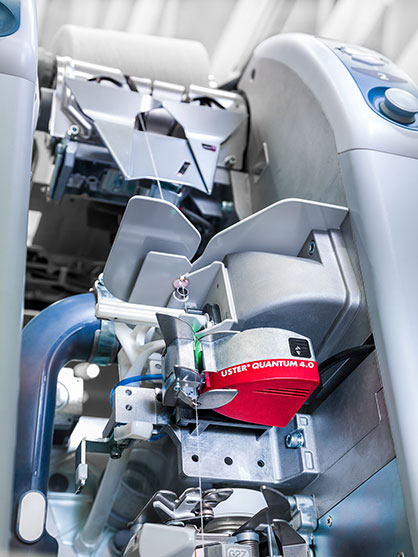
Quantum 4.0 © 2022 Uster


Total Contamination Control (TCC) balances ejections in the blowroom along with cuts in winding in the most advanced way. Uster Jossi Vision Shield and Uster Quantum 4.0 are two perfectly-linked systems in the production process, minimizing the risk of foreign matter quality issues and focusing on defined quality and profitability.

TCC is an Uster Value module with Quality Expert, which also reveals optimization potential to save costs. Data from Uster Jossi Vision Shield and Uster Quantum 4.0 combined with Uster’s long experience in contamination control, answer the following key questions in practice. What is the right level of contamination removal? How does fiber cleaning and yarn clearing achieve consistent levels of contamination that will satisfy the customer requirements? And how does it prevent waste of good material?

Beyond Pareto

Vilfredo Pareto of course couldn’t know, more than 100 years ago, about Uster’s preventive yarn clearing. This solution follows its own rules: preventive means that there’s no 20% or anything remaining needing extra effort, but there is security. The new combined clearing and enhanced detection modes protect yarn quality, while reducing cuts at the same time.

Furthermore, disturbing defects cannot pass, so that issues in downstream processes are prevented. Upstream, connectivity to Uster’s quality management platform contributes to ‘preventive yarn clearing’. Perhaps preventive yarn clearing could be called a 100/0 rule?

More News from Uster Technologies AG

#ITMA Asia + CITME Singapore 2025

Uster presents novelties at ITMA Asia + CITME 2025

There’s news from Uster Technologies to be announced for the industry’s upcoming event in Singapore. The Uster 360Q universe is growing with new products, solutions and services. Innovation developments can also be recorded in the fields of man-made fiber testing and fabric inspection. Uster innovations address the industry’s trending topics as mill management and process control, optimization of delivered fabric quality and yield.

#Spinning

Uster Technologies marks 150 years of empowering quality excellence

Uster Technologies marks 150 years of excellence – a milestone that reflects continuous adaptation to customer needs and industry change. Over the decades, Uster has evolved from manufacturing quality testing instruments into a trusted partner shaping the future of textile production.

#Recycling / Circular Economy

Challenges of making yarn from recycled fibers

What does it take to spin quality yarn from recycled fibers? Uster Technologies brought textile industry leaders together to discuss the role of technology, data and automation – as well as the current challenges in using recycled raw material. Experts from Rieter, Säntis Textiles, Otto Yarns, and TVU commented on the current situation and looked into the future of spinning in a panel discussion organized at Uster headquarters.

#Spinning

Uster Technologies wins another infringement lawsuit

In a ‘victory for innovation in China’ Uster Technologies has secured a decisive judgment in a patent infringement lawsuit against a competitor. The final ruling by the Supreme People’s Court of PR China confirms that the competitor’s actions in copying the patented yarn feeder of the Uster Tester 6 constitute unlawful infringement.

More News on INDIA ITME 2022

Latest News

#Functional Fabrics

“Action helps us change what we do!”

DAY 0 takes place deliberately before PERFORMANCE DAYS begins. It is conceived as a space for reflection, dialogue and active engagement — a moment to pause before the fair, rethink established systems and address sustainability not as a trend, but as a fundamental transformation challenge. Under the guiding metaphor “Turn the Tap Off”, DAY 0 focuses on root causes rather than symptoms, systemic change rather than isolated solutions, and collective responsibility rather than individual silos.

#Textiles & Apparel / Garment

Pets in fashion: functional and sustainable textiles find new market at Intertextile Apparel

China’s pet economy is booming, especially amongst younger generations, and pet apparel – from designer outfits to functional garments – was a RMB 3.5 billion (over USD 500 million) market in 2024, growing more than 20% annually¹. To help exhibitors harness this trend, Intertextile Shanghai Apparel Fabrics – Spring Edition 2026 will launch the Pet Boutique, presenting a range of innovative, sustainable materials that prioritise both functionality and comfort for pets.

#Sustainability

VAUDE eliminates PFAS from all products

PFAS (per- and polyfluoroalkyl substances) are now detectable worldwide – in drinking water, soil and the human body. These so-called “forever chemicals” are considered hazardous to health and potentially carcinogenic, as they do not break down and remain in the environment permanently. Despite these risks, PFAS are still used in a wide range of products. More than 15 years ago, VAUDE made a strategic decision to gradually eliminate PFAS from all product categories.

#Man-Made Fibers

Lenzing AG to become majority owner of TreeToTextile AB and accelerates industrialization of new fibers

The Lenzing Group is taking another strategic milestone by acquiring a controlling majority in the Swedish innovation company TreeToTextile AB. This step strengthens Lenzing’s position as a leading provider of sustainable, wood‑based specialty fibers and expands its innovation pipeline with a highly scalable, patent‑protected technology platform. The transaction is executed through the issuance of new shares.

TOP



