#Home Textiles
Health, sleep and sustainability trends and themes of the future dominated at Heimtextil 2020
Sustainability was a central thread that ran through the entire event at Heimtextil 2020. Extensive activities and informative displays demonstrated how material processes are changing all over the world, with a view to improving the environment, and how social responsibility in respect of the people employed in the industry is growing. Even if the figures still do not add up, and preparedness of consumers to spend more money for environmentally friendly textiles is still in its infancy, supply and demand at the world’s largest trade fair for home and contract textiles were larger than ever before. Durability and a second life are beginning to manifest themselves in products. “The re-think is really only just beginning,” says Martin Auerbach, General Manager of the Association of the German Home Textile Industry (Verband der Deutschen Heimtextilien-Industrie e.V.), “because to actually get to the circular economy, we must think and act with the entire value creation chain in mind. And moreover: up to now the product was the most important thing in the development phase. To achieve the transition to the circular economy, we need to formulate things the other way around. So, the questions become: What would the product that is optimised for economic circularity look like? How can we then achieve the required functionalities? And finally: How will manufacturers be able to differentiate themselves from the competition in the marketplace with their products?”
The new consumers are making the difference
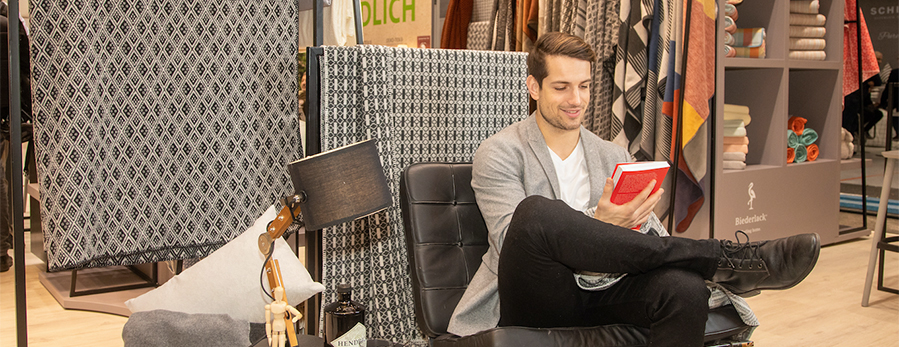
“Compared with 15 years ago, delegations of buyers have definitely become somewhat smaller; however, decision-makers continue to attend Heimtextil as they always have – with slightly less time at their disposal, but with very specific plans,” says Peter Gumbel, CEO of ARO Artländer GmbH. “One of the things that everyone was talking about was our certificated bed covers from validated organic sources.” Companies are increasingly coming to see sustainability as an opportunity. One needs to look no further than the number of companies with sustainable operations signing up for the Green Directory at Heimtextil, which, at 259, was higher than ever before. Sustainable production and company behaviours are becoming a constant and can be seen at Heimtextil in any number of aspects: throws made from recycled jeans, recycled cotton and PET bottles (HERMANN BIEDERLACK GmbH + Co. KG), sustainable bathrobes and bath linen made from GOTS-certified materials with printed floral patterns, (ESSENZA HOME), eco pillows made from recycled PET bottles (Trendsetter International), limited editions of colourfully striped towels made from residual products (Cawö Textil GmbH & Co. KG, zoeppritz since 1828), bed linen with an energy-saving, environmentally-friendly finish (Estamparia Textil Adalberto Pinto da Silva), GOTS-certified bed linen with a vintage appeal (M.G. Ekkelboom B.V.), GOTS-certified bed linen with fresh patterns and colours (Bierbaum Wohnen GmbH & Co. KG, Irisette GmbH & Co. KG), throws made from organic cotton and recycled polyester (zoeppritz since 1828). Packaging, too, has been impacted by the trend for sustainability: bed-linen is sold in printed FSC-certified cardboard, with one percent of the profits given to charity (Covers & Co., ESSENZA HOME); the profile of fitted bedsheets is raised through the use of completely compostable cardboard, made from waste paper (Adam Matheis GmbH & Co. KG); bed linen is, in future, to be manufactured from recycled yarns; baby linen made from organic cotton is to be packaged in fabric, instead of polythene bags (Kayteks); bed covers are being rebranded and sold in cotton/linen bags (f.a.n. Frankenstolz Schlafkomfort H. Neumeyer GmbH & Co. KG). “Organic fitted sheets are very much in demand,” explains Aylin Karaca von Kayteks. “We are seeing increasing interest in our organic cotton baby brand. And we want, in future, to offer bed linen made from recycled yarns. We are also shifting to fabric packaging materials.” And Barbara Matheis-Klassen confirms: “We want to give the product a higher profile, address the issue of sustainability and make everything from organic cotton in future.”
Long-term thinking has a future
As far as the visitors were concerned, the considerable interest in sustainable concepts was also in evidence in the newly instituted ‘Future Materials Library’ in the ‘Trend Space’ in Hall 3.0. The Library offered some exciting insights into sustainable innovations in materials. Amongst other things, the focus here was on recycled fabrics and cultured, so-called ‘living’ textiles. The section on ‘Natural Assets’ drew attention to some hitherto unused natural treasures in the form of algae and stinging nettles, as did ‘Living Materials’ to cultured materials from a mesh of growing fungal fibres and ‘Biological Byproducts’ to agricultural resources in the form of orange peel and agave leaves. Then again, ‘Remade’ demonstrated the potential for re-use inherent in textile waste material. Visitors were thus able to find out both about the properties of a range of innovative materials, as well as about the ways in which they are produced.
All things are possible – the unifying concept is ‘diversity’
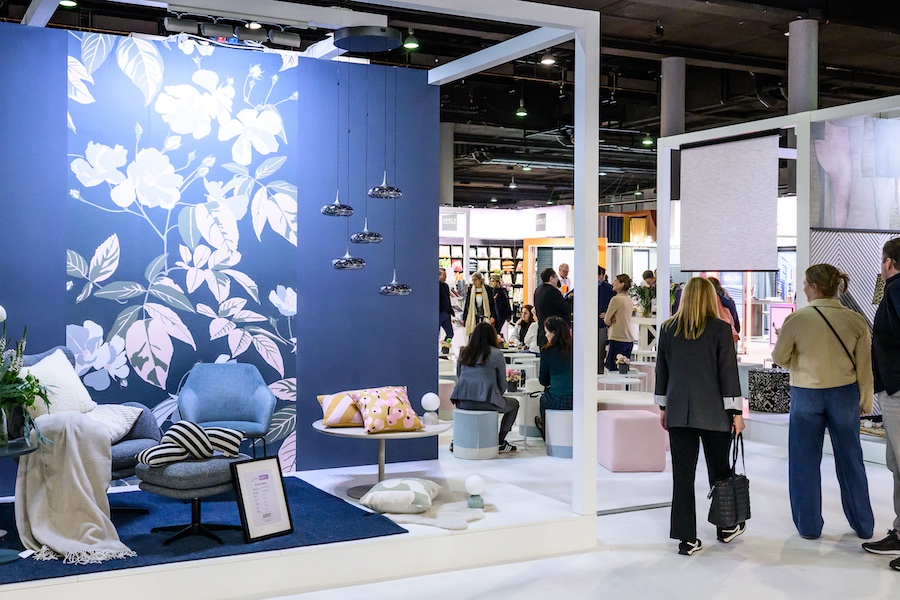
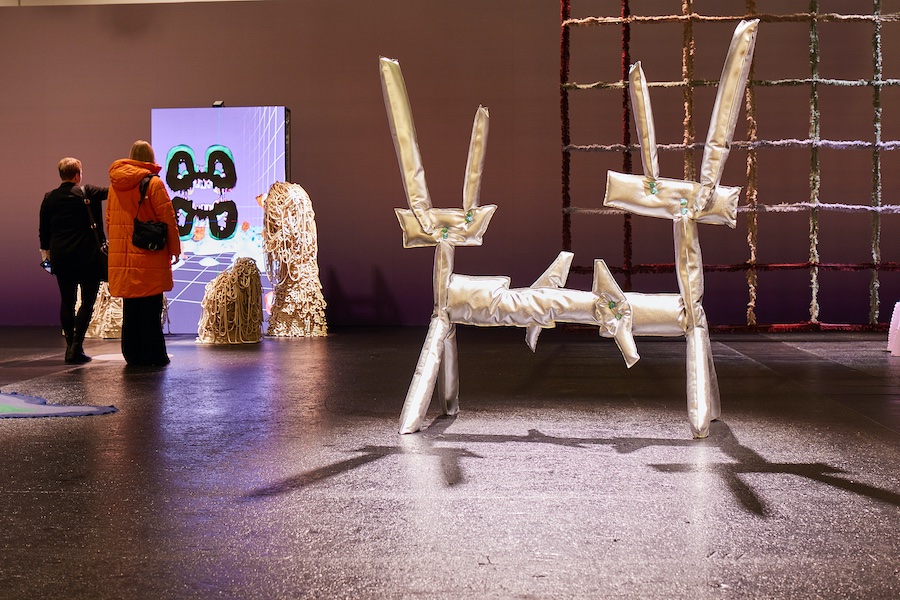
The question of trends for 2020 is not at all easy to answer. The age of fixed stylistic currents, determined in advance, is over. Mass taste no longer exists. It is all about diversity. This was given impressive and abundant expression in the lavishly staged Trend Space in Hall 3.0, with no fewer than 1,000 exhibits: the giant dome for the ‘Luxury Heritage’ theme, the half-pipe for ‘Active Urban’, the gigantic pouffe in a mix of materials representing ‘Multi Local’, the enfolding shelter of the tent for ‘Pure Spiritual’, the dynamic scenario for ‘Maximum Glam’ and the giant blow-up figure as a popular feature for all concerned. The display for the topic ‘Where I belong’ made visibly clear that identity is formed as a result of many experiences. And this impacts on the way one furnishes one’s living space and the kind of things one enjoys. It is all about inclusion, getting together, chatting. The single main aim: a sense of well-being. And it is about using textiles in interior designs to create a cosy, pleasant atmosphere. And that may well look different for each of us.
Environmental awareness and natural sleeping comfort
Hall 11.0 was all about ‘Smart Bedding’. And here, too, there was, amongst other things, a concern for a sense of well-being – specifically in relation to a comfortable sleeping environment. The aim is to be able to meet the wishes and requirements of the consumer in specific detail. By this, experts mean innovative textiles that are tailored to the needs of children’s skin, to especially sensitive skin and to that of people with care needs (Benevit van Clewe GmbH & Co. KG). Another example is the breathable Tencel-Lyocell fibre using Refibra technology and made from wood and recycled cotton (Lenzing AG). Everywhere in the bedding sector, natural materials such as cashmere, wool, linen, Tencel, bamboo and silk are becoming increasingly attractive, because of their specific qualities and their sustainability credentials, above all, when they are packaged in bags made from recycled filling materials as well (Toom Tekstiil AS). And the ‘smart pillow’ is also seen as a way of promoting a good night’s sleep; it has a sensor inside, which records movement, and can wake the sleeper via a smart, app-controlled alarm (ADVANSA Marketing GmbH). A ‘Blue Angel’ German eco label was awarded to the ‘E14 Greta-Decke’ duvet, where the entire manufacturing process respects both the environmental and social aspects of sustainability (billerbeck Betten-Union GmbH & Co. KG).
When it comes to sleep, it is not only sustainability issues and personal feelings of well-being that play a major role; there are even therapeutic effects that are important too. This is demonstrated by the success of the CURA OF SWEDEN brand, by the Swedish company, Fargust AB, who presented their therapeutic duvet at Heimtextil: “We’ve had a very, very good show,” said owner Johan Andersson with some pleasure. “It even outstripped our expectations for the show. We had visitors on our stand who came from all over the place – both interested in our brand and, also, interested in co-branding. After Heimtextil, we are looking to extend our sales channels across the EU and to other continents. We were able to create the basis for this at Heimtextil.”
Sleep! The Future Forum
In the Foyer to Hall 11.0, an in-depth programme of lectures was held for the second time. In ‘Sleep! The Future Forum’, specialist bedding retailers and those with an interest in the hospitality business were able to get information from industry and the world of science and research about the latest findings and current market trends. Numerous established experts on sleep contributed to the thematic lectures relating to the digital world, sport, hospitality, sustainability and interior design. They included academics like neuroscientist Dr. Christian Benedict from Sweden and Professor Ingo Fietze, an expert on sleep from the Charité University Hospital in Berlin, as well as professional sports personalities and sleep coach Nick Littlehales.
The experts also discussed the challenges that face manufacturers, if they wish both to act and to produce goods sustainably. The panel discussion entitled ‘Securing the future of the next generations – sustainable strategies for manufacturers and retailers’ was one of the highlights of the programme. It referred to examples of good practice at Lenzing AG, Vossen GmbH & Co. KG and IKEA and presented, to an interested specialist audience, a new state-based textile quality mark – the ‘Grüner Knopf’ (‘Green Button’), as well as the United Nations’ global sustainability objectives.
Individuality through flexibility
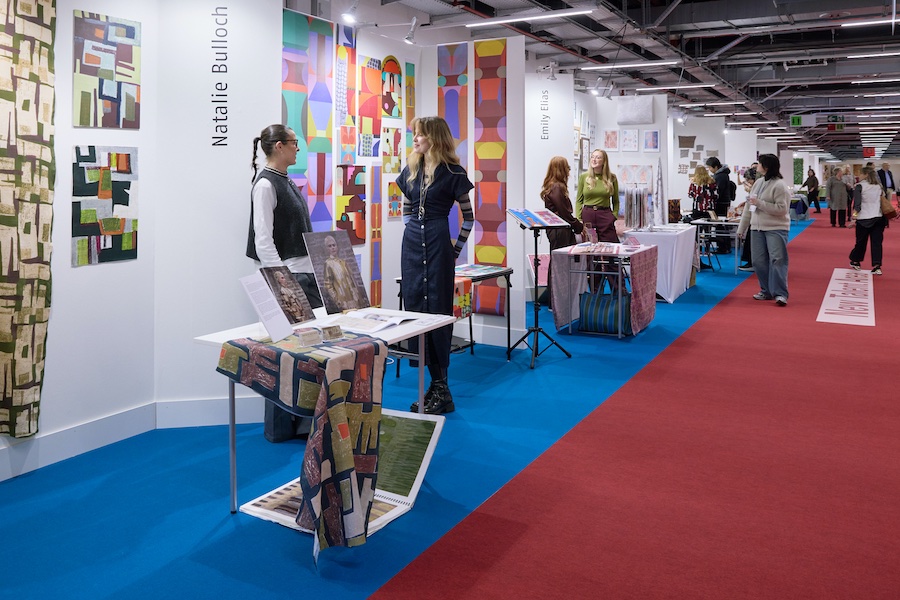
The range of products for the bedroom, bathroom and dining table has never been as varied as it is today. The diversity was to be seen on both a smaller and larger scale: as part of dining table decoration with variously patterned runners brought together on one long dining table (Sander); as a campaign theme (zoeppritz since 1828), as a mix of brands, designed to appeal to widely diverse tastes (BEDDING HOUSE B.V.). “Culture, country, state of mind are what determine colour development. The market craves serenity, pastel shades and whites. But, in our view, both are acceptable: active colours such as red and orange in the living room. Restful colours in the bedroom,” thinks Silvia Cunhar from Ricardo Milton.
Maximalism gains in popularity
From a recent upsurge of grandeur, luxury and glamour there emerge a number of expressive images that have spread across bedroom and bathroom textiles alike. The bold designs are colourful and jump out at the beholder. The new images are used in a deliberately challenging manner. Jungle motifs are eye-catchers in every respect (M.G. Ekkelboom B.V.), so too are abstracted, large-format leaf patterns (BEDDING HOUSE B.V.), extensive landscapes (ESSENZA HOME) and colonial themes with exotic animals, peonies and parrots (Alfred Apelt GmbH).
Taken from the world of fashion – decorative and artistic
The recourse to glamorous ages past also brings to interiors patterns for curtains and furniture that range from the bold to the playful and are taken from the world of fashion. Hand-painted designs (Estamparia Textil Adalberto Pinto da Silva) attract the eye. Part of this, too, is the popularity of Frida Kahlo, who acts as an ambassador for creativity, a mix of cultures and the love of nature (Makroteks Tekstil San. ve. Tic. Ltd. Sti). “Frida Kahlo, tattoos and skulls. The young target group reacts well to our colourful designs,” rejoiced Ahmet Metinöz from Makroteks Tekstil San. ve. Tic. Ltd. Sti. Cushions with abstract faces in the style of Picasso (Alfred Apelt, GmbH) are also part of this current and convey a touch of artistic sophistication, as do printed patterns for table and bed linen inspired by old Dutch masters (ESSENZA HOME).
Heimtextil – a journey through time
The 50th edition of Heimtextil revealed an all-round richly diverse and future-oriented image of the sector. It also looked back with pride and gratitude over five decades in the home and contract textiles sector. A celebration show case in Hall 9.0 displayed design classics from 1971 to the present. And during the huge party to celebrate the jubilee, the exhibitors who had been there since the very beginning were duly honoured. “That was, indeed, a very successful party for the 50th Heimtextil! Fêted as one of the original exhibitors, included in the Green Directory listing, visited as part of the Green Tour – this trade fair was the perfect place for us to introduce our sustainably produced day blankets and throws and our new ‘Green Line’,” observed Holger Steuter, Head of Marketing at HERMANN BIEDERLACK GmbH + Co. KG, with some pleasure.
The next Heimtextil will take place from 12 to 15 January 2021.