[pageLogInLogOut]

#Dyeing, Drying, Finishing

Alchemie Technology unveils its first in-market digital textile dyeing production and demonstration hub in Taiwan

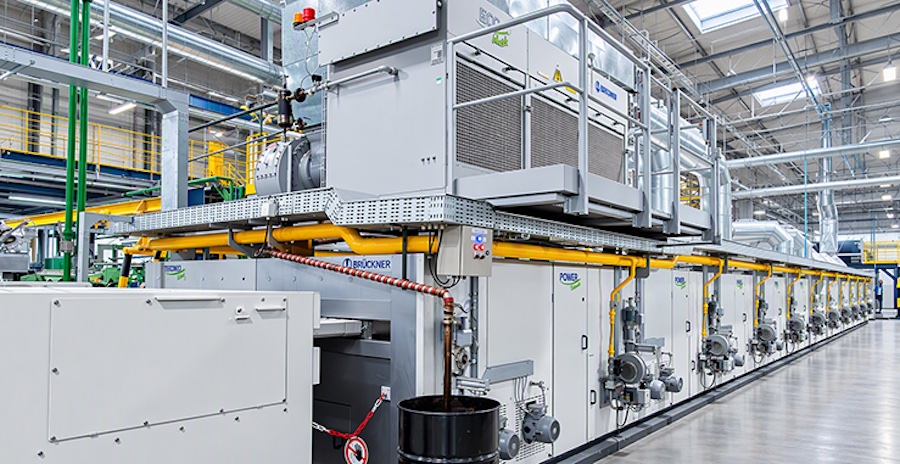
Alchemie Technology, a Cambridge-based clean digital textile dyeing technology pioneer, has today announced the opening of its first in-market production and demonstration facility in Nantou, Taiwan, dedicated to woven polyester. With the introduction of Alchemie’s Endeavour low carbon digital textile dyeing production in Nantou, Alchemie sets a new standard for textile dyeing, challenging conventional practices.

Alchemie Endeavour™ - Low Carbon Digital Textile Dyeing Production 4 website

Alchemie’s low carbon Endeavour dyeing process delivers significant sustainability benefits when compared with traditional dyeing processes. It facilitates the transition from wet dyeing to dry processing, resulting in a substantial reduction of up to 85% in carbon emissions and a decrease in waste water of up to 95%. The unveiling of the demonstration and production hub in Taiwan comes after a decade of technology development and is a major step forward in Alchemie’s mission to eradicate pollution from textile dyeing and finishing processes.

The textile industry carries a considerable environmental burden: without intervention, projections indicate that emissions could soar to 2.5 gigatons by 2050 under current practices, posing a grave threat to climate stability. To mitigate this risk and keep global warming below the critical threshold of 1.5°C, achieving net-zero emissions around 2050 is imperative. Additionally, as the world's second-largest producer of industrial waste water discharge, the textile sector directly impacts millions of individuals worldwide. This underscores the urgent need for sustainable practices and regulatory measures within the industry.
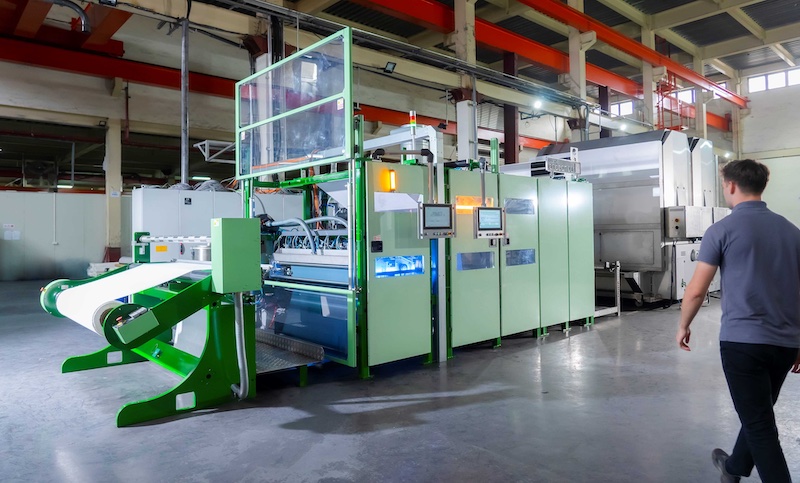
Alchemie Endeavour™ - Low Carbon Digital Textile Dyeing Production  © 2024 Alchemie
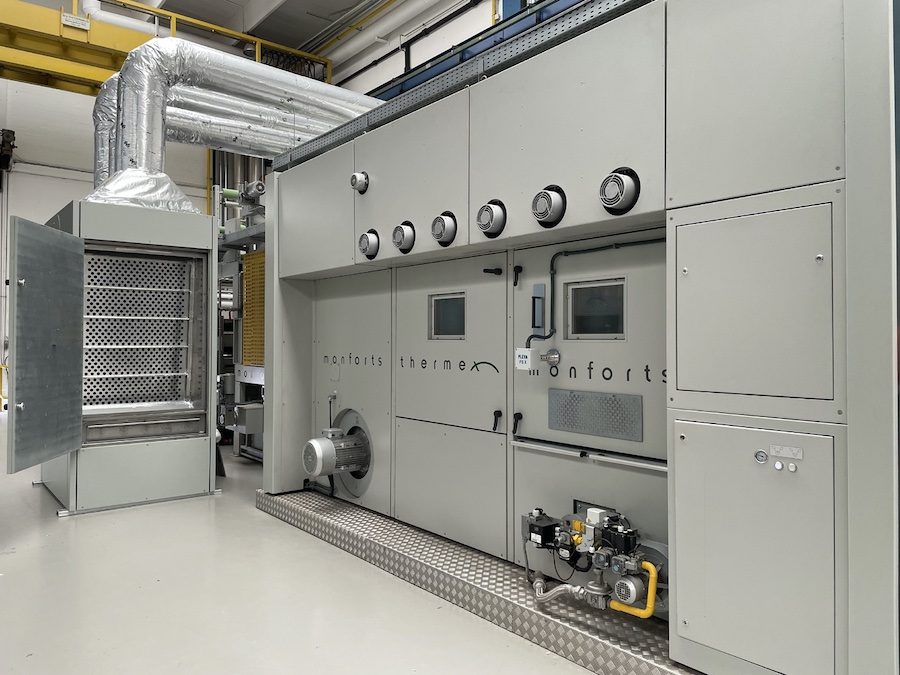
Alchemie Endeavour™ - Low Carbon Digital Textile Dyeing Production © 2024 Alchemie


Alchemie’s brand-new Taiwan facility focuses on polyester woven fabrics and serves as a pivotal step in Alchemie’s ambitious 2024 roadmap, which includes the development of in-market production solutions for cotton woven and knits, as well as polyester with elastane. Alchemie’s Endeavour low carbon digital dyeing production is a true end-to-end process solution: from virgin fabric intake to fully fixed and softened fabric colouration output, the Endeavour process ensures seamless digital dyeing, delivering high-quality results at every stage of production.

A traditional jet exhaust dyeing process uses large volumes of hot water, at temperatures of up to 135 degrees, for both dyeing and washing, requiring large amounts of energy generated by burning fossil fuels to create steam. At the core of Alchemie’s dry dyeing technology lies its patented digitally controlled piezoelectric nozzle, providing unparalleled precision: it achieves 100-micro registration of 1.2 billion drops per linear meter of dyed fabric, ensuring the highest level of accuracy.

"In light of the global fashion industry's staggering contribution of 2.1 billion metric tons of carbon emissions, equating to over 3% of global emissions, there is an urgent need for action. As the world increasingly prioritises environmental conservation, energy efficiency and carbon reduction, there's a growing demand for low carbon dyeing technology.With the opening of our new production and demonstration hub in Taiwan, we are poised to forge partnerships with leading brands and textile players to unlock greater business opportunities and sustainability. These partnerships are not only about enhancing return on investment but also about driving tangible environmental benefits”.

Dr Alan Hudd, Founder and CEO of Alchemie Technology



More News from TEXDATA International

#ITM 2026

ITM 2026: The new geography of textile production

New production hubs are emerging across North Africa and Central Asia, while Türkiye is accelerating its transformation toward higher-value, technology-driven and more sustainable textile manufacturing.

#Research & Development

“Production is a product”

From technical textiles and AI-driven robotics to the limitations of textile circularity: Professor Dr Thomas Gries looks back on more than two decades of development at ITA Aachen. In the interview, he explains why production technology remains a decisive success factor, discusses international collaborations and innovation ecosystems, and shares his views on the transformation of production landscapes and the challenges facing an increasingly regulated industry.

#Knitting & Hosiery

“We need to move away from the price trap and return to a value-driven mindset.”

With its new Textile Innovation Center, KARL MAYER is sending a strong signal for innovation, collaboration, and the future of textile applications. In this interview, Karl Josef Mayer discusses new opportunities in warp knitting, the processing of staple fibres, recycling, the changing role of machinery manufacturers, and why the textile industry must once again focus more strongly on the value of textiles. by Oliver Schmidt

#Associations

“Innovation, resilience and international experience remain the great strengths of the Swiss textile machinery industry”

Geopolitical uncertainty, growing competitive pressure from China, new free trade agreements and the shift towards a circular economy are currently reshaping the global textile industry. In this interview, Cornelia Buchwalder discusses the current mood within the Swiss textile machinery sector, the industry’s distinctive innovative strength, new market opportunities in India and Asia, and the technological trends that could shape the upcoming trade fair cycle leading up to ITMA 2027.

More News on Dyeing, Drying, Finishing

Latest News

#Recycling / Circular Economy

Reju opens its first R&D Center in the U.S. in Conshohocken, Pennsylvania

Reju, the company specializing in textile regeneration, today announced the opening of a Research and Development (R&D) Center in Conshohocken, Pennsylvania, the company's first proprietary research center in North America. Located within Technip Energies' existing Advanced Materials and Catalysts research center, the lab will allow Reju to accelerate the rollout of its recycling technologies and develop its next-generation circular solutions.

#Weaving

Itema reaffirms its commitment to the Syrian textile industry at NasTex 2026

From July 18th to 21st, Itema will exhibit at NasTex at the Damascus Fairground (Hall 11 – Stand C02), marking its return to one of the Middle East’s historically significant textile markets. Itema will showcase advanced weaving technology designed to support the competitiveness and technological evolution of Syrian manufacturers and announces a new partnership with Growfast Agency as the sole agent of Itema in Syria.

#Knitting & Hosiery

KARL MAYER's HKS 2-SE Expands Possibilities for Premium Stretch WARP KNITS

Warp knitted fabrics with a woven look are more in demand than ever in the fashion and apparel industries. Stretch WARP KNITS, in particular, impress with their freedom of movement, breathability, and virtually wrinkle-free wear – thereby opening up new style worlds such as smart casual or business casual. When it comes to the highly efficient production of premium-quality stretch WARP KNITS, the HKS 2-SE has long been the machine of choice. KARL MAYER’s best-selling tricot machine produces standard elastic fabrics characterized by high gauges, smooth, delicate surfaces, and a soft hand feel.

#Textiles & Apparel / Garment

Catalyst Club launches in Florence: Where conversations become catalysts for change

The first chapter of Catalyst Club debuted in Florence, bringing together creative directors, entrepreneurs, manufacturers, journalists and innovators from across the fashion and textile industry for an evening of dialogue, exchange and connection.

TOP