[pageLogInLogOut]

#Dyeing, Drying, Finishing

World’s first C2C Platinum for Rajby Textiles
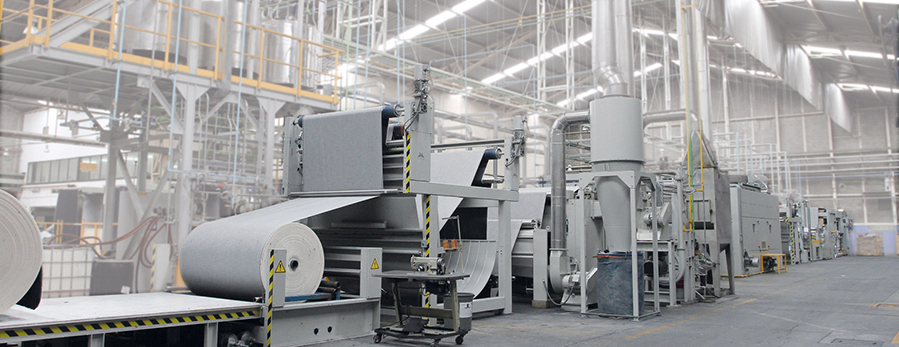
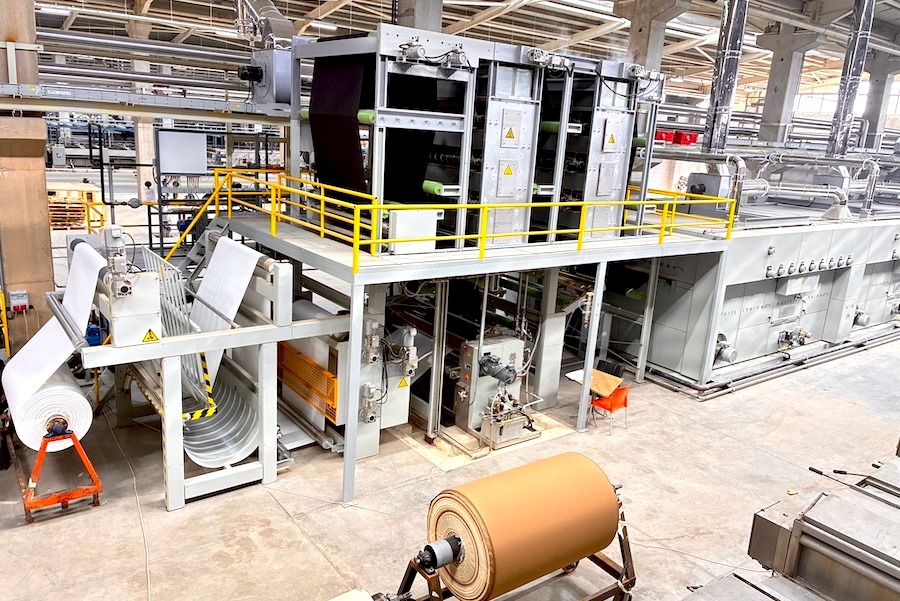
A complete Monforts ‘Denimized’ finishing range (c) 2020 Rajby
Monforts customer Rajby Textiles is the first company in the world to have finally achieved the Cradle to Cradle (C2C) Platinum Standard for a product.

Its Beluga denim fabrics have gained the ultimate sustainability score in all five categories covered by the C2C standard, which is acknowledged as involving the toughest and most thorough testing and assessment it is possible to put a product through.

As such, Beluga denim fabric is based on 100% GOTS certified organic cotton and employs no hazardous chemicals in its production. At the same time, it is both recyclable and biodegradable, with 100% of the energy used in its production offset by green energy and involving a closed loop system with no waste water generated and no material wastage.

Until now, no company has been able to achieve a Platinum rating for ANY product across all ten separate product areas in the C2C programme, which was first introduced in 2005.

Circular economy

The C2C Certified Product Standard guides designers and manufacturers through a continual improvement process, aiming to achieve a circular economy approach. The five quality categories on which products are graded are Material Health, Material Reutilisation, Renewable Energy and Carbon Management, Water Stewardship and Social Fairness.

A product receives an achievement level in each of these categories – Basic, Bronze, Silver, Gold or Platinum – with the lowest achievement level representing the product’s overall mark.

The criteria at each level builds towards the expectation of eliminating all toxic and unidentified chemicals, and the products breaking back down to nutrients after use, top establish a safe, continuous cycle.

Golds

So far, the C2C Certified Product Registry lists 612 separate products, with 113 being Gold standard.

Rajby has already achieved Gold for its Greenmystery and Blue Magic denim fabrics and three other Monforts denim companies based in Pakistan have also achieved Gold to date – Artistic Fabric and Garment Industries for Earthmatics denims, Artistic Milliners for Dylan denim fabrics and Soorty, for both its Pure D and Smart Loop ranges.

The new Beluga denim fabrics, however, represent a new zenith in circular denim production.

Garments made from the new Beluga fabrics. Images courtesy of Rajby Textiles (c) 2020 Rajby


To meet the active cycling requirement, Rajby has committed to using Beluga denim fabric exclusively in apparel products sold by retailers with take back programmes in place and estimated expected cycling rates for such products. Rajby collaborated with C&A, which led the research and quantification for this initial certification through its We Take it Back programme and will track active cycling rates through it.

The fabrics range from 4oz to 13oz in weights in a range of different woven constructions.
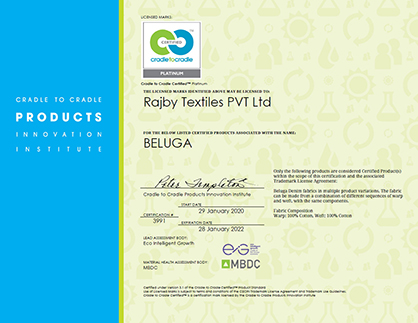
The first Platinum Cradle to Cradle Certificate awarded to Rajby Textiles (c) 2020 Rajby


Advanced technology

With a 10,000-strong workforce, Karachi-headquartered Rajby Textiles has a monthly production of 3.2 million metres of denim and 1.3 million finished garments and sustainability is at the top of its agenda.

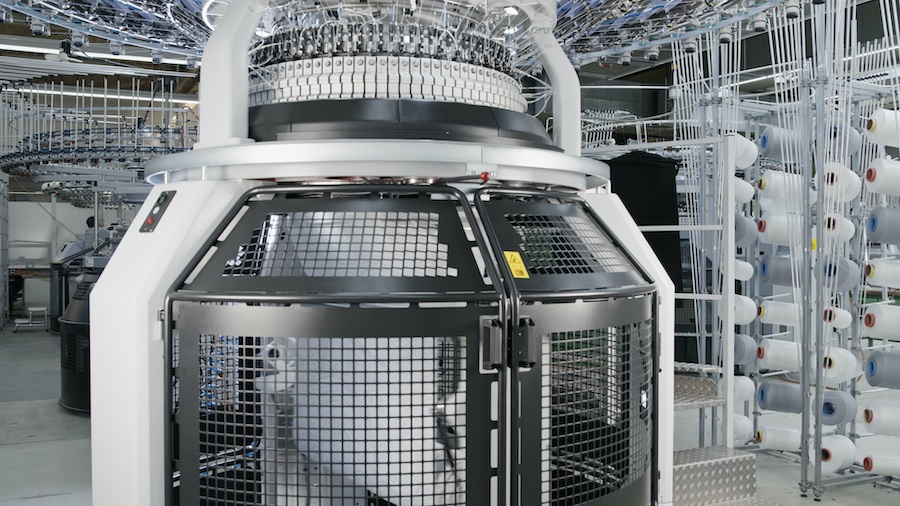
Its advanced technology includes a Monforts denim finishing range comprising washing compartments, padder, a weft straightener, cylinder dryers, a levelling field, a compressive shrinking unit, felt calender, inspection table and an outlet combination. With a working width of two metres, the complete installation has a length of 42 metres.

“When we started working for C2C Gold certification it wasn’t easy, because the requirements are very tough,” says Safdar Shah, who led the C2C project team at Rajby. “We worked very hard to create a completely green supply chain and we also modified our machines and processes to meet the standard, going beyond what was required and creating a 100% closed loop process, including Zero Waste Water Discharge Dyeing (ZDD) and Zero Waste Water Discharge Finishing (ZDF).

“As a result, we have reduced the load of our biological ETP water effluent plant by approximately 99%, since we are not discharging a single drop of water in the entire process. The fabrics are named after the Beluga whale and dedicated to preserving ocean life.”

Igatex 2020

Experts from Monforts will be on hand to discuss the latest technologies for sustainable denim finishing at the forthcoming IGATEX International Exhibition for Garments, Textiles and Accessories which takes place in Lahore, Pakistan, from July 1-4 2020. It has been postponed from March due to the Corona Virus Covid-19.

In the latest short film released on the Monforts YouTube Channel – captured at the recent Denim Première Vision show in London – some of the leading global manufacturers discuss their initiatives for more sustainable denim production.

The Monforts Denim PV film can be viewed here, or by visiting the Monforts website at.

http://www.monforts.de/en/latest-news-media/

More News from A. Monforts Textilmaschinen GmbH & Co. KG

More News on Dyeing, Drying, Finishing

#ITM 2026

The address for environmentally friendly dyeing and finishing systems: ITM 2026

Dyeing and finishing technologies, one of the most critical and value-added areas of the textile sector, have gained strong growth momentum on a global scale. Technologies that are pioneers of this transformation focused on sustainability, quality and efficiency will meet with sector professionals at the ITM 2026 International Textile Machinery Exhibition. Dyeing and Finishing Hall (11–12) will host the latest technologies that increase efficiency, optimize resource use and reduce environmental impact in textile finishing processes.

#Techtextil 2026

iNTERSPARE presents latest developments and upgrade solutions for technical textile finishing at Techtextil

iNTERSPARE Textilmaschinen GmbH will present its latest solutions for technical textile finishing at Techtextil 2026 in Frankfurt (VDMA joint stand, Hall 12 / Stand C55A). The focus will be on further developments within the Krantz, Artos and Babcock (BTM) product lines, in particular the Krantz K30 stenter as well as the reintroduction of the Artos Vari-Flex foulard. The presentation will be complemented by modular solutions for upgrading existing installations and new approaches in automation and digitalization.

#Techtextil 2026

Sedo Treepoint will exhibit smart technologies for technical textile production

As technical textile production becomes increasingly complex and sustainability requirements intensify, digital integration is evolving from an efficiency tool into a strategic task. At Techtextil 2026 (April 21–24, Frankfurt am Main), Sedo Treepoint will present smart digital systems designed to address the demanding production environments of technical textile manufacturing. The company’s focus will be on practical technologies that enhance process transparency, reproducibility, and efficient resource use. Visitors will meet Sedo Treepoint in Hall 12, Booth D05.

Latest News

#Texprocess 2026

Kornit Digital expands digital production into footwear and technical textiles with Presto MAX PLUS

Kornit Digital (NASDAQ: KRNT) (“Kornit” or the “Company”), a global pioneer in sustainable, on-demand digital fashion and textile production, today unveiled the Kornit Presto MAX PLUS, a new roll-to-roll system expanding digital manufacturing into footwear, automotive interiors, military camouflage, high-performance sportswear, and high-end furnishings. Debuting at Texprocess 2026 in Frankfurt, Presto MAX PLUS enables entirely new applications for on-demand textile production.

#Textile processing

NATULON® zipper series surpasses 50% of YKK’s global zipper sales

YKK Corporation (Headquarters: Chiyoda-ku, Tokyo; President: Koichi Matsushima; hereafter, YKK) announces that the global sales share of its NATULON® zipper series—zippers that incorporate recycled materials—has exceeded 50%.

#Smart Textiles

Covestro, FILK Freiberg, and OUT e.V. develop flexible, conductive polymer smart textile system

As the smart textiles market continues to grow across healthcare, personal protection, sportswear, and automotive applications, developers are seeking new ways to integrate electronic functionality directly into textiles, without the rigidity and complexity of conventional wiring. To address this challenge, FILK Freiberg Institute, an independent research institution with expertise in polymer coatings for textile applications, collaborated with Optotransmitter-Umweltschutz-Technologie (OUT) e.V. The joint project, funded under the German Industrielle Gemeinschaftsforschung (IGF) program of the Bundesministerium für Wirtschaft und Energie (BMWE), focused on developing flexible, conductive polymer surfaces for next-generation smart textiles.

#HIGHTEX 2026

Global growth in the technical textile sector drives interest in HIGHTEX 2026 to its peak

The continued steady growth of the technical textiles and nonwoven sector worldwide is increasing interest every year in the HIGHTEX Exhibition, one of the sector’s most important meeting points. In this strong growth climate, HIGHTEX 2026 International Technical Textiles and Nonwoven Exhibition, which will bring together the sector’s leading manufacturers, technology providers, and international buyers, is preparing to open its doors at Tüyap Fair and Congress Center on June 9–13, 2026.

TOP