[pageLogInLogOut]

#Digital Printing

The second collaboration between the inkjet textile printer “FOREARTH” and the fashion brand “ANREALAGE” was presented at Paris Fashion Week® Spring/Summer 2025

Kyocera Document Solutions Inc. (President: Hironori Ando) is pleased to announce a collaborative work designed and produced by Kunihiko Morinaga, the founder and designer of the Japanese fashion brand “ANREALAGE,” using fabrics printed on our inkjet textile printer “FOREARTH”. The collaborative work was presented at the women's collection of Paris Fashion Week for Spring/Summer 2025. This is the second collaboration following the previous Paris Fashion Week® for Fall/Winter 2024-2025.

The collaborative work was unveiled on Tuesday, September 24 at 17:00 local Paris time. In this collaboration which was based on the concept of “WIND,” FOREARTH printed on very light weight fabrics such as high-density polyester taffeta, which expects to keep soft hand feel and light weight with sustainability. FOREARTH contributes not only flexible printing but also dramatically reduces environmental impact.

ANREALAGE is a fashion brand that has participated in Paris Fashion Week more than 20 times in 10 years. This collaboration is implemented by Mr. Morinaga, who shares affinity with the concepts of the environmentally friendly inkjet textile printer “FOREARTH,” which uses 99.98% less water.
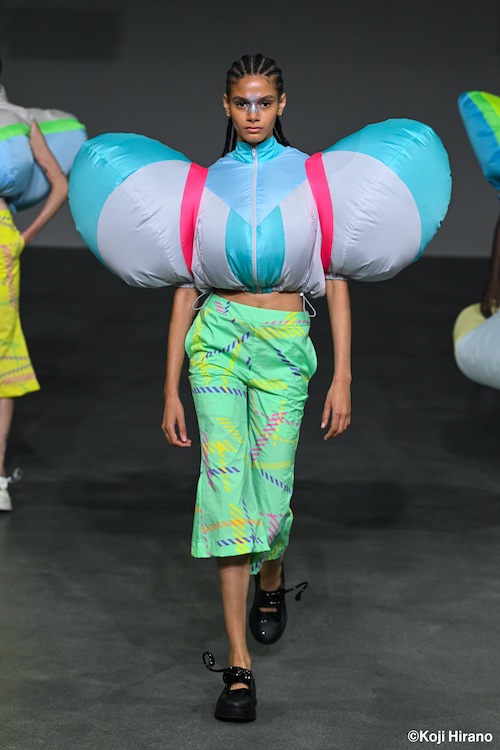
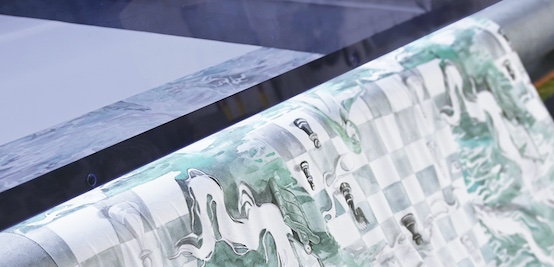
ANREALAGE 0007 0710 at Paris Fashion Week © 2024 Anrealage


Comment from Mr. Kunihiko Morinaga:

"The concept of this collection is "WIND". We visualized the invisible force of the wind. The clothes are transformed from ordinary form into an extraordinary form by wind inside. When the wind stops, the form of the clothes changes again to draped daily wear due to gravity. I also thought that the wind could be visualized through graphic design, which is essential for fashion. Normally, graphic prints are arranged regularly without the concept of gravity, but I thought that if the wind were to blow there, the graphic pattern itself would be released from the gravity on the earth and would float freely in the sky. I created graphic designs that allow petals to dance in floral patterns, and even polka dots, checkered patterns, houndstooth patterns, and tartan checks to dance freely in spaces. The wind, which is the theme of the collection, is expressed in the form of the clothes and the visuals by sending the wind into the textile space surrounded by the graphic. 

The reason we adopted "FOREARTH’s" printing technology is because wind and water are closely related. Originally, when the wind blows, waves are generated on the surface of the sea, and those waves become ocean currents, which evaporate to form clouds. By creating clouds, rain falls on the ground and creates a water cycle on the earth. We believe that wind and water are inseparable for the environment. I felt affinity with the characteristics of "FOREARTH," which uses as little water as possible, and adopted it as a printing technology.

What was also noteworthy about the clothes this time was the part where the textile expands lightly as if it were flying in the air when wind is fed into the clothes. For this reason, we used thin and light textiles that weigh only 23 grams per square meter, but we needed a technology that would not affect the weight and lightness of the textiles by placing prints on them. Ordinary pigment inkjet prints tend to be heavy and hard, but with "FOREARTH" we have been able to reproduce the light, flexible, and supple texture without losing its originality."
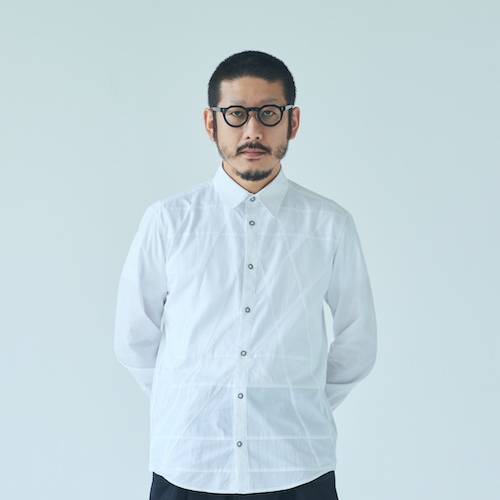
Mr. Kunihiko Morinaga © 2024 Mr. Kunihiko Morinaga


Features of the inkjet textile printer "FOREARTH"

  • Water Free Concept

Dramatically reduces water usage in textile printing.* 

  • Creative Free

Proprietary water-based pigment ink realizes both soft hand-feel prints and high fastness in a wide range of fabrics. 

  • Location Free

Textile printing does not rely on water resources, so it supports optimized production volumes and optimized manufacturing location setting and contributes to the reduction of logistic costs, time, and excess inventories.

As "FOREARTH" dramatically reduces water usage in textile printing next to zero, it does not require separate facilities such as for steaming and washing needed in pre- and post-treatment processes of conventional textile printing. This will also contribute to a significant reduction in energy consumption and CO2 emissions.

Furthermore, it achieves a soft texture maintaining softness of the fabric that are important in the textile and apparel industries, and enables high-definition printing on a wide range of fabrics such as cotton, silk, polyester, nylon, and blended fabrics.
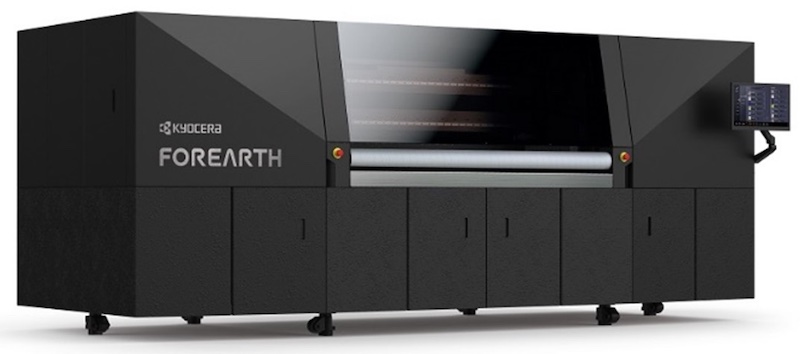
Inkjet textile printer
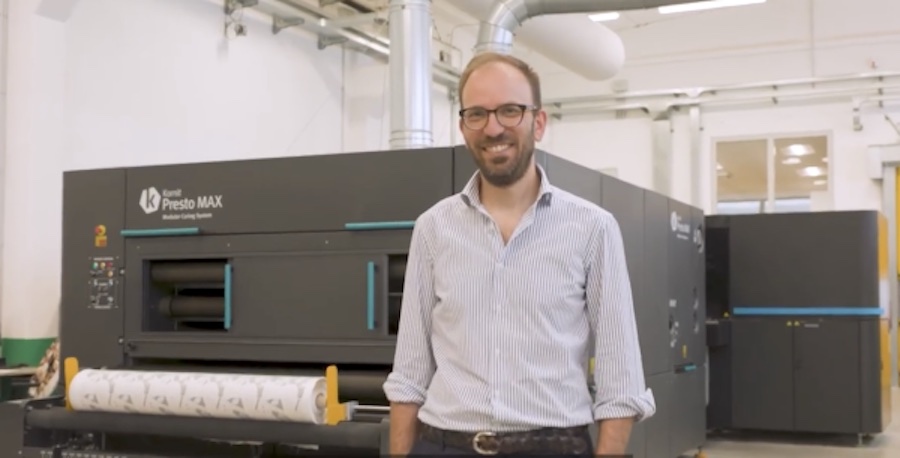
Inkjet textile printer "FOREARTH" © 2024 Kyocera


*FOREARTH has a two-step printing and drying process. No water is used in the printing process based on the concept of "WATER FREE". Kyocera focuses on reducing water usage not only for the printing process but also for the maintenance process. FOREARTH also recycles cleaning water used for the conveyor belt with filters resulting in water consumption per 1kg of fabric reduced to 0.02L (Based on Kyocera research, in 2022).
More News from Kyocera

More News on Digital Printing

#Digital Printing

Epson launches SureColor G9000: high-production Direct-To-Film printer delivering greater productivity and reliability

Epson today announces the launch of the SureColor G9000, a new high-production Direct-To-Film (DTFilm) printer designed to meet growing global demand for flexible and efficient textile transfer printing. Expanding Epson’s DTFilm line-up alongside the SC-G6000, the SC-G9000 introduces enhanced speed, reliability and ease of maintenance for commercial garment decorators and textile producers.

#Digital Printing

Maximising print efficiency exploring ink saving features for modern print production

In today’s print industry, balancing quality, efficiency, and environmental responsibility is a growing priority. With increasing pressure on margins and sustainability, solutions that streamline production without sacrificing results are more relevant than ever.

#Digital Printing

Mimaki upgrades TS330 series for vibrant and seamless dye sublimation printing

The TS330 Series now provides users with an extended colour gamut, offering the flexibility to serve different markets profitably from one solution – from fashion to décor to signage – with improved colour vibrancy, fidelity and accuracy. Mimaki also introduces a larger solution to the TS330 Series, the TS330-1800, able to accommodate single-piece, wide textile fabrics, ideal for larger home décor applications.

#Digital Printing

Call for speakers and partners: Kornit Konnections 2026

Kornit Konnections today announced it is officially accepting speaker proposals and partner interest for what is set to be the most influential digital apparel industry gathering of the decade. Interested parties should visit www.kornitkonnections.com.

Latest News

#Raw Materials

Modern testing methods for raw cotton

The 38th International Cotton Conference Bremen will take place from 25 to 27 March 2026 at the Bremen Parliament. This conference has traditionally stood for in-depth expertise and international exchange. The program will focus on technical innovations, market trends, and regulatory frameworks across the entire value chain – from agriculture to the circular economy. With high-profile speakers, the conference is regarded as the key meeting point for the global cotton industry. Today’s focus: Cotton quality and testing methods.

#

Rieter responds to higher raw material prices

Global political and economic developments have been leading to rising raw material and energy costs for some time. The textile machinery industry is also affected by this trend. Rieter machines and components consist to a large extent of steel, copper, aluminum and electronics. These materials in particular have seen higher demand and higher prices in recent months.

#Weaving

Stäubli demonstrates how innovation translates into real benefits for weaving mills at SITEX 2026

One of India’s most prominent textile industry events, SITEX 2026, is held from February 21 to 23 in Surat. Committed to empowering Indian weaving mills with state‑of‑the‑art solutions tailored to regional needs, Stäubli will present a selection of solutions designed for performance, reliability, and power efficiency. Through its weaving preparation, cam and dobby shedding solutions and Jacquard technologies, Stäubli highlights its global expertise tailored to the specific needs of the local market.

#Weaving

Itema exhibits the two best-selling high-end rapier weaving machines of the Region, R9500EVO and Galileo-RX at SITEX 2026

Following the opening of its new Surat Service Center in November, Itema will exhibit at SITEX (Stand 286) from February 21st to 23rd at the Surat International Exhibition and Convention Centre (SIECC). Surat has long been one of Itema’s most strategic markets, a role further reinforced by the inauguration of the Surat Service Center last November. Equipped with an advanced electronic repair center, a weaving machine behavior simulator, and a local spare parts warehouse, the new facility strengthens Itema’s presence in the region while bringing the company even closer to its Customers.

TOP