[pageLogInLogOut]

#Digital Printing

TPS 2022 announces final conference programme

With two months to go, the first edition of Textile Printing & Sustainability (TPS) conference unveils an agenda full of inspiring and engaging content. In total 24 presentations held by experts from industry and academia focus on technology choices, automation practices and environmentally conscious business models. The event takes place on 8-9 September 2022 at Dorint Kongresshotel Düsseldorf-Neuss and welcomes audience from all stages of a textile value chain.

“Textile industry is more than ever under pressure from sustainability requirements”, explains Peter Buttiens from the European Specialist Printing Manufacturers Association, organiser of TPS. “The EU’s Green Deal targets textiles as one of the world’s most polluting sectors. On global scale, we look at UN Sustainable Development Goals and initiatives such as UN Alliance for Sustainable Fashion. Their timeline set for 2030 and 2050 may seem far in future but the time to act and exchange know-how is now. With the new TPS conference we want to contribute to the solution from the printing perspective.”

Textile Printing & Sustainability takes a broad look at all critical factors and global trends which influence textile market condition today and in the nearest future: customer-made fashion, responsible businesses, quality concerns, customisation and personalisation. The event assembles industry experts from core printing and dyeing processes, to promote best practices, discuss new application fields and explain benefits and challenges of individual technology choices.

Each conference day opens with a keynote address. Karin Ekberg, former Chair of the Sustainable Apparel Coalition, presents five principles of sustainability leadership. Bianca Seidel, a pioneer of sustainable fashion design, makes a plea for transformation and for hope in the world of tomorrow. Other keynotes include Debbie McKeegan who looks at opportunities and risks of on-demand business models, and Alexandra De Raeve who explores the digitization of textile design and production.

The world’s leading printing hardware brands, Brother and Epson explain their approaches to environmentally friendly manufacturing, resource management and recent reshoring trends. Representatives of ink and chemistry companies offer a comprehensive overview of the latest material solutions, pigment ink innovations, including a novel white pigment concentrate, and their implications for specific printing techniques. Two companies lay a particular focus on dyeing and the reduction of its environmental impact, also through removing of textile prints and efficient fabric recycling at the end-of-life stage.


Strong academic representation includes contributions by RWTH Aachen, HS Niederrhein, DITF Denkendorf and Saxon Textile Research Institute. They share their latest research results on smart textiles with integrated electronics, functionalisation of textiles with digital printing, sustainability assessment for microfactories, circular economy and eco-labels.

Although an engaging programme fills up two conference days, the event features also several networking moments in the accompanying exhibition part. The current list of companies which showcase their solution at tabletops includes: Brother, BYK, CHT Germany, Covestro, DITF, Druckprozess, Epson, Evonik, Farbenpunkt, Fujifilm Ink Solutions, Global Inkjet Systems, Kronos, Marabu, Meteor Inkjet, Münzing, Nextil, Nur Ink, Seiko Instruments, STFI, Vividye and Trijet.

Last tabletop spaces are available and all interested in booking should contact info@esma.com.

TPS 2022 enjoys media support of “Specialist Printing Worldwide” and “IDtex”.

Delegates may now register via the TPS website and organisers offer a 200-euro discount on the second booking.

Textile Printing & Sustainability (TPS) conference

Date: 8-9 September 2022

Place: Dorint Kongresshotel Düsseldorf-Neuss

Programme and registration: tps-conference.com

More News from TEXDATA International

#ITM 2026

ITM 2026: The new geography of textile production

New production hubs are emerging across North Africa and Central Asia, while Türkiye is accelerating its transformation toward higher-value, technology-driven and more sustainable textile manufacturing.

#Research & Development

“Production is a product”

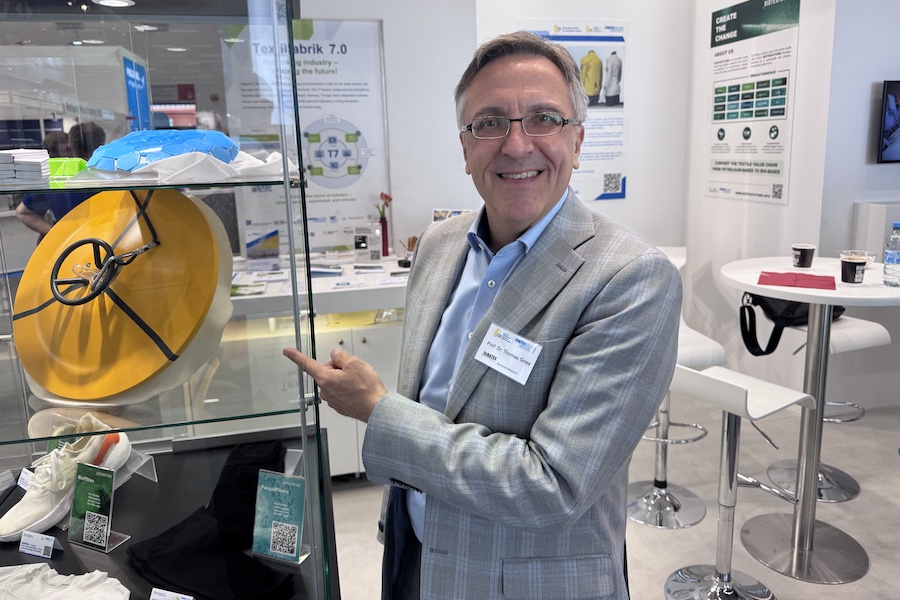
From technical textiles and AI-driven robotics to the limitations of textile circularity: Professor Dr Thomas Gries looks back on more than two decades of development at ITA Aachen. In the interview, he explains why production technology remains a decisive success factor, discusses international collaborations and innovation ecosystems, and shares his views on the transformation of production landscapes and the challenges facing an increasingly regulated industry.

#Knitting & Hosiery

“We need to move away from the price trap and return to a value-driven mindset.”

With its new Textile Innovation Center, KARL MAYER is sending a strong signal for innovation, collaboration, and the future of textile applications. In this interview, Karl Josef Mayer discusses new opportunities in warp knitting, the processing of staple fibres, recycling, the changing role of machinery manufacturers, and why the textile industry must once again focus more strongly on the value of textiles. by Oliver Schmidt

#Associations

“Innovation, resilience and international experience remain the great strengths of the Swiss textile machinery industry”

Geopolitical uncertainty, growing competitive pressure from China, new free trade agreements and the shift towards a circular economy are currently reshaping the global textile industry. In this interview, Cornelia Buchwalder discusses the current mood within the Swiss textile machinery sector, the industry’s distinctive innovative strength, new market opportunities in India and Asia, and the technological trends that could shape the upcoming trade fair cycle leading up to ITMA 2027.

More News on Digital Printing

#Digital Printing

DTF vs DTG Printing - The technologies shaping today’s custom merchandise market

From sportswear to branded tote bags, custom merchandise continues to grow in popularity across sectors, driving print shops to cater to short runs, personalisation, and rapid turnaround. As print providers look to this market, two printing technologies often stand out: Direct‑to‑Film (DTF) and Direct‑to‑Garment (DTG). Each offers its own benefits, and understanding these differences helps determine the most suitable production method for print service providers.

#Digital Printing

Mimaki celebrates Triple EDP Award win at FESPA 2026

Mimaki Europe, a leading manufacturer of industrial inkjet printers and cutting plotters, was presented with 3 EDP Awards at the association’s 2026 ceremony, held at FESPA Global Print Expo. These highly acclaimed awards celebrate best-in-class innovation across the print industry, and Mimaki was honoured in three different categories.

#Digital Printing

EFI brings high-performance display graphics, packaging, and textile printing innovations to FESPA 2026

Electronics For Imaging, Inc. (EFI™) is bringing a broad range of new hybrid, roll-to-roll, and textile inkjet innovations to FESPA Global Print Expo 2026, taking place 19-22 May at Fira Barcelona Gran Via. Visitors to the EFI stand (Hall 3, #C85) will see the new EFI VUTEk M3h X hybrid LED printer, new EFI VUTEk® FabriVU® 340 i8 eight-colour dye sublimation printer, the EFI VUTEk X5r roll-to-roll LED printer, and the EFI VUTEk Q3h XP seven-colour hybrid printer in action, each designed to help sign and display producers scale output, diversify applications, and drive more profitable growth.

#Digital Printing

Mimaki ‘Powers Possibilities’ with a market-diverse application and printer line-up at FESPA 2026

Mimaki Europe, a leading manufacturer of industrial inkjet printers and cutting plotters, is bringing its “Print Different - Powering Possibilities” theme to life at FESPA Global Print Expo 2026 (Fira de Barcelona, 19-22 May 2026), demonstrating how digital printing technology can turn ideas into high-value applications and new business opportunities.

Latest News

#Dyeing, Drying, Finishing

Ferraro S.p.A. acquires the “Finishing” business unit of Cibitex S.r.l.

Ferraro S.p.A. and Cibitex S.r.l. are pleased to announce the completion of the agreement pursuant to which Ferraro S.p.A. has acquired the “Finishing” business unit of Cibitex S.r.l., specialized in the development and manufacturing of technological solutions for textile finishing.

#Recycling / Circular Economy

Reju opens its first R&D Center in the U.S. in Conshohocken, Pennsylvania

Reju, the company specializing in textile regeneration, today announced the opening of a Research and Development (R&D) Center in Conshohocken, Pennsylvania, the company's first proprietary research center in North America. Located within Technip Energies' existing Advanced Materials and Catalysts research center, the lab will allow Reju to accelerate the rollout of its recycling technologies and develop its next-generation circular solutions.

#Weaving

Itema reaffirms its commitment to the Syrian textile industry at NasTex 2026

From July 18th to 21st, Itema will exhibit at NasTex at the Damascus Fairground (Hall 11 – Stand C02), marking its return to one of the Middle East’s historically significant textile markets. Itema will showcase advanced weaving technology designed to support the competitiveness and technological evolution of Syrian manufacturers and announces a new partnership with Growfast Agency as the sole agent of Itema in Syria.

#Knitting & Hosiery

KARL MAYER's HKS 2-SE Expands Possibilities for Premium Stretch WARP KNITS

Warp knitted fabrics with a woven look are more in demand than ever in the fashion and apparel industries. Stretch WARP KNITS, in particular, impress with their freedom of movement, breathability, and virtually wrinkle-free wear – thereby opening up new style worlds such as smart casual or business casual. When it comes to the highly efficient production of premium-quality stretch WARP KNITS, the HKS 2-SE has long been the machine of choice. KARL MAYER’s best-selling tricot machine produces standard elastic fabrics characterized by high gauges, smooth, delicate surfaces, and a soft hand feel.

TOP