[pageLogInLogOut]

#Digital Printing

Industrial printer shipments show modest decrease in Q1 2022, according to IDC
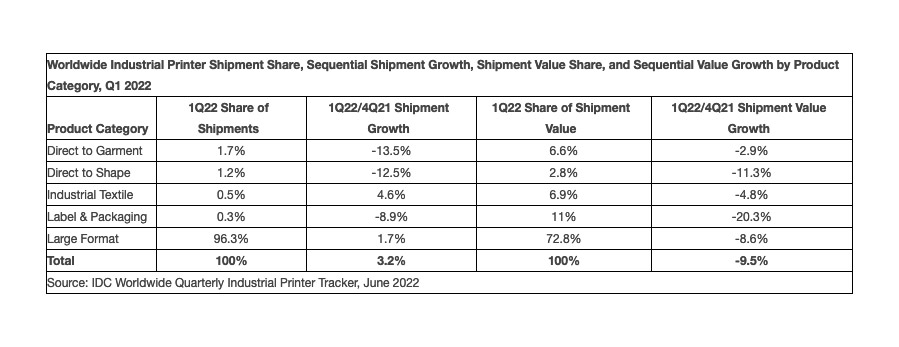
Industrial printer shipments declined 2.1% year over year in the first quarter of 2022 (1Q22), according to new data from the International Data Corporation (IDC) Worldwide Quarterly Industrial Printer Tracker.

"Shipments at the beginning of the year started off relatively soft," said Tim Greene, research director, Hardcopy Solutions at IDC. "The market is wrestling with supply chain challenges, war, and pandemic that all contribute to inconsistencies in efficient supply and demand cycles." 

Worldwide Industrial Segment Highlights for Q1 2022

  • Large format digital printer shipments make up the bulk of industrial printers and declined by less than 2% in 1Q22 compared to Q4 2021.
  • Dedicated direct-to-garment (DTG) printer shipments declined again in 1Q22 despite some strong numbers at the high end of the market. The replacement of dedicated DTG printers with aqueous direct-to-film printers continues.
  • Direct-to-shape printer shipments declined 12.5% quarter over quarter in 1Q22.
  • Digital label & packaging printer shipments declined 8.9% sequentially in 1Q22.
  • Industrial textile printer shipments were a bright spot, growing 4.6% worldwide compared to Q4 2021.

Regional Analysis

  • Shipments were down by almost 25% in the Central European market as a result of the war in Ukraine. Many industrial printer manufacturers have suspended activities in the region.
  • The strongest growth was in the Japanese market, where shipments grew more than 20% year over year.
  • Shipments in North America grew 4.5% for the quarter while shipments in Western Europe grew 3.5%.
  • The Asia/Pacific region declined by more than 5% as the region continues to deal with high levels of the pandemic.


Outlook for 2022

Supply chain challenges, the ongoing pandemic, and the Russia-Ukraine war combined to drive industrial printer activities lower in key areas. The resumption of trade shows, the drive for sustainable textile printing, and the reopening of retail are still driving demand.

IDC's Worldwide Quarterly Industrial Printer Tracker provides total market size and vendor share for five major market categories: large format, label and packaging, direct to garment, industrial textile, and direct to shape. In addition to units, shipment value, and average selling price (ASP), the Tracker also provides market results for each product category by ink type, media size, hardware class, or primary application across nine geographic regions and 90 countries. 


More News from TEXDATA International

#ITM 2026

ITM 2026: The new geography of textile production

New production hubs are emerging across North Africa and Central Asia, while Türkiye is accelerating its transformation toward higher-value, technology-driven and more sustainable textile manufacturing.

#Research & Development

“Production is a product”

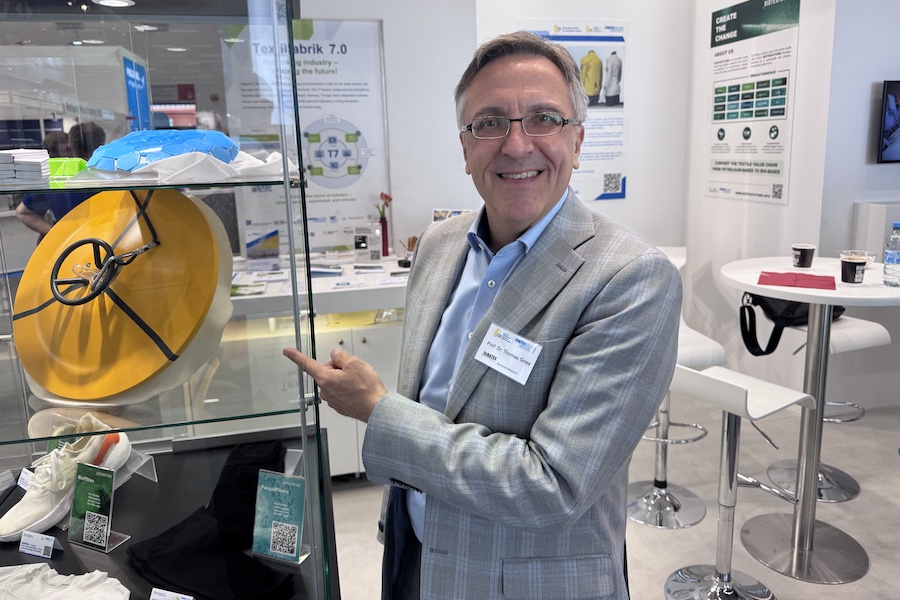
From technical textiles and AI-driven robotics to the limitations of textile circularity: Professor Dr Thomas Gries looks back on more than two decades of development at ITA Aachen. In the interview, he explains why production technology remains a decisive success factor, discusses international collaborations and innovation ecosystems, and shares his views on the transformation of production landscapes and the challenges facing an increasingly regulated industry.

#Knitting & Hosiery

“We need to move away from the price trap and return to a value-driven mindset.”

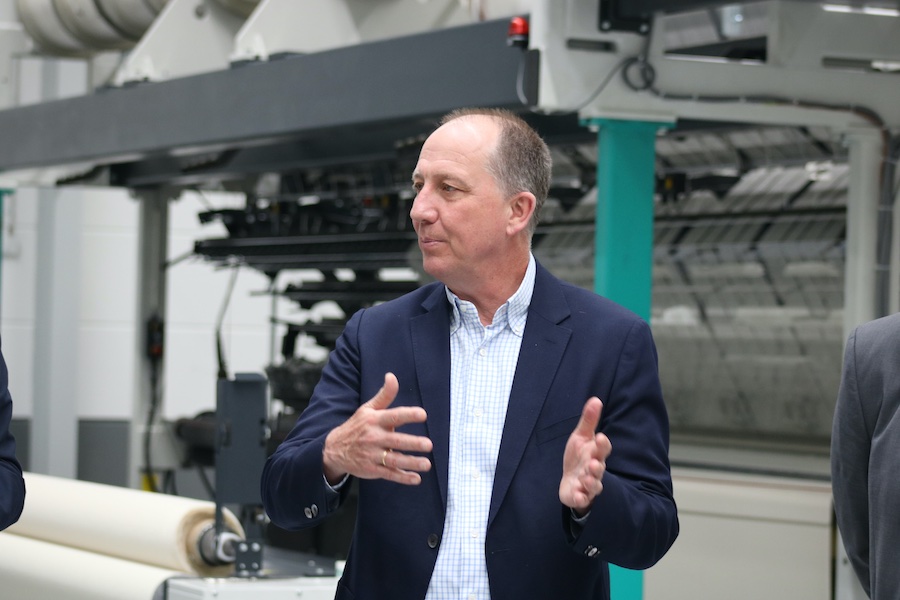
With its new Textile Innovation Center, KARL MAYER is sending a strong signal for innovation, collaboration, and the future of textile applications. In this interview, Karl Josef Mayer discusses new opportunities in warp knitting, the processing of staple fibres, recycling, the changing role of machinery manufacturers, and why the textile industry must once again focus more strongly on the value of textiles. by Oliver Schmidt

#Associations

“Innovation, resilience and international experience remain the great strengths of the Swiss textile machinery industry”

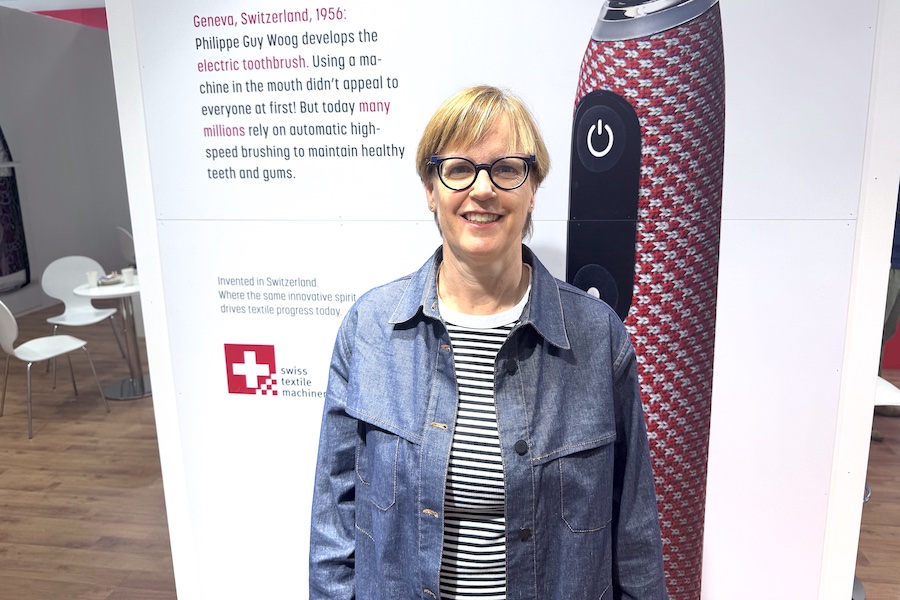
Geopolitical uncertainty, growing competitive pressure from China, new free trade agreements and the shift towards a circular economy are currently reshaping the global textile industry. In this interview, Cornelia Buchwalder discusses the current mood within the Swiss textile machinery sector, the industry’s distinctive innovative strength, new market opportunities in India and Asia, and the technological trends that could shape the upcoming trade fair cycle leading up to ITMA 2027.

More News on Digital Printing

#Digital Printing

USColorworks expands digital platform with Kornit Atlas MATRIX and Atlas MAX PLUS solutions

Kornit Digital Ltd. (NASDAQ: KRNT), a global pioneer in sustainable, on-demand digital fashion and textile production, today announced that USColorworks, a North Carolina-based apparel decoration and fulfillment company specializing in custom and on-demand printing for retail and promotional markets, has expanded its Kornit digital production platform with the addition of Atlas MATRIX and Atlas MAX PLUS systems to deliver high-quality, on-demand apparel across cotton, blended fabrics and polyester.

#Digital Printing

DTF vs DTG Printing - The technologies shaping today’s custom merchandise market

From sportswear to branded tote bags, custom merchandise continues to grow in popularity across sectors, driving print shops to cater to short runs, personalisation, and rapid turnaround. As print providers look to this market, two printing technologies often stand out: Direct‑to‑Film (DTF) and Direct‑to‑Garment (DTG). Each offers its own benefits, and understanding these differences helps determine the most suitable production method for print service providers.

#Digital Printing

Mimaki celebrates Triple EDP Award win at FESPA 2026

Mimaki Europe, a leading manufacturer of industrial inkjet printers and cutting plotters, was presented with 3 EDP Awards at the association’s 2026 ceremony, held at FESPA Global Print Expo. These highly acclaimed awards celebrate best-in-class innovation across the print industry, and Mimaki was honoured in three different categories.

#Digital Printing

EFI brings high-performance display graphics, packaging, and textile printing innovations to FESPA 2026

Electronics For Imaging, Inc. (EFI™) is bringing a broad range of new hybrid, roll-to-roll, and textile inkjet innovations to FESPA Global Print Expo 2026, taking place 19-22 May at Fira Barcelona Gran Via. Visitors to the EFI stand (Hall 3, #C85) will see the new EFI VUTEk M3h X hybrid LED printer, new EFI VUTEk® FabriVU® 340 i8 eight-colour dye sublimation printer, the EFI VUTEk X5r roll-to-roll LED printer, and the EFI VUTEk Q3h XP seven-colour hybrid printer in action, each designed to help sign and display producers scale output, diversify applications, and drive more profitable growth.

Latest News

#Spinning

Ibrahim Fibres and Trützschler: A strong partnership enters its next phase with the TC 30Si

For more than two decades, Ibrahim Fibres and Trützschler have grown side by side, driven by a shared ambition to continuously improve spinning performance, strengthen technology leadership and set new benchmarks in the textile industry. Today, Ibrahim Fibres is a leading yarn and polyester staple fiber manufacturer in Pakistan. The company operates the largest number of Trützschler cards in the country, with more than 200 machines running across its mills in Faisalabad, and plays an important role in one of Asia’s largest textile industries.

#Functional Fabrics

CovationBio introduces two new bio-based innovations at Functional Fabric Fair New York

Covation Biomaterials LLC (“CovationBio®”) is showcasing its two new bio-based innovations, Xatryx® and Sorona® elasterell-p fiber, at this year’s Functional Fabric Fair in New York City, July 7–9, 2026. Attendees can visit CovationBio at Booth #404 to explore this next generation of bio-based performance materials.

#Research & Development

Geotextiles made from recycled materials: GREEN leads the way into the industry

For the industry, recycled materials are creating new opportunities in geotextile production. In the GREEN project, the Fraunhofer Cluster of Excellence Circular Plastics Economy CCPE demonstrates that recycled polypro-pylene (PP), polyethylene terephthalate (PET), and high-density polyeth-ylene (HDPE) can be processed into nonwovens, fibers, and membranes that meet industrial requirements. This creates opportunities for use in existing production lines and new value chains in the geotextile market.

#Nonwoven machines

A Penteadora starts up ANDRITZ textile recycling and needlepunch nonwoven lines in Portugal

A Penteadora SA has successfully started up a complete mechanical textile recycling line and a needlepunch nonwoven line supplied by ANDRITZ at its production site in Unhais da Serra, Portugal. This investment enables A Penteadora to expand its industrial capabilities and develop a new generation of solutions based on pre- and post-consumer recycled textiles. The input materials originate from its own production waste and other textile waste streams. Both lines are fully operational, and the first products are expected to reach the market in July.

TOP