[pageLogInLogOut]

#Digital Printing

Ricoh next generation Direct to Garment technology offers productivity breakthrough
© 2020 Ricoh
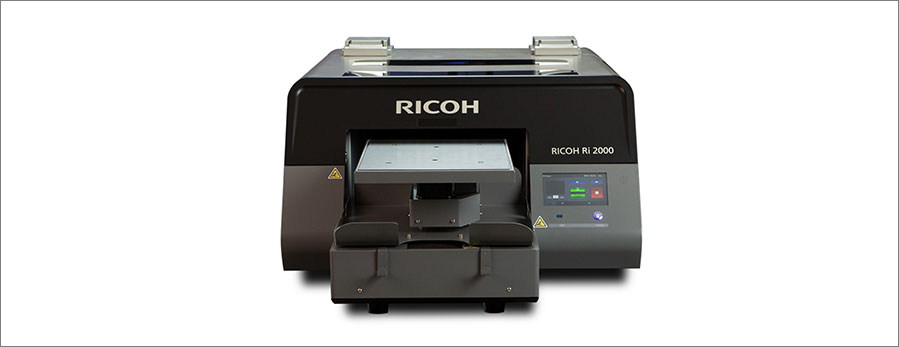
Ricoh is responding to the needs of the modern garment decorator for heightened productivity, best-in-class operation and ease of use with the launch of the Ricoh Ri 2000 Direct to Garment (DTG) printer. The next generation system supports the production of promotional and personalised goods locally.

The Ricoh Ri 2000 prints 1200 x 1200 dpi resolution on a wide range of garments, from traditional t-shirts or tote bags to an extended application range of canvas shoes, baseball caps or long sleeve shirts. It also supports the production of textile face masks and safety vests via the flexibility of the quick-change magnetic platen mechanism and the automatic table height adjustment that easily switches between garment types.

"The new generation of DTG printer represents Ricoh's continued commitment to deliver industry leading inkjet solutions, empowering our customers to grow their business," said Graham Kennedy, Director Industrial Printing, Ricoh Europe. "Working closely with early adopters in the continuously growing DTG market during product development, Ricoh customers can now enjoy the benefits of a DTG turnkey solution. The Ri 2000 meets the needs of innovative digital print providers, custom apparel online retailers, as well as traditional businesses offering added value by printing on garments. It joins Ricoh’s DTG portfolio that already includes the Ri 100 and Ri 1000 devices as the production flagship.”


The Ri 2000 sets a new benchmark in terms of productivity and efficiency in its class. This is achieved by integrating hardware and advanced software end-to-end.

  • Enabling colour consistency, automation of production workflows and creation of white layers for printing on dark garments with ColorGATE’s Textile Productionserver.
  • Continuously monitoring ink supply, temperature and humidity levels, reducing human interaction whenever required.
  • Intuitively guiding the operator with a 7-inch colour touchscreen display providing maintenance alerts, for all tasks that are not automated.
  • Simplifying maintenance with automated cleaning and an innovative head cleaning jig that eliminates the need to manually maintain print head nozzles.


The Ricoh Ri 2000 will be available in EMEA from November onwards. To see it live, book your (virtual) demo through your local Ricoh representative.




More News from TEXDATA International

#ITM 2026

ITM 2026: The new geography of textile production

New production hubs are emerging across North Africa and Central Asia, while Türkiye is accelerating its transformation toward higher-value, technology-driven and more sustainable textile manufacturing.

#Research & Development

“Production is a product”

From technical textiles and AI-driven robotics to the limitations of textile circularity: Professor Dr Thomas Gries looks back on more than two decades of development at ITA Aachen. In the interview, he explains why production technology remains a decisive success factor, discusses international collaborations and innovation ecosystems, and shares his views on the transformation of production landscapes and the challenges facing an increasingly regulated industry.

#Knitting & Hosiery

“We need to move away from the price trap and return to a value-driven mindset.”

With its new Textile Innovation Center, KARL MAYER is sending a strong signal for innovation, collaboration, and the future of textile applications. In this interview, Karl Josef Mayer discusses new opportunities in warp knitting, the processing of staple fibres, recycling, the changing role of machinery manufacturers, and why the textile industry must once again focus more strongly on the value of textiles. by Oliver Schmidt

#Associations

“Innovation, resilience and international experience remain the great strengths of the Swiss textile machinery industry”

Geopolitical uncertainty, growing competitive pressure from China, new free trade agreements and the shift towards a circular economy are currently reshaping the global textile industry. In this interview, Cornelia Buchwalder discusses the current mood within the Swiss textile machinery sector, the industry’s distinctive innovative strength, new market opportunities in India and Asia, and the technological trends that could shape the upcoming trade fair cycle leading up to ITMA 2027.

More News on Digital Printing

#Digital Printing

Mimaki advances DTF productivity and stability with new TxF330-800

Mimaki Europe, a leading manufacturer of industrial inkjet printers and cutting plotters, announces the TxF330-800, its new direct-to-film (DTF) printer. Designed to support stable, high-quality garment decoration in demanding print environments, the system combines automated maintenance, expanded white ink capacity and advanced production capabilities to streamline workflow.

#Digital Printing

Where every detail counts: Experiential applications of DTF and UV-DTF printing

Personalisation has moved far beyond the traditional logo on a t-shirt. Today, brands want to create complete experiences, where every detail – from clothing and accessories to décor and packaging – feels distinctive and reflective of their identity.

#Dyeing, Drying, Finishing

EFI Reggiani and Danitech Group announce strategic multi-year agreement for Mezzera textile finishing machinery

Electronics For Imaging, Inc. (EFI), through its subsidiary EFI Reggiani (Reggiani Macchine S.p.A.), together with Danitech Engineering and Solutions Srl (Italy) and Suzhou Danitech Intelligent Technology Co. Ltd (China), announces a multi-year license and manufacturing agreement covering the Mezzera and Jaeggli textile finishing machinery portfolio.

#Digital Printing

USColorworks expands digital platform with Kornit Atlas MATRIX and Atlas MAX PLUS solutions

Kornit Digital Ltd. (NASDAQ: KRNT), a global pioneer in sustainable, on-demand digital fashion and textile production, today announced that USColorworks, a North Carolina-based apparel decoration and fulfillment company specializing in custom and on-demand printing for retail and promotional markets, has expanded its Kornit digital production platform with the addition of Atlas MATRIX and Atlas MAX PLUS systems to deliver high-quality, on-demand apparel across cotton, blended fabrics and polyester.

Latest News

#Associations

Automation, digitalization and new business models are shaping the future of footwear and leather technology

The European footwear and leather machinery industry is facing profound transformations. Global competitive dynamics, technological innovation, automation and digitalization are fundamentally reshaping markets, production processes and business models. This is one of the key findings of the new study “Threads of the Future – Footwear and Leather Technology Edition”, which was presented today by VDMA Textile Care, Fabric and Leather Technologies (VDMA TFL) during a press conference at SIMAC Tanning Tech in Milan.

#Knitting & Hosiery

SHIMA SEIKI to showcase flat knitting and digital design solutions at Egypt Stitch & Tex

Leading Japanese computerized flat knitting technologist SHIMA SEIKI MFG., LTD. of Wakayama, Japan, together with its sales representative in Egypt, TTS (EL MASRIA FOR TRADE & TECHNICAL SERVICES), will participate in the upcoming 24th International Exhibition for Textile & Carpet Machineries, Printing Technologies and Accessories (Egypt Stitch & Tex) to be held in Cairo, Egypt this month.

#Associations

EURATEX calls for urgent action on industrial competitiveness

EURATEX, the European Apparel and Textile Confederation, welcomes today’s State of the Union Address by European Commission President, Ursula von der Leyen, and in particular her recognition of Europe’s need to rebalance unfair trade, cut red tape, and strengthen its industrial and strategic autonomy.

#Raw Materials

Cotton made in Africa puts farmer dialogue at the heart of agricultural training

A new manual created by the Aid by Trade Foundation and African People & Wildlife shows how Cotton made in Africa aims to transform cotton cultivation through dialogue rather than directives.

TOP