[pageLogInLogOut]

#Digital Printing

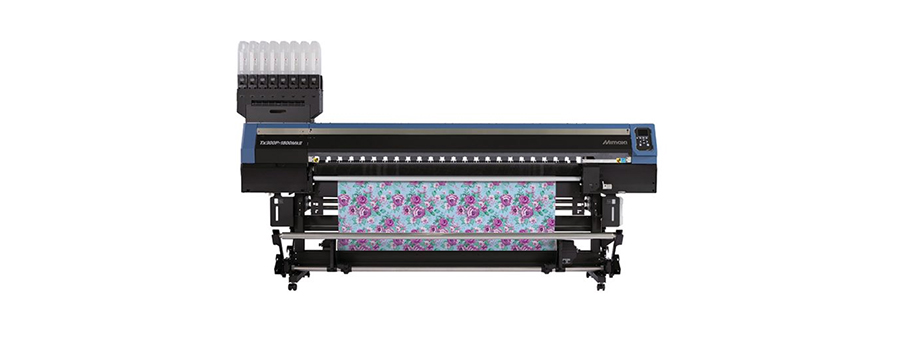
Mimaki with new hybrid textile printer at FESPA 2020
(c) 2020 Mimaki
New entry-level hybrid printer, boasting both direct-to-textile and sublimation transfer print capabilities, expected to allow smaller print service providers to enter new markets

Mimaki Europe today announces that its brand-new hybrid digital textile printer, the Tx300P-1800 MkII, will headline their product line-up at FESPA 2020 (Madrid, Spain, 24-27 March, Stand 7-C20). Uniquely designed with versatility at its core, the new printer enables both direct-to-textile and transfer printing, with interchangeable platens and three different ink combinations – providing unrivalled flexibility within a single system and opening new doors for print service providers.

With Mimaki’s Tx300P-1800 digital textile printer having previously led the way for high-quality, cost-effective printing, the evolved Mimaki Tx300P-1800 MkII now adds sublimation transfer printing to its capabilities, opening up a host of possible new materials and applications. The capability to fulfil diverse applications from fashion textiles to interior fabrics and wallpaper within one system makes the printer an ideal entry-level solution. It affords both smaller print service providers and large volume production houses all of the well-known benefits of digital print technology not attainable with analogue print methods still prevalent in the modern textile printing industry, including more cost-effective short runs and faster turnarounds, benefits that make this technology ideal for sampling.

“We are delighted to be bringing the Tx300P-1800 MkII to FESPA this year to show customers exactly how game-changing it can be for their businesses,” comments Danna Drion, Senior Marketing Manager at Mimaki EMEA. “With the introduction of this new hybrid printer, we are not only delivering an affordable, streamlined single-system solution for printing on both paper and textile, but we are also providing print service providers with the versatility to continue exploring different substrates and applications as they grow their businesses into the future. We anticipate a very bright future for digital printing in the textile industry and have no doubt that our new printer, at the cutting edge of this sector, will have a role in realising this transition.” 

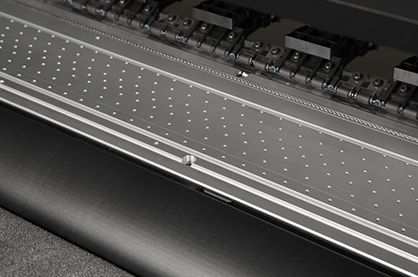
The ability of the Mimaki Tx300P-1800 MkII to switch between direct-to-textile and transfer printing is enabled by its interchangeable platens. When printing direct-to-textile, excess ink penetrated through the fabric is drained by a platen with an ink-receiving channel.

When printing on heat transfer paper however, this platen can be quickly and easily exchanged for a vacuum platen needed for paper printing – without the need for service engineers. The hybrid printer is also able to facilitate either a traditional one-way ink set, configured with any one of five ink types, as well as various combinations of inks, providing unparalleled flexibility. Users are able to select from three different ink combinations – textile pigment/direct sublimation, textile pigment/sublimation transfer, or direct sublimation/sublimation transfer – to provide the best results across various applications.
(c) 2020 Mimaki
(c) 2020 Mimaki

“At Mimaki, our goal is to consistently provide the best products in each market, which is why we have also worked meticulously to provide a number of clever adaptations to ensure that the print quality and reliability exceed expectations,” continues Drion. “These technologies, such as our Nozzle Check Unit to provide uninterrupted printing and minimise downtime, our MAPS4 system to reduce banding, and our new ‘high head gap’ printhead to ensure accurate ink droplet placement, are just some of the ways in which we ensure that products such as the Mimaki Tx300P-1800 MkII have the substance to continually impress our customers and provide really valuable changes to their businesses.” 

The new hybrid digital textile printer will form part of an impressive exhibition line-up from Mimaki of more than 15 products at FESPA this year, including the brand-new SWJ-320EA large format solvent printer, JFX200-2513 EX large flatbed UV inkjet printer and two models of the recently launched Plus series in the large format sector alone. Visitors can also explore Mimaki’s 3D print technology through full-colour samples created on the 3DUJ-553 3D printer, capable of faithfully replicating more than 10 million colours. Focused on providing inspiration and encouraging visitors to “experience print”, Mimaki will also be celebrating real-life customer, partner and collaborator examples and success stories, with a host of creative applications for visitors to delve into on the stand. 

For more information about products and services from Mimaki, visit www.mimakieurope.com.
More News from Mimaki Europe B.V.

#Digital Printing

Mimaki highlights growing demand for hybrid UV printing across European markets

Insights from Mimaki's European partner network reveal how hybrid UV printing is responding to different regional market needs, driven by growing demand for flexible, application-oriented printing technologies.

#Digital Printing

Mimaki advances DTF productivity and stability with new TxF330-800

Mimaki Europe, a leading manufacturer of industrial inkjet printers and cutting plotters, announces the TxF330-800, its new direct-to-film (DTF) printer. Designed to support stable, high-quality garment decoration in demanding print environments, the system combines automated maintenance, expanded white ink capacity and advanced production capabilities to streamline workflow.

#Digital Printing

Where every detail counts: Experiential applications of DTF and UV-DTF printing

Personalisation has moved far beyond the traditional logo on a t-shirt. Today, brands want to create complete experiences, where every detail – from clothing and accessories to décor and packaging – feels distinctive and reflective of their identity.

#Digital Printing

DTF vs DTG Printing - The technologies shaping today’s custom merchandise market

From sportswear to branded tote bags, custom merchandise continues to grow in popularity across sectors, driving print shops to cater to short runs, personalisation, and rapid turnaround. As print providers look to this market, two printing technologies often stand out: Direct‑to‑Film (DTF) and Direct‑to‑Garment (DTG). Each offers its own benefits, and understanding these differences helps determine the most suitable production method for print service providers.

More News on Digital Printing

#Digital Printing

From a bedroom startup to 3,000 designs: How Lonely Kids Club built its business with DTG printing

Founded in Sydney in 2011, independent clothing label Lonely Kids Club has grown from a bedroom startup into a business offering around 3,000 graphic T-shirt designs. With its own production studio, direct-to-garment printing and a demand-driven manufacturing model, the company demonstrates how smaller apparel brands can combine creative independence with flexible production – while navigating the everyday challenges of quality control, workflow efficiency and sustainability.

#Digital Printing

VistaPrint increases apparel production capacity with Kornit Apollo

Kornit Digital (NASDAQ: KRNT), a provider of on-demand digital textile production technologies, reports that VistaPrint has significantly increased its apparel production capacity through the implementation of the Kornit Apollo system. The installation has enabled the international print and design company to add approximately 25,000 units of weekly production capacity while improving production speed, operational efficiency and order turnaround times.

#Digital Printing

Blue Tomato accelerates agile retail apparel production with Kornit Digital

Kornit Digital (NASDAQ: KRNT), a global pioneer in on-demand digital fashion and textile production technologies, is highlighting how Blue Tomato, Europe’s largest board sports retailer, is using two Kornit Atlas MAX PLUS systems to support a more agile approach to in-house apparel production. The systems are helping Blue Tomato respond faster to changing consumer trends, produce high-quality apparel for its network of 86 retail stores across Europe and reduce inventory by printing only what the market demands.

#Digital Printing

Growth at the speed of demand: Kornit Digital brings digital textile innovation to PERFORMANCE DAYS 2026

Kornit Digital Ltd. (NASDAQ: KRNT) (“Kornit”), a global pioneer in on-demand digital fashion and textile production, will showcase the possibilities of digital, on-demand production at PERFORMANCE DAYS 2026, October 13–14 at Messe München, Hall 6, Booth E08.

Latest News

#Associations

Christoph René Holler to succeed Uwe Mazura as managing director of textil+mode

Christoph René Holler will take over as managing director of textil+mode, the German textile and fashion industry confederation, on 1 January 2027. He succeeds Uwe Mazura, who has led the association for 13 years and will remain in charge of collective bargaining policy through the next round of negotiations before retiring.

#Heimtextil 2027

Heimtextil and The Florentin showcase the role of textiles in hotel design

Heimtextil has partnered with Frankfurt hotel The Florentin by Althoff Collection for its new Interior.Architecture.Hospitality campaign. The collaboration will give architects, interior designers and other contract-sector professionals a closer look at how textiles were used in the hotel. The two studios behind the project will discuss their work at Heimtextil on 14 January 2027 in Hall 4.1.

#EU Textile Strategy

EU Commission proposes advanced materials agenda with targets for 2035

The European Commission has proposed an Advanced Materials for Europe agenda to accelerate the development, production and adoption of safer and more sustainable advanced materials. The proposal sets three benchmarks for 2035 and calls for closer coordination among EU member states to help move new materials from the laboratory into industrial production.

#Research & Development

Empa develops liquid-core fibre for insecticide-treated mosquito nets

Empa researchers have developed a liquid-core fibre for mosquito nets that can incorporate insecticides unsuitable for conventional melt spinning. The fibre gradually releases the active ingredient through a polymer sheath. The team developed and tested the yarn over three years in the Innosuisse project MalCoFil with Swiss industry partners Vestergaard and Monosuisse.

TOP