[pageLogInLogOut]

#Digital Printing

Durst opens new headquarters and Customer Experience Center

Christoph Gamper - CEO & Co-Owner Durst Group (c) 2019 Durst
Durst has opened a futuristic new headquarters and Customer Experience Center in Brixen, northern Italy, that represents a watershed in its transformation into a highly integrated process service provider.

Customers, employees and business partners were among 1,000 guests who attended the inauguration ceremony for the state-of-the-art building. Speakers were CEO and Co-Owner Christoph Gamper, Owner Harald Oberrauch, Owner Christof Oberrauch, Mayor of Brixen Peter Brunner, Dean of Brixen Albert Pixner, Regional Council of South Tyrol representative Philipp Achammer, and Patrik Pedó and Juri Pobitzer from architects Monovolume.

In future, Durst will invite more of its international customers to the Customer Experience Center in the 5,700 square meter headquarters that embodies the transformation into a highly specialized, high-tech business. The integrated concept has been incorporated into the the architecture of the building as it connects a new administrative block with production facilities.
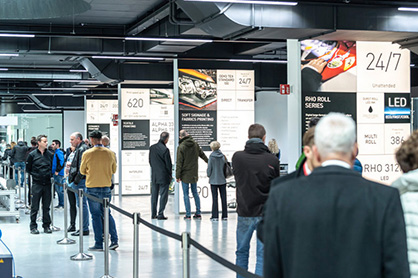
Durst HQ customer experience center (c) Durst


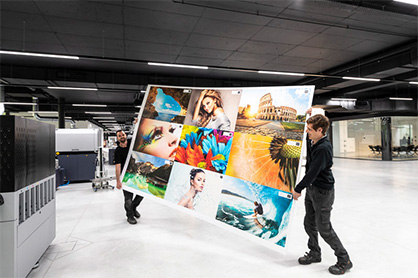
The iconic design for a company building with a tower was first presented more than 50 years ago, but never realized. Architects Monovolume pursued the original concept and designed a flat, floating ‘wing’ with a six-storey tower. The powder-coated metal façade has 850 multi-colored, luminous window elevations arranged in pixel-like fashion. The pixelated facade of Durst’s new headquarters is also a pointer to the company’s areas of business, as Durst is a global leader in high-performance printing systems – from image data processing and printing to final product finishing – all from a single source.
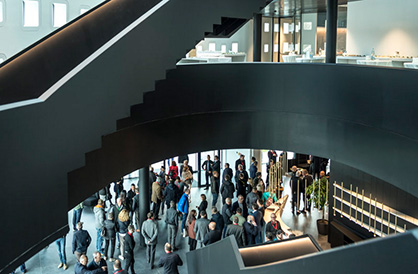
Durst HQ customer experience center (c) 2019 Durst


Durst HQ entrance (c) 2019 Durst


 Durst employs more than 700 people and has more than 20 subsidiares across the world. Its history dates back more than 80 years is closely associated with the Oberrauch family, which is now in the third generation of ownership. The management board recently underwent a management change with Christof Oberrauch handing over the reins to his son, Harald Oberrauch. At the same time, Christoph Gamper was appointed CEO, and has now been given stronger ties to the long-established business through joint ownership.
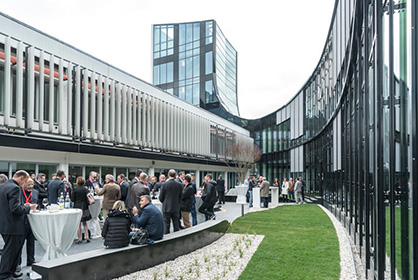
Durst HQ garden (c) 2019 Durst


Mr Gamper has led Durst’s transition and introduced a new management structure and a new business philosophy: passion for technologies and markets, innovation as the driver, and active collaboration and participation in every area.

“This is a very proud day in the long history of Durst,” Mr Gamper told guests. “We do not fear the future. We are here to shape the future. We have the best employees, the best customers and the best technology. Driven by the mantra of innovation, Durst offers complete solutions from pixel to output. Here at our headquarters in the south Tyrol is where things come full circle with the mountain habitat and the aim of focusing not just on the machines but also on the people behind them.”

He added: “Here it is not a question of appearance but of essence, of conveying the idea to the outside world, of creating a protected space for innovation, of bringingg together very special people who have devoted themselves to a vision: to create something new, to inspire, and to always ask the next question.”
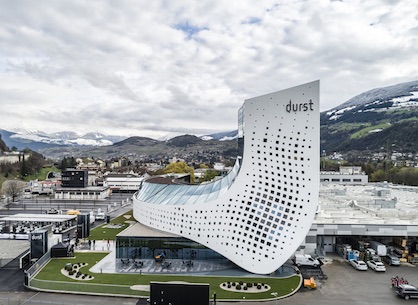
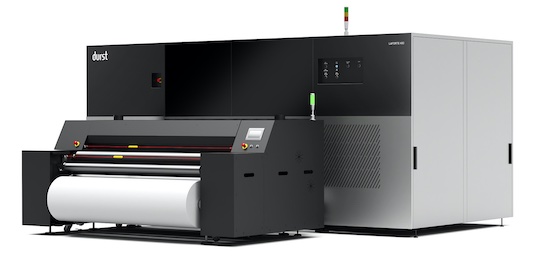
Durst HQ front (c) 2019 Durst


More News from Durst Phototechnik AG

More News on Digital Printing

#Digital Printing

Mimaki takes DTF performance to the next level with TxF300-75Plus

Mimaki Europe, a leading manufacturer of industrial inkjet printers and cutting plotters, announces the TxF300-75Plus, an upgraded model within its high-productivity direct-to-film (DTF) printing portfolio. Following on from the success of the original TxF300-75, this enhanced version reflects Mimaki’s commitment to continuously evolving its solutions to meet the changing demands of the market.

#Digital Printing

Former ASOS CEO Nick Beighton joins Kornit Digital to help shape the future of on-demand fashion

Kornit Digital LTD. (NASDAQ: KRNT) ("Kornit" or the "Company"), a global leader in sustainable, on-demand digital fashion and textile production technologies, today announced it has appointed Nick Beighton, former Chief Executive Officer of ASOS, as a strategic advisor to the Company and its Board of Directors. His appointment reflects Kornit’s continued focus on strengthening its connection to global brands, retailers, and digital commerce platforms as the industry transitions toward on-demand production. The Company plans to nominate Mr. Beighton for election to the Board at Kornit’s 2026 Annual Shareholder Meeting.

#Digital Printing

FESPA confirms participation from leading exhibiting suppliers and brands for inaugural textile event

FESPA has confirmed a strong exhibitor line-up for its inaugural Textile show, a dedicated new event that will run as part of FESPA 2026, alongside co-located events: Global Print Expo, Personalisation Experience, European Sign Expo, WrapFest and the brand-new Corrugated.

#Digital Printing

UK Manufacturer Basic Prints commits to digital-first production model with dual investment in Kornit Digital’s Apollo

Kornit Digital, a global leader in sustainable, on-demand digital fashion and textile production technologies, today announced that UK clothing manufacturer Basic Prints has expanded its digital production capacity with a second Kornit Apollo Direct-to-Garment (DTG) system. This marks a strategic shift supporting Basic Prints’ digital-first manufacturing model.

Latest News

#Techtextil 2026

AI, Start-ups, Research: Techtextil and Texprocess bring together players in the textile industry

From start-ups to universities and research institutes: at Techtextil and Texprocess, the world’s leading innovation trade fairs in Frankfurt am Main, exhibitors present future-oriented concepts for the global textile industry. With the international Campus & Research area, a strong participation from start-ups and the latest AI applications for textile processing, both trade fairs showcase current developments in the textile industry. By bringing together innovation, research and application, they enable new partnerships across the textile value chain.

#Techtextil 2026

IVGT joint stand brings innovation and networking to Techtextil 2026

At Techtextil 2026 and the parallel Texprocess 2026, key transformation topics such as artificial intelligence, digitalisation, sustainability, recycling and the circular economy will be reflected across the show. Against this backdrop, the IVGT, together with 16 member companies, will present its joint stand in Hall 12.1 (Stand D62) as a platform for exchange and networking.

#Man-Made Fibers

Indorama Ventures supports Southeast Asia’s textile customers with reliable regional supply and global innovative portfolio

Indorama Ventures, one of the leading global polyester fiber and filament yarn suppliers globally, will participate in Indo Intertex 2026 in Jakarta this April, making its diverse global portfolio available to apparel, home textile, and hygiene customers across Southeast Asia.

#Raw Materials

New study shows low environmental impact by Cotton made in Africa Organic Cotton from Tanzania

Today, the Aid by Trade Foundation (AbTF) is announcing the results of a comprehensive life-cycle analysis (LCA) for cotton produced in Tanzania under the Cotton made in Africa Organic (CmiA Organic) standard. The study emphasises the small ecological footprint of CmiA Organic verified cotton. This can largely be traced back to the absence of synthetic pesticides, artificial fertilisers, and artificial irrigation. Consequently, CmiA Organic cotton can help the textile industry meet regulatory requirements as well as science-based targets. The results also show that the consequences of climate change threaten the livelihoods of these cotton farmers, even though the type of agriculture they practise barely contributes to climate change.

TOP