[pageLogInLogOut]

#Denim

Jeanologia transforms denim design with the newest version of eDesigner

With the update of its powerful software for the digital creation of jeans, the Spanish firm positions itself as a partner of reference for eco-efficient digitalization.
  • This jean-design software marks a milestone in the virtual creation of garments.
  • eDesigner promotes eco-design through the digitization of the collections, reducing samples by 80% and ensuring perfect reproducibility of production designs.
  • With a more intuitive interface, the latest version improves usability and enhances hyperrealism, while incorporating both fabric digitalization and access to Jeanologia's know-how.
  • Designers are connected to wash developers, and brand names to manufacturers, creating a fluid and agile channel for design validation and accelerated production and marketing. 


Jeanologia, a leading Spanish company in the development of eco-efficient technologies, is boosting digitalization in eco-design with a new version of its eDesigner software.

Since its development in 2020, this innovative software for the digital creation of jeans has situated itself as the creative and eco-efficient technological alternative to traditional denim design, shaping the future of garment finishing.

The perfect editor for denim design

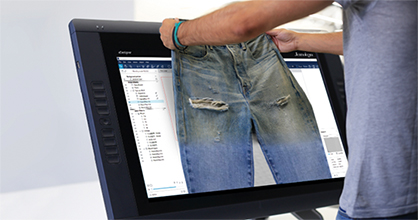
The new version of eDesigner offers a more intuitive user interface, as well as tools specific to jean design, providing a unique design experience. Worth highlighting is the "Trace" tool, which uses artificial intelligence to generate hyper-realistic designs from a single image.

It also features the possibility of working with digitized fabrics, thus enhancing hyperrealism with high-definition renders to ensure that the design seen on the screen is what will be obtained in production: “What you see is what you get”

Access to Jeanologia's know-how

eDesigner also provides designers with a valuable source of inspiration and expertise through its Lightbrary, which gives users access to an extensive gallery of laser designs, vintage designs, wash effects, textures, tear and fray gallery, as well as a "Discover" section with trends and inspirational designs.

Jeanologia thus will share its know-how with designers, who will be able to create things from scratch or build on previous designs as a starting point for new creations.

Digital wash

The new eDesigner takes digitization to the next level, enabling the digital creation of patterns and garments and in doing so, reduces physical samples by 80%. This not only means significant savings in terms of resources, but also a substantial reduction in the carbon footprint generated by the transportation of samples.

The user can create digital cufflinks, combining digital patterns (eFit) with digital fabrics (eFabric), and partake in a truly authentic experience, as he or she will be able to analyze the results of wash applications on the fabrics.

All these innovations make it possible to shorten product development times by months, eliminating significant sample quantities and the now-unnecessary costs of shipping them around the world.


The perfect partner for the digitization of the development process

eDesigner acts as a fluid and agile two-way communication channel that connects laser designers with wash developers and brands with manufacturers. In this way, it speeds up the production and marketing of collections. 
© 2023 Jeanologia
© 2023 Jeanologia


Once the design is finalized and the collection approved, the tool provides final digital files, which can be sent to production centers around the world to be converted into actual jean production.

As Jeanologia's Marketing Director, Carmen Silla, explains, "Thanks to this tool we’ll enable infinite iterations at zero cost and impact, while standardizing formats and communication. We’ll improve production processes by making them more efficient and accelerate time-to-market, since we go from design, to sample and approval in a very short time.”

More than simply software, eDesigner is an eco-efficient digital transformation tool, destined to revolutionize the textile industry and contribute to its transformation into a more competitive, productive and sustainable industry.

More News from JEANOLOGIA S.L.

#Industry 4.0 / Digitalization

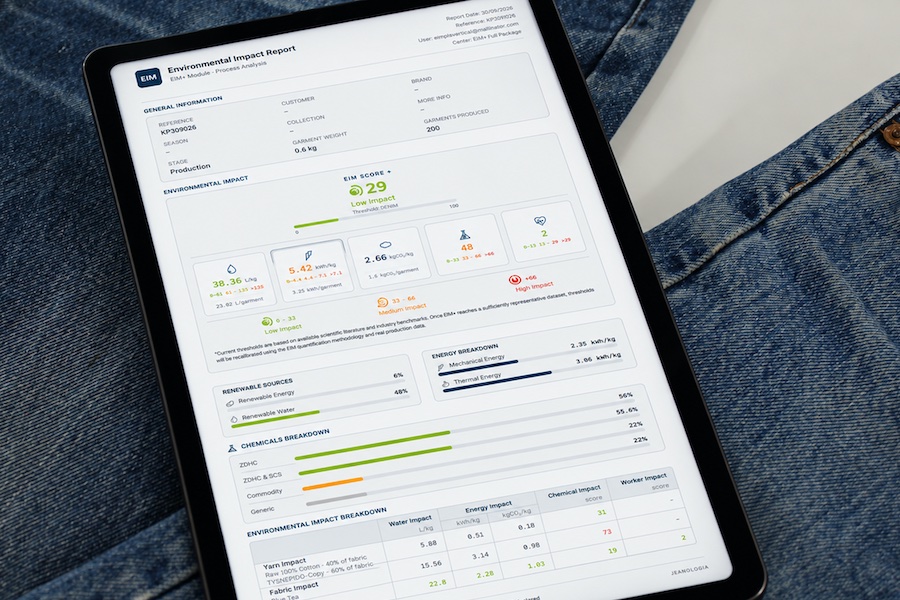
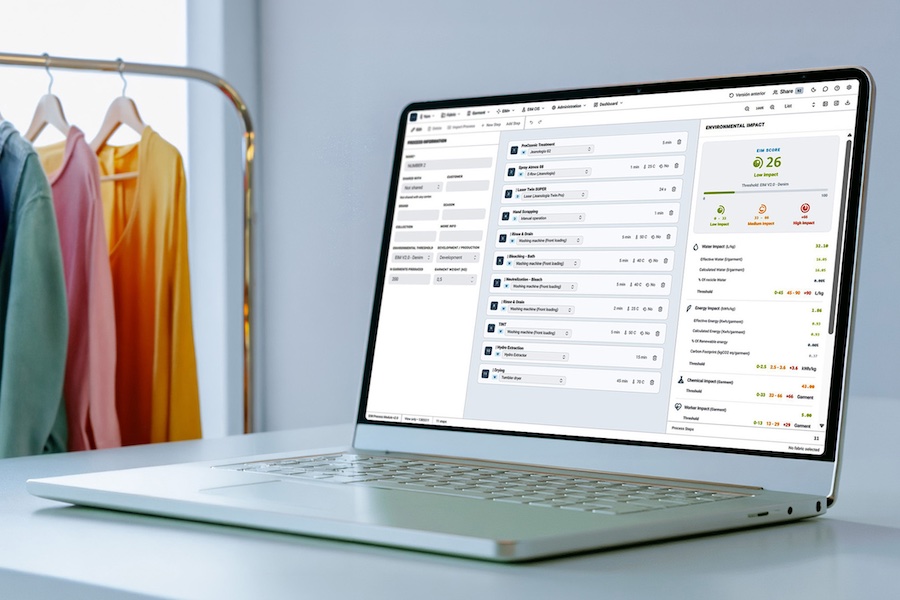
EIM evolves into a new Environmental Intelligence to measure the impact of textile production

¿Do we really know the environmental impact behind a garment? Answering this question remains one of the textile industry’s major challenges. Garment production involves multiple stages, from yarn and fabric to final finishing, carried out by different players across the supply chain. Accesing reliable data from each process, connecting it and establishing a common language are essential to understanding a product’s true impact.

#Sustainability

Jeanologia Sustainability Report highlights environmental impact of textile technologies

Jeanologia has published its Sustainability Report 2025, reporting a 13.64% reduction in its own carbon footprint and quantifying the environmental impact associated with the use of its technologies across the global textile industry. According to the company’s calculations, their use avoided the pollution of 21.52 million m³ of water and emissions of approximately 103,530 tonnes of CO₂ compared with conventional textile finishing processes.

#Recycling / Circular Economy

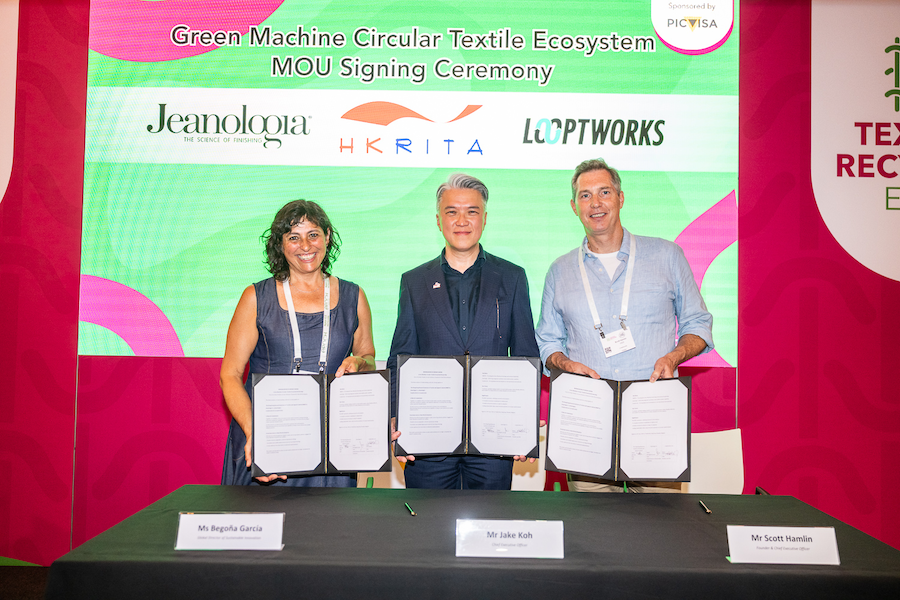
HKRITA signs MoU with Jeanologia and Looptworks to establish the Green Machine Circular Textile Ecosystem

The Hong Kong Research Institute of Textiles and Apparel (HKRITA) yesterday officially signed a landmark Memorandum of Understanding (MoU) with two key global partners, Jeanologia and Looptworks, to establish the Green Machine Circular Textile Ecosystem – a first-of-its-kind collaboration to accelerate the large-scale recycling of blended textiles.

#Denim

Jeanologia brings “Billy” to China, the AI transforming denim design

The denim industry is turning its attention to Hangzhou this week, where a new edition of Kingpins, the leading international trade show for the sector, takes place on May 21 and 22. There, the Spanish company Jeanologia, a global leader in sustainable technologies for the textile industry, is introducing its latest innovation to the Chinese market: “Billy”, the first artificial intelligence specifically developed for denim finishing design.

More News on Denim

#Denim

Officina39 and Gold Girl Co. explore unconventional materials in denim at Kingpins Amsterdam

Officina39 and Gold Girl Co. will present their experimental collaboration “Renegade Renaissance” at Kingpins Amsterdam on October 14–15, 2026. The project brings together the creative direction of Marta and Glenda Goldschmied, founders of Gold Girl Co., with Officina39's expertise in textile chemistry and material development.

#Denim

MK SONS Denim Research to make its debut at Kingpins Amsterdam

MK SONS Denim Research, a specialist denim development and manufacturing division of Pakistan-based textile and garment manufacturer MK SONS, will make its debut at Kingpins Amsterdam on October 14–15, 2026. The company will present its approach to integrating denim product development with industrial manufacturing at stand T in the Green Area.

#Man-Made Fibers

Lenzing and Kaihara to debut REMOD denim collection at Kingpins Amsterdam

The Lenzing Group, a global producer of wood-based fibers for the textile and nonwovens industries, has partnered with Japanese denim manufacturer Kaihara Corporation to launch the “REMOD Collection”. The collection combines three of Lenzing's fiber offerings for denim applications: TENCEL™ Lyocell Standard, TENCEL™ Lyocell – HV100 and TENCEL™ Lyocell dtex 2.2.

#Recycled Fibers

Eastman Naia™ brings its inside-out denim vision to Kingpins New York

Following its debut at Kingpins Amsterdam, Eastman Naia™ brings the next chapter of its denim story to Kingpins New York, taking place July 22–23. At Booth Green 7, Naia™ presents its denim proposition built around three complementary design directions: Performance Denim, Fashion Denim and Authentic Denim.

Latest News

#Functional Fabrics

ROICA™ presents stretch textile innovations from nine partners at PERFORMANCE DAYS 2026

ROICA™ by Asahi Kasei will return to PERFORMANCE DAYS Munich on October 13–14, 2026, presenting textile developments from seven European partners and two Japanese specialists under its global brand message, “STRETCH YOUR FUTURE.” Visitors can discover the developments at Booth P10 in Hall A4.

#IGATEX 2026

SHIMA SEIKI to showcase flat knitting and digital design solutions at IGATEX Pakistan 2026

Leading computerized flat knitting technology provider SHIMA SEIKI MFG., LTD. of Wakayama, Japan, together with its Pakistani representative ALMURTAZA MACHINERY CO., (PVT) Ltd., will exhibit at the upcoming International Exhibition for Garment, Textile Machinery and Accessories (IGATEX Pakistan 2026) in Lahore, Pakistan, from October 15–18. SHIMA SEIKI will introduce computerized flat knitting machines, 3D design software and various web platforms as proposals for sustainable production through innovative shaping technology and the latest digital solutions.

#Dyeing, Drying, Finishing

Brazilian market leader Cedro Têxtil focuses on greater efficiency, sustainability, and product quality with Brückner

After more than 150 years of company history, Cedro Têxtil is once again embracing the challenges of a changing industry. Widely recognized as the largest manufacturer of workwear fabrics in Latin America, the Brazilian textile company continues to invest in the modernization of its production facilities. A key milestone in this process was the decision to install a state-of-the-art Brückner stenter frame just over a year ago.

#Recycling / Circular Economy

The Or Foundation, adidas, BESTSELLER, H&M Group, and Inditex launch Apparel Recovery Coalition, responding to impacts of post-consumer textile exports

adidas, BESTSELLER, H&M Group, Inditex and The Or Foundation, with support from Circle Economy, unveiled the Apparel Recovery Coalition (ARC). The coalition will explore how producer responsibility systems can support circular pathways such as reuse, upcycling, recycling, and responsible waste management in countries that receive large volumes of exported secondhand apparel.

TOP