[pageLogInLogOut]

#Denim

Genoa | Genova | Garibaldi in Jeans by Ian Berry

Ian Berry has been delving into the history of denim, in fact, so far back it can be said the history before jeans. While Jacob Davis’s rivet may have helped Levi Strauss develop what we now know as the modern jean, few know why one of the most loved garments on the planet are called; Jeans.

Back in the 15th century, shipbuilders and merchants in the Italian city of Genoa used a cheap, coarse and strong, cross weaved type of cotton to make sails and protect their goods. This kind of fabric was produced in the French city of Nimes, (where Ian Berry visited in 2018) resulting in the name ‘denim’ from Serge de Nim, and used in combination with moleskin. In the Internationally important port city of Genoa, similar textiles were dyed blue by indigo traded with India. Their use extended to work clothes, and they were exported under the French name ‘bleu de Gênes’ that became blue jeans when once again translated to English.

‘When I ask people where the names come from I, and I’ll admit few seem to know already, tell them it comes from England as it is the words we called them as, and I quote from back then, ‘they didn’t want a French sounding cloth’. Ian Berry joked. 

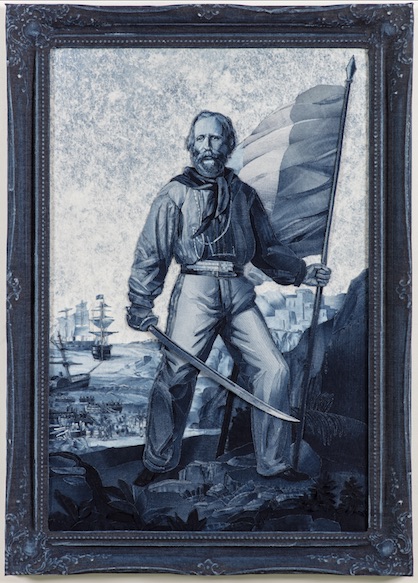
Ian Berry was commissioned to make a piece of a man connected to the city, an icon of his day and internationally renowned; Giuseppe Garibaldi, often noted as the most popular and famed Italian ever. Berry has been talking to the city for several years and then the Municipal’s Manuela Arata, who visited his London studio.

Back in 2017 plans were being formed to do an event in Genoa, and Ian Berry was working with Cristiano Palozzi toward this goal. But then horror struck, on 14th August 2018, the Morandi motorway bridge in Genoa, Italy, collapsed during a torrential rainstorm killing 43 people and shocking a stunned city and the world. Obviously the city was reeling and the project was sidelined.
(c) 2021 Ian Berry
(c) 2021 Ian Berry


‘I was in Nimes at the time so very invested in both of the cities and in my heart. The bridge tragedy was awful but only made my commitment to Genoa greater.’ 

Ian Berry’s Garibaldi in Jeans, (denim on denim, 106 x 77 x 6 cm) is placed at the Museo del Risorgimento. The museum was the birthplace of Giuseppe Mazzini whose efforts, like that of Garibaldi, helped bring about the independent and unified Italy.

It is based on the painting by Gerolamo Induno’s GARIBALDI A MARSALA (11 May 1860), oil on canvas, 1861, in the Museo Nazionale del Risorgimento Italiano in Turin, who supported this portrait. In the painting, like other iconographic testimonies dedicated to Garibaldi and the Red Shirts, including those in the Museo del Risorgimento in Genoa, the protagonist wears trousers made of the typical blue fabric, whose Genoese origins are recognised.

www.ianberry.org
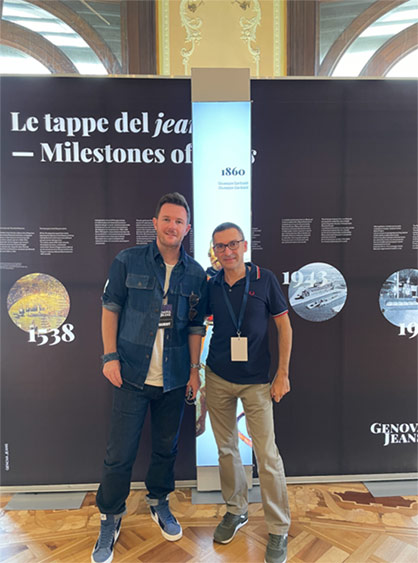
 

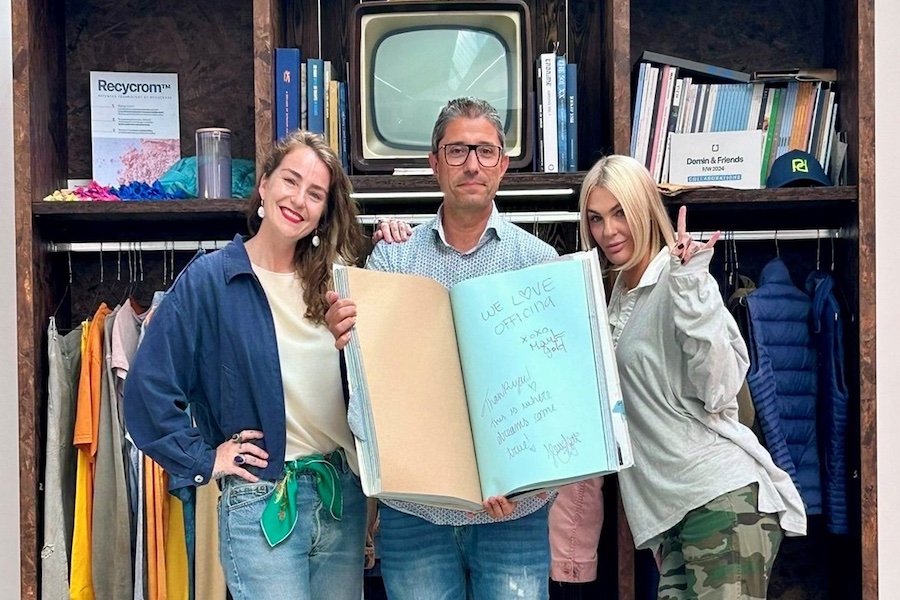
Cristiano Palozzi with Ian Berry © 2021 Ian Berry


More News from TEXDATA International

#ITM 2026

ITM 2026: The new geography of textile production

New production hubs are emerging across North Africa and Central Asia, while Türkiye is accelerating its transformation toward higher-value, technology-driven and more sustainable textile manufacturing.

#Research & Development

“Production is a product”

From technical textiles and AI-driven robotics to the limitations of textile circularity: Professor Dr Thomas Gries looks back on more than two decades of development at ITA Aachen. In the interview, he explains why production technology remains a decisive success factor, discusses international collaborations and innovation ecosystems, and shares his views on the transformation of production landscapes and the challenges facing an increasingly regulated industry.

#Knitting & Hosiery

“We need to move away from the price trap and return to a value-driven mindset.”

With its new Textile Innovation Center, KARL MAYER is sending a strong signal for innovation, collaboration, and the future of textile applications. In this interview, Karl Josef Mayer discusses new opportunities in warp knitting, the processing of staple fibres, recycling, the changing role of machinery manufacturers, and why the textile industry must once again focus more strongly on the value of textiles. by Oliver Schmidt

#Associations

“Innovation, resilience and international experience remain the great strengths of the Swiss textile machinery industry”

Geopolitical uncertainty, growing competitive pressure from China, new free trade agreements and the shift towards a circular economy are currently reshaping the global textile industry. In this interview, Cornelia Buchwalder discusses the current mood within the Swiss textile machinery sector, the industry’s distinctive innovative strength, new market opportunities in India and Asia, and the technological trends that could shape the upcoming trade fair cycle leading up to ITMA 2027.

More News on Denim

#Denim

Jeanologia brings “Billy” to China, the AI transforming denim design

The denim industry is turning its attention to Hangzhou this week, where a new edition of Kingpins, the leading international trade show for the sector, takes place on May 21 and 22. There, the Spanish company Jeanologia, a global leader in sustainable technologies for the textile industry, is introducing its latest innovation to the Chinese market: “Billy”, the first artificial intelligence specifically developed for denim finishing design.

#Denim

Officina39 brings modular Low Temperature Reactive Dyeing and a new vision of denim efficiency to Denim Première Vision Milan 2026

At Denim Première Vision Milan 2026, at Stand G21, Officina39 returns to the international denim stage with a clear message: the next phase of denim innovation will be shaped by process efficiency, creative flexibility and the ability to rethink established industrial routines.

#Denim

ISKO unveils a new circular vision of color, texture and tactile innovation at Denim Première Vision Milan

At Denim Première Vision Milan (booth G3), ISKO introduces its FW27-28 Collection, built around three defining elements: color, texture and touch. This season, ISKO presents a vision where emotion and advanced textile innovation converge, rooted in a steadfast commitment to responsible material development by utilizing patented technologies and high-quality raw materials, powered by RE&UP.

#ITM 2026

Uster FiberQ excels for recycled raw materials too

Uster FiberQ is a complete solution for raw material utilization, supporting spinners to achieve consistent quality and profitability every day, building further growth for the future. The Turkish company ORTA relies on FiberQ with recycled yarn for its denim production. Data-driven knowledge puts the producer in control of raw material utilization – ready to make the correct decisions for process efficiency, quality and productivity.

Latest News

#Recycled Fibers

Indorama Ventures enables brands to scale circular textiles through proven, traceable supply chains

Indorama Ventures, a global leader in recycled polyester staple fibers and filament yarns, will exhibit at Textiles Recycling Expo in Brussels on June 24–25. At the event, the company will show how brands and textile manufacturers can build traceable, circular textile supply chains by working with proven partners who deliver recycled materials on an industrial scale.

#Recycled Fibers

RECOVER™ launches Recover™ Yarns to accelerate recycled cotton uptake

Recover™, a leading materials science company and one of the world’s largest producers of recycled cotton fiber, today announces the launch of Recover™ Yarns, a curated portfolio of ready-to-use yarn solutions designed to accelerate the adoption of recycled cotton across the apparel supply chain.

#Spinning

Barmag and Hitech Automation enter into partnership for an auto-doff system for texturing machines

Barmag (Suzhou) Technology Co., Ltd. and Hitech Automation Solutions PVT LTD. of Surat, India, have agreed to an exclusive partnership to jointly market Hitech’s Doffmatic automation solution for Barmag’s proven manual eFK texturing machines. In many texturing facilities, manual doffing processes remain heavily operator-dependent – resulting in issues such as increased scrap, inconsistent quality, and limited productivity.

#ITM 2026

Uster’s new Recycling Opening Index guides spinners to the perfect blend

Uster AFIS 6 now offers the key data for better decisions when blending recycled fibers. Process control is decisive in determining the quality and economic outcome. The new R Recycling Module of AFIS 6 introduces the Recycling Opening Index (ROI), so spinners can optimize their circularity credentials. It was officially launched at ITM 2026 in Istanbul, Türkiye.

TOP