[pageLogInLogOut]

#Recycling / Circular Economy

Levi's most sustainable jean ever – a collaboration with re:newcell

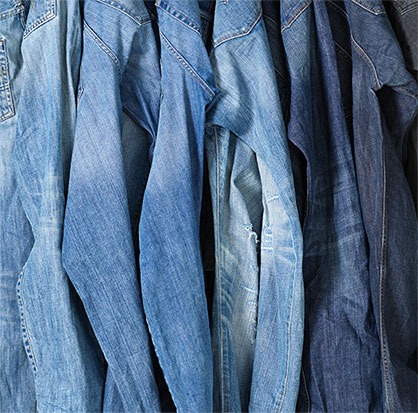
On July 21st, Levi’s® launches its most sustainable jean ever, a garment made with organic cotton and Circulose®, a breakthrough material made from worn-out jeans. Available as part of the Levi’s® Wellthread™ line in the 502 for men and High Loose for women, this jean represents more than five years of research in circular denim design.

This unique collaboration between Levi’s® Wellthread™, the laboratory to test and validate sustainability ideas through research & development, and re:newcell, the innovators behind Circulose®, marks a significant milestone in the fashion industry’s transition to circularity. It’s like-for-like fiber input means the garment can itself be recycled through an existing chemical recycling processes.

“Bringing fashion full circle, denim-to-denim, together with a brand as iconic as Levi’s® is a dream come true. To make fashion sustainable, it’s important to show people that a material like Circulose® is a real alternative to virgin cotton both in performance and style. I can’t think of a better proof than putting truly circular Levi’s® 502’s into stores worldwide” says Patrik Lundström, CEO of re:newcell.

To make Circulose®, re:newcell repurposes discarded cotton textiles, such as worn-out denim jeans, through a process akin to recycling paper. The incoming waste fabrics are broken down using water. The color is then stripped from these materials using an eco-friendly bleach. After any synthetic fibers are removed from the mix, the slurry-like mixture is dried and the excess water is extracted, leaving behind a sheet of Circulose®. This sheet is then made into viscose fiber which is combined with cotton and woven into a new fabric.

“We want to recycle Levi's jeans in a way that doesn't diminish their quality. By collaborating with re:newcell, our garment-to-garment recycling takes an important step forward,” notes Una Murphy, Levi’s® Senior Designer for Innovation. “Recycling keeps garments out of landfills and minimizes the use of natural resources. We're transforming old jeans into high-quality materials, moving us beyond traditional cotton recycling, which shortens and breaks fibers. By using high-quality fiber, Levi's jeans last longer, and designing for circularity allows our old jeans to become new jeans, again and again.”

Designed in a way that maximizes recyclability so it can be regenerated into a new jean again, each part of the jean – trims, thread, etc. – are carefully calibrated to ensure it meets recycling specifications, allowing it to have a second life when it's worn out. Innovations like this are what will allow Levi’s®, and the fashion industry, to reduce dependency on virgin materials. What’s more, Levi’s® and re:newcell were able to successfully put a pair of the Wellthread™ jeans made with Circulose® and organic cotton, sourced from Turkey, through re:newcell’s recovery system and come away with viable material output for future use, demonstrating that this garment is, in fact, fully recyclable and truly circular.

(c) 2020 re:newcell
(c) 2020 re:newcell


“This is a sustainability challenge that we’ve been wrestling with for years, so it’s really exciting to see an aspirational concept become a familiar pair of Levi’s jeans that consumers can actually buy and wear,” says Paul Dillinger, Levi’s VP of Global Product Innovation. “The fashion industry has long been chasing the potential of the ‘circular economy.’ The jeans we’ve made in collaboration with re:newcell proves that it can be done.”

In addition, Circulose® is manufactured in a first-of-its-kind recycling facility powered by renewable energy in Kristinehamn, Sweden. This translates to denim that requires less water and energy, leaving us with an overall lighter carbon footprint.



More News from TEXDATA International

#Recycling / Circular Economy

textile.4U publishes special edition “Top 100 Textile Recycling Companies 2025”

With a comprehensive 176-page special edition, textile.4U is dedicating its latest issue entirely to one of the most dynamic and influential topics in today’s textile industry: textile recycling. The new issue, published exclusively in high-quality print, presents the Top 100 textile recycling companies researched and selected by TexData – organizations that already play a key role in the transition to circular textiles or are expected to have a significant impact in the near future.

#Recycling / Circular Economy

Responsible Textile Recovery Act of 2024 signed by Governor

Senator Josh Newman (D-Fullerton) is proud to announce that Senate Bill 707 (SB 707), the Responsible Textile Recovery Act of 2024, has been signed into law by the Governor of California, Gavin Newsom. This groundbreaking legislation establishes the country’s first Extended Producer Responsibility (EPR) textile recycling program, marking a significant step forward in the state’s efforts to combat waste and promote sustainability.

#Textiles & Apparel / Garment

Modtissimo promotes sustainability with 28 coordinates in the Green Circle

Modtissimo is proving more and more to be a textile and clothing show that delivers the latest innovations in the area of sustainability, with the iTechStyle Green Circle being the main showcase for companies' creations. In this 60+4 edition, taking place on 12 and 13 September, 28 coordinates will be exhibited in a section organised by CITEVE and curated by Paulo Gomes.

#Europe

The EU and Egypt team up to mobilise private sector investments at Investment Conference and sign a Memorandum of Understanding underpinning €1 billion in macro-financial assistance for Egypt

At the EU-Egypt Investment Conference, co-organised by the EU and the Government of Egypt on 29-30 June, the EU and Egypt are teaming up to intensify private sector investments in Egypt. They are also signing a Memorandum of Understanding (MoU) for the disbursement to Egypt of up to €1 billion in Macro-Financial Assistance.

More News on Recycling / Circular Economy

Latest News

#Heimtextil 2026

Mimaki demonstrates versatile, simple TRAPIS textile printing at Heimtextil 2026

Mimaki’s textile pigment transfer printing system, TRAPIS, is able to print on a diverse range of fabrics - unlike traditional processes - including natural fibres and synthetic fabrics. The full solution will be shown on Mimaki’s booth (Hall 3.0 Stand A97), as the company returns to Heimtextil to showcase its advancements in sustainable, high quality and efficient textile printing.

#ITM 2026

The Technology Hub for global denim trends: ITM 2026

The ITM 2026 International Textile Machinery Exhibition, to be held at the Tüyap Fair and Congress Center in Istanbul from June 9–13, 2026, brings together groundbreaking technologies in denim production. From smart production systems to eco-friendly raw materials, from digital washing solutions to laser effect technologies, innovations that will shape the future of denim will be showcased for the first time at ITM 2026.

#Natural Fibers

38th International Cotton Conference Bremen: Let´s Talk about Cotton!

The 38th International Cotton Conference Bremen, to be held on 25-27 March 2026 in Bremen’s parliament building on market square, once again sends a powerful signal for professional excellence and international dialogue. The focus is on the latest market trends and technical innovations throughout the entire value chain – from agriculture and quality assurance to processing and the circular economy. With its high-calibre speakers, the conference remains an indispensable forum for anyone involved in shaping the cotton industry scientifically, technically, or economically.

#Research & Development

More safety and comfort for protective clothing thanks to auxetic fabrics

When everyday materials are pulled, they stretch or elongate in the direction of the pull and become narrower in cross-section. We can also observe this property in two-dimensional textiles. Auxetic structures behave differently here. They have the striking property of not changing under tensile stress or even increasing their width or thickness. These properties are advantageous, for example, in protective textiles or textile filter media. The DITF are researching auxetic fabrics for various applications.

TOP