[pageLogInLogOut]

#Denim

ISKO took part in Amazon Destination Denim to design denim for the future

Led by the leading ingredient brand ISKO, the discussion dealt with the entire production chain, from field to shelf, highlighting current issues and the innovative solutions that are already improving the fashion industry. Among these, ISKO R-TWOTM platform and its fabrics, mixing and blending certified reused cotton and certified recycled polyester.

A four day extravaganza to reimagine the retail experience of finding the perfect pair of jeans: this was Amazon Destination Denim. It took place from October 24th to 27th at Berlin’s Kuehlhaus and it will continue on Amazon online hub, where customers can experience interactive features. ISKO was involved in this landmark online and offline fashion event, sharing the knowledge and expertise that made the company the denim ingredient brand behind people’s favorite jeans.

Supported by the latest innovative Amazon technology, the occasion resulted in an unprecedented scenario for the whole fashion industry. Structured in a six-week online activation and a four-day live event, it revolved around an agenda fully-packed with panels, workshops and various activities. Among these, a Digital Catwalk, a styling experience to “Discover your perfect pair” of jeans with the support of Amazon Alexa voice assistant, a selection of capsule collections gathered by leading fashion influencers and an exclusive launch party, on October 24th.

Designing denim for the future: a panel to tackle the industry’s improvement and best practices from field to shelf.

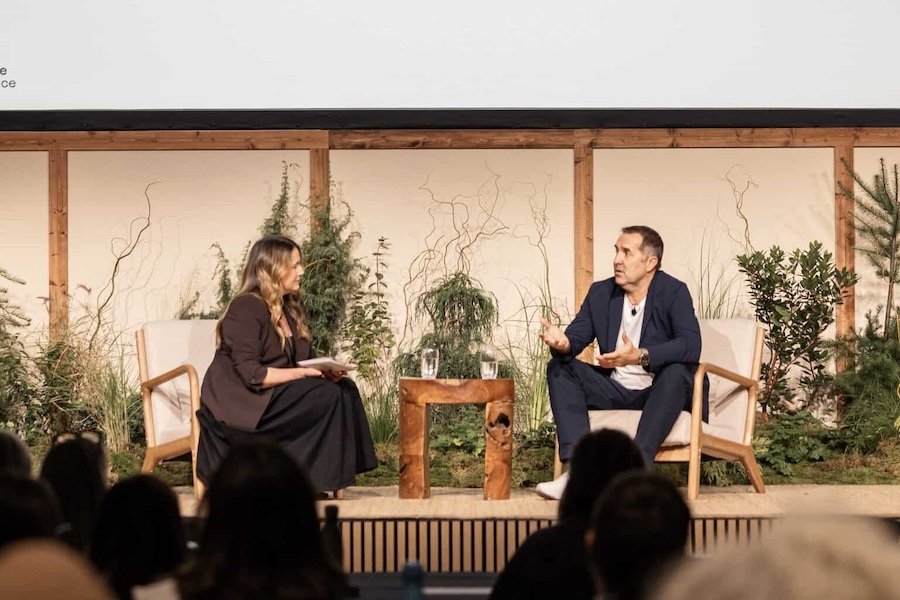
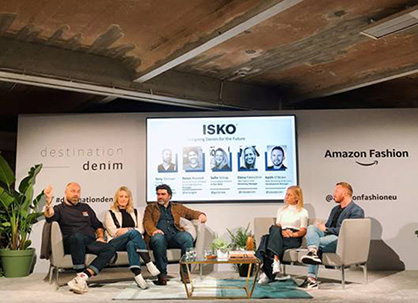
On Sunday, October 27th, ISKO sponsored and hosted the panel “Designing denim for the future”, gathering four denim experts to discuss the industry’s current situation and what more could be done to ensure a more responsible future in fashion, highlighting how the sustainability global issue might be tackled through small but effective decisions.

Targeting the entire production chain, to foster awareness and knowledge among industry players and final consumers, the discussion was led by Keith O’Brien, ISKO Marketing & Business Development Manager, and involved Elena Faleschini, ISKO Global Field Marketing Manager, Sophie Schope, G-star Sustainability Manager, Tony Tonnaer, Kings of Indigo Founder and Roian Atwood, Wrangler Senior Director of Global Sustainable Business.

Moderator: Keith O’Brian

ISKO Marketing & Business Development Manager

Keith is Marketing & Business Development Manager at ISKO, leading denim ingredient brand behind everyone’s favorite jeans. The company is committed to developing an integrated field- to-fabric approach in every step of the value chain, with a strong focus on preserving the planet, its resources and its people. Keith leads the strategic marketing activity and brand partnerships in the UK with a focus on positioning ISKO as a leader in Responsible InnovationTM in the UK market.

Elena Faleschini

ISKO Global Field Marketing Manager

Elena Faleschini is Global Field Marketing Manager at ISKO, leading denim ingredient brand for the fashion industry and pioneer in the world of responsible denim production. She manages and defines business strategies with key clients globally, overseeing marketing activations such as co-branding, events, trade shows, training, and road shows in line with the company’s Responsible InnovationTM approach.

Sophie Schope

G-star Sustainability Manager

Sofie believes that with transparency at the top of its agenda, the fashion industry can make huge changes to becoming more sustainable. Through her work as Sustainability Manager at G- STAR – implementing new strategies, working with suppliers and partners, as well as managing collaborations and new initiatives – she is navigating the denim giant into a more sustainable future.

Tony Tonnaer

Kings of Indigo Founder

Firm in the belief that neither sustainability nor quality should be compromised for a stylish end- product, Tony founded Kings of Indigo to make sustainable denim and clothing that is made to last, and does not cost the earth. The Amsterdam-based brand helps customers shop thoughtfully by being totally transparent – from the specific organic cotton content of each item to their entirely recycled labels.

(c) 2019 ISKO
(c) 2019 ISKO


Roian Atwood

Wrangler Senior Director of Global Sustainable Business

As Wrangler Senior Director of Global Sustainable Business, Roian Atwood has covered a major role in the shift to more positive practices. Wrangler has led the charge of late, developing the IndigoodTM Foam-Dye process to eliminate water waste from the dyeing process as well as use 60% less energy and produce 60% less waste.

Responsible InnovationTM to enhance industry improvement.

As emerged during the discussion and its opening video, responsibility in the fashion industry is a valuable and feasible option to be developed through awareness and collaboration. Miles Johnson’s “Light on the Land” was presented at the beginning of the panel as an example of this positive and responsible approach. Realized with the support of both ISKO and its research on style and design hub Creative RoomTM, this is a project featuring innovative textile concepts belonging to the R-TWOTM platform, the latest advancement of the mill’s reusing and recycling strategy.

These fabrics are made with a mix or blend of reused cotton, obtained from production loss with Content Claim Standard Certification (CCS) of Textile Exchange, and recycled polyester certified by the Recycled Claim Standard (RCS) or Global Recycle Standard (GRS), depending on the percentage used.

The platform delivers a futuristic and innovative responsible approach, as it allows to decrease the usage of raw materials while improving sourcing efficiency through the recovery of production losses. These are added back into the spinning process to obtain re-used cotton yarn that is fully traced, documented and audited. This verification process has been pioneered by the company in partnership with its yarn supplier Sanko, offering full clarity into the traceability of re-used cotton from field to fabric. The reused cotton is then blended with the certified recycled polyester to create R-TWOTM fabrics.

With a strong holistic Responsible InnovationTM approach deeply rooted in the company’s DNA, ISKO has committed to the quest for increasingly sustainable solutions since the very beginning.

Being the first mill in the world awarded both the EU Ecolabel and Nordic Swan Ecolabel, the company has a portfolio of 25,000+ responsibly produced textile concepts, ranging from traditional denim to cutting-edge patented technologies. Life-Cycle Assessments (LCAs) have been obtained for each one of them, ensured by independently verified Environmental Product Declarations (EPD®s). These assess the lifecycle of products and provide the water usage and carbon footprint of 1 square meter of fabric to allow our customers make responsible sourcing choices.

To further advance the development of increasingly sustainable ways to tackle textile productions and to maintain an open dialogue with all the different stakeholders, ISKO has also become part of Textile Exchange in March 2019. This global non-profit organization focuses on minimizing the impacts of the textile industry on the world’s water, soil, air and people, allowing the mill to shape and design more responsible business models and more efficient practices.



More News from TEXDATA International

#Texprocess 2026

Texprocess 2026: Automation, digitalisation and AI reshape textile processing

Investment decisions in textile processing have become increasingly complex. Rising energy prices, labour shortages and geopolitical uncertainties are forcing companies to prioritise technologies that deliver measurable improvements in efficiency and process stability. This applies not only to apparel production, but also to the processing of technical textiles and high-performance materials. Modernisation projects are therefore being evaluated more selectively – but the pressure to upgrade production systems continues to grow. Texprocess 2026 reflects this tension between cautious investment behaviour and increasing technological demand.

#Techtextil 2026

Textile Chemicals & Dyes: Innovation in Textile Chemistry moves into focus at Techtextil 2026

From PFAS-free finishes and water-saving dyeing technologies to advanced coatings and recycling-compatible formulations, innovation in textile chemistry is accelerating across the industry. Reflecting this development, Techtextil 2026 introduces Textile Chemicals & Dyes as a dedicated product segment, highlighting the growing role of chemical solutions in shaping the next generation of technical textiles.

#Recycling / Circular Economy

textile.4U publishes special edition “Top 100 Textile Recycling Companies 2025”

With a comprehensive 176-page special edition, textile.4U is dedicating its latest issue entirely to one of the most dynamic and influential topics in today’s textile industry: textile recycling. The new issue, published exclusively in high-quality print, presents the Top 100 textile recycling companies researched and selected by TexData – organizations that already play a key role in the transition to circular textiles or are expected to have a significant impact in the near future.

#Recycling / Circular Economy

Responsible Textile Recovery Act of 2024 signed by Governor

Senator Josh Newman (D-Fullerton) is proud to announce that Senate Bill 707 (SB 707), the Responsible Textile Recovery Act of 2024, has been signed into law by the Governor of California, Gavin Newsom. This groundbreaking legislation establishes the country’s first Extended Producer Responsibility (EPR) textile recycling program, marking a significant step forward in the state’s efforts to combat waste and promote sustainability.

More News on Denim

#Denim

Jeanologia launches Billy

The new AI extracts precise laser designs from a garment image in minutes, transforming how vintage denim is recreated for production. If Jeanologia’s laser changed the way jeans were made at the end of the last century, its AI now takes the next step: moving from reproducing wear to designing it. / archive photo © 2026 Jeanologia

#Textile chemistry

Jeanologia urges industry to accelerate PP Spray phase-out following ZDHC Watchlist update

Potassium permanganate has officially entered the Chemical Watchlist of the ZDHC Foundation, signaling increased scrutiny and potential phase-out of one of the most hazardous chemicals still used in denim finishing. The inclusion confirms an industry shift that Jeanologia anticipated more than a decade ago.

#Denim

ISKO’s denim language at Bluezone

ISKO returns to Bluezone to showcase its latest advancements in denim innovation, presenting a comprehensive overview of its SS27 collection alongside key creative and technological collaborations. At booth C02, ISKO offers visitors an immersive look into how performance, design, and circular thinking are shaping the future of denim.

#Fabrics

MUNICH FABRIC START: Between Attitude and Sensuality

The future begins where we reimagine it. After seasons of restraint, Spring.Summer 27 marks a conscious counter-trend: optimism, sensuality, and creative freedom are replacing pragmatism and neutrality. Physical presence and individuality are regaining importance – as a response to uncertainty, exhaustion, and algorithmic predictability. The overarching theme of PLEASURE stands for fashion as an emotional space, as an expression of attitude and cultural reflection. Colours, surfaces, and materials become vehicles for self-confidence and joie de vivre.

Latest News

#Textile chemistry

A flagship for chemical production: BASF inaugurates world-scale Verbund site in China

BASF today (March 26, 2026) celebrated the official inauguration of its newly built, world-scale Verbund site in Zhanjiang, Guangdong Province in southern China. Covering an area of around four square kilometers, it is more than a major BASF project in the chemical growth market of China. “Zhanjiang shows what the future of chemistry looks like: efficient, digital and sustainable by design. The site showcases a smart integrated Verbund structure on an industrial scale,” said Dr. Markus Kamieth, CEO of BASF, at the ceremony attended by representatives from government, customers, business partners and employees.

#Nonwovens

VEOCEL™ Lyocell production expands to Asia – Launching a new chapter for nonwovens in the region

VEOCEL™, Lenzing's flagship specialty nonwovens brand, expands production at its Thai plant in Prachinburi. This is the first-ever production of its nonwoven-grade lyocell fibers in Asia. Built in 2022 with a 100,000-ton annual production capacity, the facility - previously focused on fibers for textile applications - now can directly meet the demand for VEOCEL™’s biodegradable¹, wood-based lyocell fibers for nonwovens products. These fibers are an essential ingredient for high-quality nonwovens products, ranging from baby wipes to facial sheet masks and everyday personal hygiene items.

#Research & Development

Hof University develops sustainable textile coating for the fashion of tomorrow from mushrooms

Clothing is often treated as disposable: T-shirts for events, general merchandise, or short-term campaigns frequently end up in the trash after only a few uses. This is particularly problematic given that their production still largely relies on fossil-based materials. This is precisely where a new research project at Hof University of Applied Sciences comes in.

#Raw Materials

Fashion for Good mobilises industry to adopt mass balance attribution and accelerate decarbonisation

Fashion for Good launches today the Mass Balance Demonstrator project, a collaborative industry initiative to implement and scale the mass balance attribution (MBA) chain-of-custody model for biomass-attributed PET in textile applications. The project represents a concrete step toward accelerating brand-driven decarbonisation across the apparel value chain.

TOP