#Composites
COMPOSITES EUROPE trade fair to show latest developments for wind power industry
An on-shore wind turbine built in Germany in 2013 has an average (hub) height of 117 metres, a rotor diameter of 95 metres and an output of 2,598 kW. All 23,645 installations currently active in Germany generate approximately 33,730 MW, which averages out to 1,427 kW per wind turbine. By way of comparison, the analogous cumulative figures for 2003 were 15,387 installations putting out about 14,609 MW or 949 kW on average. These figures, published by the German Wind Energy Association, show that both the number of installations and the capacity has increased, but they also indicate that a wind turbine built today is significantly larger and more powerful than those just ten years ago.
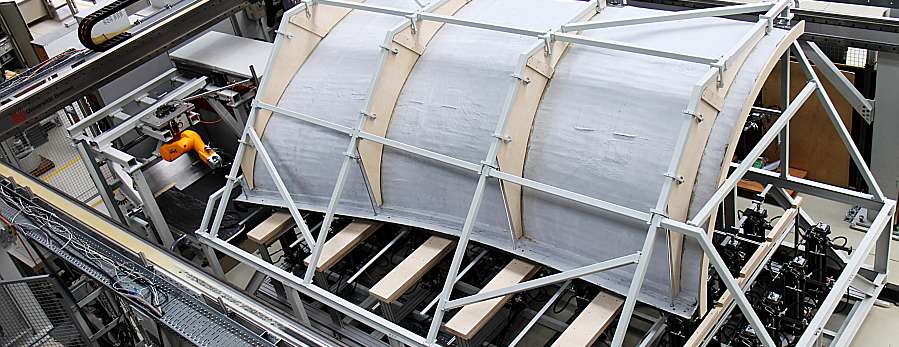
The advantages of the Mapretec system lie in the reduction of layup time and the possibility for parallel production of preforms. Overview of the joint Mapretec research facility at the Institute for Integrated Product Development (BIK) at the University of Bremen.
Saertex: two-dimensional layup of NCF layers
One of them is Saertex. Together with partners and with the support of the German Environment Ministry, the company has been a key promoter of the “Mapretec” innovation project. Project research revolves around the automated two-dimensional layering of individual NCF layers, which are then shaped using 3D preform technology. The advantage of the preform process over conventional methods is that it saves significant amounts of time while only adding a limited amount of complexity, thus enabling automation.
Current automation concepts in the manufacturing of rotor blades for wind power plants are limited to the automated tape laying of the highly stressed rotor blade spar caps. Even though such ideas may be promising and useful, they can’t be applied to other parts of the rotor blade production process because of the complex 3D geometry involved. This complexity is what prevents the seamless execution of automated processes, which would be far too expensive anyway.
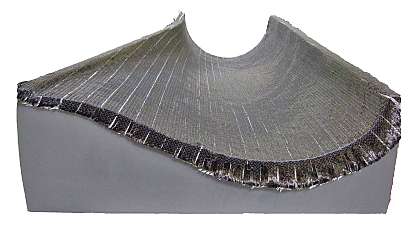
In the Mapretec process, the plain layup of the single layers to a 2D preform takes place on a morph field equipped with a flexible membrane. Hydraulic actuators under the membrane then form the stack against the rotor blade segment mould over the membrane. The preforming process starts at the neutral point of the stack and then transforms the 2D stack into a 3D preform. The main advantages with this method are the reduction of layup time and the possibility for parallel production of preforms to reduce the amount of layup work in the rotor blade mould.
But Mapretec offers valuable advantages compared to the manual process beyond a higher processing speed. For instance, the use of sensitive and flexible hybrid textiles minimises form and position errors. The high accuracy of the process also results in increased quality of the finished product. Because of the higher accuracy, an option exists to reduce the number of textile layers building the rotor blade without reducing reliability. In turn, the resulting weight reductions allow for resource-efficient production and more economic operation of the wind plant.
3B Fibreglass tests new composite for turbine blades
The majority of materials currently used in the manufacture of wind turbine blades are based on epoxy resins. These are able to withstand stresses well, but they’re difficult to process and sensitive to process fluctuations while requiring time-consuming post-cure in order to reach optimum physical properties. With 3B Fibreglass, COMPOSITES EUROPE will feature a company presently developing a new composite for wind turbine rotor blades in cooperation with a number of European partners. Siemens Wind Power in Denmark is currently evaluating the material, which is intended to deliver numerous benefits to manufacturers, including a major reduction in blade manufacturing costs and improved process output.
The new material combines excellent performance results in manufacturing and application: easy resin infusion and processing, zero styrene emissions and outstanding fibre/resin interaction for superior fatigue resistance. The system is based on DSM’s Beyone 201-A-01, a resin that is styrene-free, cobalt-free (based on BluCure™ Technology) and 40% bio-based. The system also incorporates 3B Fibreglass’ novel SE3030 glass rovings. Enhanced adhesion to the reinforcement is achieved through an optimised sizing applied on the glass filament.
The sizing ensures excellent fibre/resin interaction, resulting in improved composite properties and longer-lasting blades. In addition, the project partners have been able to demonstrate that this system can be used to produce long blades at record speed thanks to faster resin infusion and reduced post-cure requirements. The end result: increased output per mould and outstanding process consistency.
Dow: new line of adhesives for resilient rotor blades
Chemical specialist Dow, another exhibitor presenting at COMPOSITES EUROPE, is also researching applications for wind energy customers. The company recently announced a further development of its Airstone family of products. When producing extremely long and durable wind blades, designers and manufacturers will now be able to use the new Airstone 87 series of high-elongation adhesives. According to the company, epoxy systems are the perfect material for rotor blades since they deliver improved performance compared to conventional polyester composites while matching their strength and low weight. In addition to modern infusion systems, Dow also offers special hardeners for manufacturing larger blades.
3A Composites presents PET foam core material with optimised formability
3A Composites has developed a new generation of the PET foam core material Airex. Sequentially dubbed “GEN 2”, it features a very homogenous cell structure and yet further enhanced mechanical properties compared to the successful Airex T92. While it remains a recycled and recyclable material, its formability and processing have also been optimised. Thanks to Multishape, the state-of-the-art automated production process implemented by 3A’s composites partner Gaugler & Lutz, GEN 2 delivers significant cost savings to end users. Both companies will present their know-how at COMPOSITES EUROPE.
Zoltek creates new trend: production-ready CFRP materials as structural components
Also represented will be Zoltek, a company that last year introduced pultruded profiles, based on the Panex 35 product line, for the structural reinforcement of advanced wind turbine blades. Since then, they have been extensively tested and deployed in real-world applications. For example, wind blade spar caps have been manufactured that are characterised by their high fibre volumes, locked-in filament alignment and nearly zero void content. Zoltek hopes this new semi-finished product will enable the company to offer pre-cured and/or production-ready carbon fibre materials as structural components to the wind energy sector, thus creating a new trend.
Pic: The advantages of the Mapretec system lie in the reduction of layup time and the possibility for parallel production of preforms. (c) Photo: Composites Europe / Saertex
COMPOSITES EUROPE presents production solutions
After eight successful events, COMPOSITES EUROPE – in conjunction with the International AVK Conference – has become firmly established as the leading German trade fair event for fibre-reinforced plastics. Some 440 exhibitors from 25 nations are expected at the Düsseldorf Exhibition Centre from 7 to 9 October. COMPOSITES EUROPE will present a comprehensive overview of the entire composites spectrum. Automation of high-volume processes for manufacturing composites components will play a central role again this year. New lightweight construction concepts, materials and state-of-the-art production and automation solutions will be on display. COMPOSITES EUROPE is organised by trade fair organiser Reed Exhibitions in cooperation with the European industry association EuCIA, the German Federation for Reinforced Plastics AVK, the VDMA Forum Composite Technology and the international trade magazine Reinforced Plastics.
The leading international trade fair ALUMINIUM will take place at the same time. The world’s largest industry event for the aluminium sector will bring together aluminium manufacturers and processors as well as providers of production, processing and finishing technology and equipment. Across four exhibition halls, some 940 exhibitors from 50 nations will showcase the industry’s entire spectrum of products and services: from the production of the material to processing to the finished product.