#Composites
Why composite materials require a more precise production process

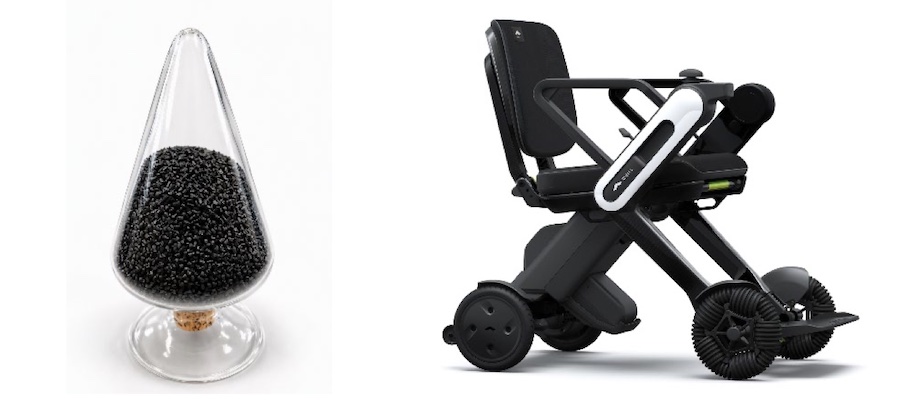
Unfortunately, it is not often that a single material has all of the desired properties or the ability to meet a variety of needs. In these instances, many opt to work with a composite material instead. Composite materials are developed by combining two or more materials with different properties in order to achieve specific needs in a material—such as something that is very light, yet also very strong. Examples can include kevlar, fiberglass, carbon fiber and many others.
While the new material has distinct advantages, it can also be very difficult to cut—and importantly, expensive to waste. For these reasons, it is important that there is a precise production process to minimize errors and optimize the use of the product.
Composites are unique materials wherein the components do not dissolve or blend together, but instead form a heterogeneous mixture. Most composites rely on one material serving as the matrix and the other (often stronger) material as the reinforcement. Composites are used in a variety of industries including aerospace, military and personal protective equipment (PPE).
The first developed, and most common composite, is fiberglass. Fiberglass is made from plastic with fibers or filaments of glass embedded in order to provide reinforcement to the material, yet still minimize weight. Another example is Kevlar which can be used as a reinforcing material (due to its strength and toughness), and, when it is combined with a lighter matrix material, can provide added reinforcement to products that require lightweight and reliable construction, such as an aircraft or even PPE. Other applications, such as building conductors, insulators or improving magnetic properties can also be achieved with composites.
Composites are challenging to work with, largely due to their designed toughness. Fiberglass, for example, has threads of glass that are very strong under tension, but are also brittle if they are bent. Because of the matrix in the material, the fibers are held in place and any stress is shared across the fibers. This allows for the material to be shaped carefully with tools, or softened with specific solvents.
However, anytime there is a deformation in the material—the fibers are inherently stretched. The composition of the material can handle some stretching by distributing the load, but if not handled correctly can still break.
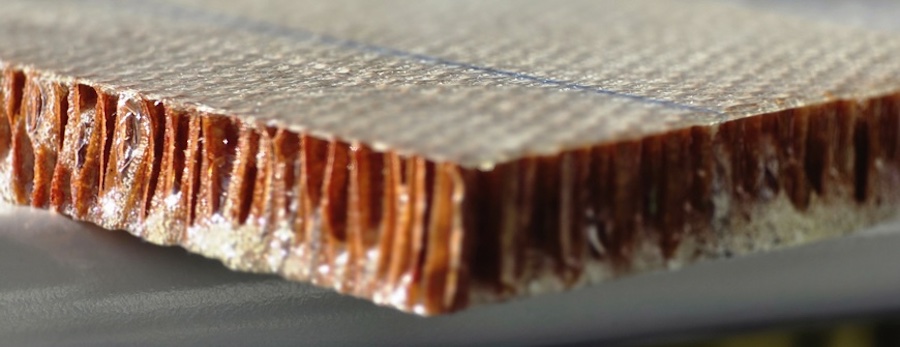
Both manual and automated processes can be used for developing the unique composite materials, and these methods contribute to the complexity of the materials. Composites are often built by layering sheets of material until a desired thickness is achieved prior to curing. Another approach includes building a honeycomb of material sandwiched between two reinforced materials. These complex structures, and reinforced materials, make it very difficult to cut or shape composites precisely after they have cured. In the example of the honeycomb, cuts can weaken the structural integrity and the varying density can create a non-uniform cut if not properly managed.
Many composites are very durable and also heat resistant, which can limit other cutting applications. Furthermore, since composites are often uniquely designed—they are also very expensive. For these reasons, many initially will have a manual process for cutting and preparing composite material. A manual process can be useful for attention to detail and mitigating the unique properties of the material, but it is also imperfect.
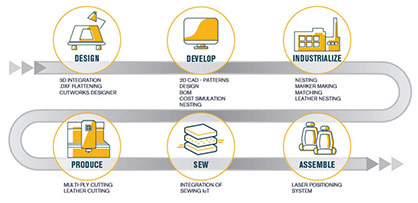
Another option is to automate the process with machines such as the Gerber MCT Cutter and the GERBERcutter® Z1 IoT-connected, industrial fabric cutting machines. These types of smart machines can improve efficiency and automate the level of cutting precision. With many being both programmable and adaptable, this allows for a piece of technology that can be used on a variety of projects and with a variety of composite materials. As the project needs change, the technology adapts. Using patterns based on the unique characteristics of the material, improving cut planning and optimizing the cutting process with next-generation CAD and cut planning software all yields a higher probability of success, and less waste of time and material.
Another strategy to optimize efficiency can include the use of laser templating solutions. A laser outline of the design template is projected in 2D or 3D, operators can be guided through the process of layup, part fabrication, assembly and component placement. This minimizes the need for manual procedures, such as measuring and marking and using physical templates, instead you create digital data of your process. Lasers can also measure the accuracy and quality of two-dimensional and formed parts, which can help ensure that a high level of accuracy is achieved in the most efficient manner. Whether it is through the use of an automated laser, or an automated cutting machine—finishing efficiency can be dramatically improved over manual methods. In the time it could take to cut one composite product, 10 more could have been not only cut, but cut to a higher level of precision and accuracy with less waste and errors. These types of gains are hard to ignore in an industry with high costs, and an often high demand for precision and quality.