[pageLogInLogOut]

#Composites

Airplanes to delivery vans: composites gain ground

Accelerating the industrialisation of composite parts manufacturing © 2020 Solvay
A Solvay partnership in the UK is paving the way for the industrialisation of the production of composite material parts for vehicles, making for quicker and easier manufacturing as well as lightweighting that reduces CO2 emissions. New delivery vans for British supermarket chain Asda are the first to benefit, but the aerospace industry is paying close attention…


Better design, lower emissions, reduced costs: the composite miracle

As a leading supplier of high-performance composite materials, Solvay has been collaborating for many years with Penso, a British manufacturing company specialized in the production of automotive parts made of those very materials. A few years back, the two companies partnered to create the Flexible Lightweight Architecture for Volume Applications consortium (FLAVA), to establish a composite supply chain for the automotive industry that would enable design flexibility, logistics simplification and lightweighting to meet emissions legislation while reducing costs.

Reaching these objectives requires increasing volumes and demonstrating the possibilities offered by industrialisation. “Composite parts for the automotive industry are still a relatively small market,” says Gérald Perrin, Head of Automotive Market Strategy at Solvay’s Composite Materials. “So we’ve been working on solutions to reduce costs and make manufacturing processes more robust in order to enable mass production.”

© 2020 Solvay
© 2020 Solvay


To prove the validity of these new manufacturing processes, Solvay created a pilot unit at its facility in Heanor, UK to demonstrate that a fully robotized manufacturing process for composite parts was possible. The result: the rapid production of perfectly identical, flawless parts without any human intervention, with manufacturing times that are a fraction of what they are with metal.

In 2017, FLAVA was awarded a multi-million-pound grant by the UK’s Advanced Propulsion Centre (APC), and Mercedes-Benz Vans UK became a project partner. “Through FLAVA, we were able to demonstrate that composite intensive vehicles could be produced industrially,” says Gérald. “We did this by investing in product development and automation R&D. FLAVA is a stepping-stone on our industrialisation roadmap.”

A game-changer for grocery deliveries

A few years down the road, the result of this multi-partner collaboration is visible in the streets of Britain, through Asda’s new fleet of delivery vans, whose carbon fibre and recycled plastic bodies make them 300kg lighter than standard vehicles. “Our new van has the potential to be a game-changer for our grocery delivery operations,” says Sean Clifton, Asda’s Senior Fleet Manager in a recent article in Global Cold Chain News. “It is the culmination of collaboration between Asda’s Fleet Team, Mercedes, Penso and many other key partners.”

All this was made possible by working on the chemistry of composites: accelerating their polymerisation means they can be manipulated by robots, which means they can be mass produced, which in turn means their incorporation in vehicles such as everyday use delivery vans becomes commercially viable - with many benefits to reap: “Composite materials provided by Solvay enable design innovation, allowing us to concentrate performance where it is required, resulting in huge structural efficiency”, explains Dave Roche, Penso’s Technical Director. “It's also worth noting the CO2 reduction, which starts with material selection, is magnified with our processing methods and use of recycled materials.”


What’s more, with far superior corrosion and impact resistance, composite materials have a lifetime that is nearly double that of metal: parts can last up to ten years instead of five on average.

Miles to go for composite manufacturing

And this is just the beginning. Home delivery of online purchases is a rapidly expanding market, generating substantial demand growth, with specific technical requirements such as modularity and thermal resistance, as vans such as these have to be able to transport goods at sub-zero, refrigerated and ambient temperatures simultaneously.

Composite parts are capable of meeting all these requirements, and more: in addition to making vehicles lighter, the improved design flexibility they provide means each one of Asda’s new delivery vans can transport up to 30% more merchandise. “Stunning payload improvement will help reduce trips, miles and hours on the road,” confirms Sean in Global Cold Chain News. “Coupled with sleek, aerodynamic design, we are expecting a significant reduction in fuel usage and emissions. With the backdrop of the pandemic, I’m delighted we have been able to bring this innovative vehicle into our stores this year.”
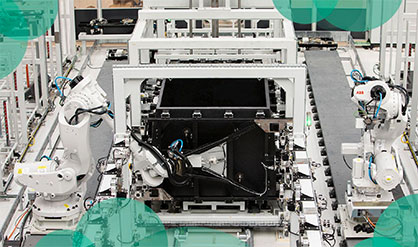
Penso robot line © 2020 Solvay


Even the sky isn’t the limit for composites

With Asda’s fleet of vans, Solvay and its partners were able to demonstrate that industrializing the manufacturing of composite parts was technically and commercially viable. In fact, Penso’s fully robotized assembly plant for these trucks began full-scale manufacturing in 2020.

Needless to say, the intensive use of composites is bound to rapidly expand beyond delivery vans. “Now that this new market is in the process of being inaugurated, our interest is to transpose these manufacturing processes to other markets such as large-scale car production and the aerospace industry,” says Gérald. Technological partnerships with some of the major players in these industries have already been signed, and visits to the Heanor pilot unit by interested customers started early 2020.

A traditionally conservative industry where innovations are implemented slowly, the aerospace sector is increasingly looking at technological developments in the faster-moving automotive industry. “The manufacturing processes and chemistries we have developed for this project have demonstrated their validity,” sums up Gérald. “They are now ready to be widely deployed.” Composite parts for vehicles of all sorts just moved into the fast lane.



More News from TEXDATA International

#Recycling / Circular Economy

textile.4U publishes special edition “Top 100 Textile Recycling Companies 2025”

With a comprehensive 176-page special edition, textile.4U is dedicating its latest issue entirely to one of the most dynamic and influential topics in today’s textile industry: textile recycling. The new issue, published exclusively in high-quality print, presents the Top 100 textile recycling companies researched and selected by TexData – organizations that already play a key role in the transition to circular textiles or are expected to have a significant impact in the near future.

#Recycling / Circular Economy

Responsible Textile Recovery Act of 2024 signed by Governor

Senator Josh Newman (D-Fullerton) is proud to announce that Senate Bill 707 (SB 707), the Responsible Textile Recovery Act of 2024, has been signed into law by the Governor of California, Gavin Newsom. This groundbreaking legislation establishes the country’s first Extended Producer Responsibility (EPR) textile recycling program, marking a significant step forward in the state’s efforts to combat waste and promote sustainability.

#Textiles & Apparel / Garment

Modtissimo promotes sustainability with 28 coordinates in the Green Circle

Modtissimo is proving more and more to be a textile and clothing show that delivers the latest innovations in the area of sustainability, with the iTechStyle Green Circle being the main showcase for companies' creations. In this 60+4 edition, taking place on 12 and 13 September, 28 coordinates will be exhibited in a section organised by CITEVE and curated by Paulo Gomes.

#Europe

The EU and Egypt team up to mobilise private sector investments at Investment Conference and sign a Memorandum of Understanding underpinning €1 billion in macro-financial assistance for Egypt

At the EU-Egypt Investment Conference, co-organised by the EU and the Government of Egypt on 29-30 June, the EU and Egypt are teaming up to intensify private sector investments in Egypt. They are also signing a Memorandum of Understanding (MoU) for the disbursement to Egypt of up to €1 billion in Macro-Financial Assistance.

More News on Composites

#Associations

Driving innovation in technical textiles, digitalisation and testing

Members of the British Textile Machinery Association (BTMA) can look back on 2025 as a year marked by notable technological advances and continued progress in global trade, despite an uncertain and volatile market.

#Composites

MEL Composites delivers advanced hull infusion for Técnico Solar Boat’s hydrogen-powered São Gabriel 01

MEL Composites has reinforced its partnership with Técnico Solar Boat through the successful hull infusion of the São Gabriel 01, an 8m long, 2.4m wide, hydrogen-powered hydrofoiling vessel. Designed to compete at the Monaco Energy Boat Challenge in July 2026, the São Gabriel 01 is the team’s most technically demanding project to date and showcases the future of sustainable marine engineering by combining advanced composite manufacturing with clean energy systems.

#Composites

Sicomin appoints CS Kompozyty as exclusive Distributor for Poland

Sicomin is pleased to announce the appointment of CS Kompozyty as its exclusive distributor for Poland. The partnership will provide Polish composite manufacturers with comprehensive access to Sicomin's broad range of performance epoxy resins, green epoxies, hardeners, and adhesive solutions, supported by local technical expertise and rapid delivery capabilities.

#Composites

JEC World 2026 reveals the list of finalists for the Innovation Awards

Each year, the JEC Composites Innovation Awards recognize collaborative, innovative, and ambitious projects that illustrate the potential of composite materials. Created in 1998, this benchmark program aims to identify, promote, and reward the most innovative composite solutions worldwide. In 28 years, the JEC Composites Innovation Awards have attracted more than 2,200 participating companies from around the world. A total of 269 companies and 811 associated partners have been recognized for the excellence of their innovations.

Latest News

#Dyeing, Drying, Finishing

Stefan Moll becomes new CEO of the machinery manufacturer

Starting January 1, 2026, Stefan Moll will take over the management of Mahlo GmbH + Co. KG, the world’s leading provider of measurement and control technology for web-shaped materials. With this move, Mahlo is focusing on the long-term safeguarding of its market position and technological leadership. The current CEO, Rainer Mestermann, will leave the company after 14 years as part of a planned succession arrangement.

#Spinning

Barmag's new texturing machine impresses the market

Since its premiere at ITMA Asia + CITME 2025, the eFK EvoSmart texturing machine has achieved impressive market success. The innovative technology is winning over yarn manufacturers worldwide who are committed to energy-efficient and economical production processes. A total of 84 machines has already been sold – including in China, Turkey, and Indonesia – a clear sign of the industry's confidence in this forward-looking solution.

#Yarns

Durak Tekstil enters 2026 with positive momentum, strengthens its global market focus

Durak Tekstil, maintaining its profitability and turnover levels in 2025 compared to the previous year, prioritizes growth through its export-oriented sales strategy. Increasing both its capacity and utilization rate, the company anticipates further gains in 2026 through expansion in global markets.

#Heimtextil 2026

Global textile expertise meets high-end contract design: Heimtextil and Hospitality Interiors Europe announce partnership starting 2027

Heimtextil further expands its role as the global leading trade fair for home and contract textiles and textile design – and starts a new partnership with the format Hospitality Interiors Europe (HINT). With the launch, a complementary event will take place alongside Heimtextil 2027, targeting decision-makers from the hotel and high-end hospitality design sector. Both platforms combine their strengths, create tangible synergies for exhibitors and visitors – and expand the holistic interior design offering for architecture, interior design, hospitality and the contract sector. Hospitality Interiors Europe already presents itself at Heimtextil 2026 with its own dedicated lounge area.

TOP