[pageLogInLogOut]

#Yarn & Fiber

Lenzing lays the foundation stone for world’s largest lyocell fibers plant
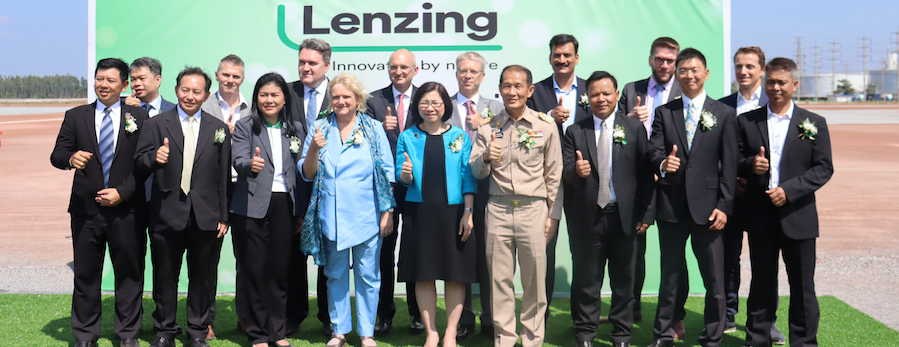
Laying of the foundation stone (c) 2019 Lenzing AG
Within the context of the foundation stone laying ceremony held on Friday, November 15, 2019, the Lenzing Group officially launched construction work in Thailand right on schedule to build the world’s largest lyocell production plant.

Following the approval granted to the project in June 2019 and the successful signing of the Engineering, Procurement, Construction Management (EPCM) contract with Wood PLC in August 2019, construction work was formally commenced on the new manufacturing facility located at Industrial Park 304 in Tatoom, Srimahapoj in Prachinburi province. The ceremony was attended by Prachinburi Governor Mr. Piboon Hattakitkosol, Ms. Eva Hager, Austrian Ambassador to Thailand, Mr. Duangjai Asawachintachit, Secretary General of the Thailand Board of Investment and more than 100 guests from society and politics. 
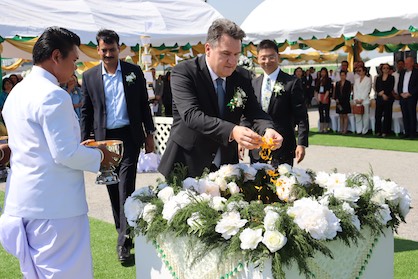

Christian Dressler, VP Global Engineering, laying of the foundation stone  (c) 2019 Lenzing AG
Christian Dressler, VP Global Engineering, laying of the foundation stone (c) 2019 Lenzing AG


Promising project for Lenzing

The new plant with a capacity of 100,000 tons per year will be the largest lyocell facility in the world. It will help Lenzing to meet the strong demand for lyocell fibers and simultaneously strengthen the company’s market leadership position for specialty fibers.

The investment volume for a first production line amounts to EUR 400 million. Up to three additional production lines can be built and operated on the site. The project is of great importance to Lenzing as it is the first step in bringing lyocell production to Asia, home to the largest markets, the most important customers and the most extensive growth potential in specialty fiber production. The new manufacturing facility is scheduled to be completed in the third quarter of 2021, with production of the first fibers already expected for the fourth quarter of the same year.
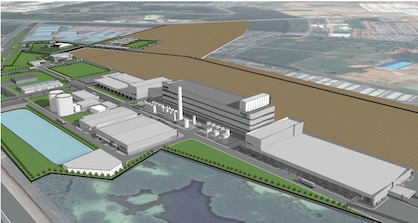
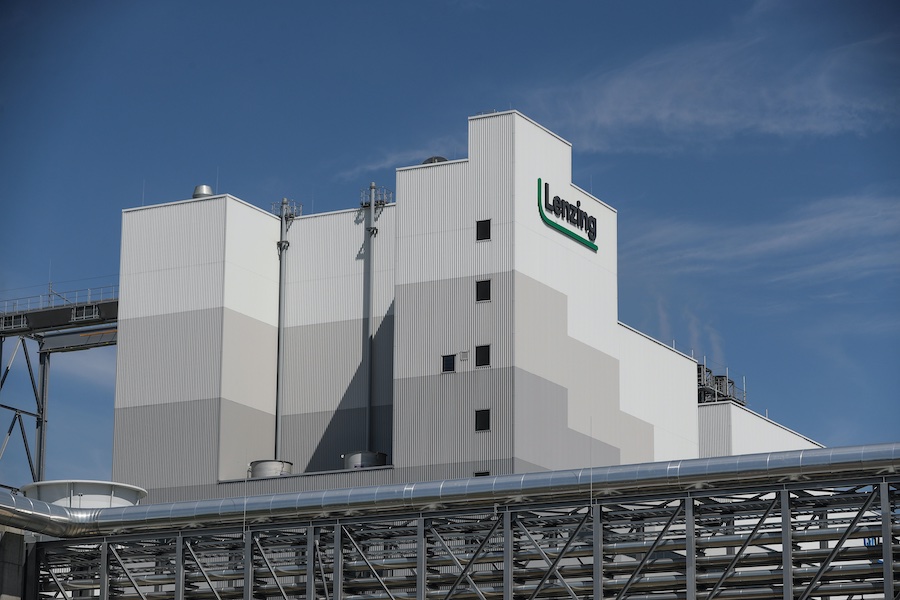
Prachinburi - Lyocell plant (c) 2019 Lenzing AG


More News from Lenzing

#Nonwovens

Lenzing Group highlights scalable, bio-based nonwovens solutions at leading global industry fairs

From CIDPEX in China to Techtextil in Frankfurt and INDEX in Geneva, the Lenzing Group showcases ready-for-market, bio-based nonwoven solutions and receives industry recognition for LENZING™ Nonwoven Technology.

#Yarn & Fiber

Lenzing AG appoints Georg Kasperkovitz as Chief Executive Officer

The Supervisory Board of Lenzing AG has appointed Georg Kasperkovitz, Member of the Management Board and Chief Operations Officer, as Chief Executive Officer (CEO) of Lenzing AG with effect from June 1, 2026.

#Denim

TENCEL™ Lyocell - HV100 achieves global denim availability in six months; Vol. 2 debuts at Kingpins Amsterdam

When TENCEL™ Lyocell - HV100 debuted at last year’s Kingpins Amsterdam in October, 17 mill partners across five countries presented fabrics featuring the new fiber. Just six months on, participation has more than doubled, evolving into a global network that spans nine countries and four continents, signaling both strong industry momentum and growing demand.

#Techtextil 2026

Lenzing unveils three-tier cellulosic fiber portfolio for next generation protective wear

The Lenzing Group, a leading supplier of regenerated cellulosic fibers for the textile and nonwovens industries, today introduces Lenzing Solutions for Protective Wear. This integrated three-tier portfolio is anchored by LENZING™ FR fibers at the highest protection tier for inherent flame resistance and brings together complementary solutions including TENCEL™ Lyocell fibers, both EU Ecolabel-certified² and derived from certified or controlled wood sources³, within a unified protective wear architecture for the first time. The launch marks the most significant expansion of Lenzing’s protective wear business since the company pioneered inherently flame-resistant cellulosic fiber in 1977, and comes as the global personal protective equipment (PPE) market accelerates toward an estimated USD 130 billion by 2033⁴.

More News on Yarn & Fiber

#Yarn & Fiber

R-Evenge chooses Q-NOVA® yarn by Fulgar for its line of technical socks dedicated to wellness

Q-NOVA®, Fulgar’s sustainable polyamide 6.6 yarn, has been selected by R-Evenge for the development of its collection of technical socks dedicated to wellness, fitness, and water-based activities.

#Yarns

Yarn Expo Shenzhen 2026 closes doors, advancing sustainable and innovative sourcing in South China

Yarn Expo Shenzhen 2026 served as a strategically positioned mid-year sourcing platform for the Greater Bay Area, highlighting Shenzhen’s role in connecting regional demand, supply and innovation exchange across the textile value chain. During the three-day fair, over 20,000 visits were drawn from 74 countries and regions[1], as exhibitors and buyers engaged with new developments in greener, performance-led, and value-added yarn and fibre solutions. Held in conjunction with Intertextile Shenzhen Apparel Fabrics and PH Value, the fair underscored the benefits of closer synergy and new materials across yarn, fabric and apparel platforms for the South China market.

#Yarns

Yarns and technologies in symbiosis: Biella Yarn presents Fall/Winter 2027/2028 collection “New Romance_”

Biella Yarn, the flat knitting brand of Suedwolle Group, launches new Fall/Winter 2027/2028 collection, inspired by the symbiosis of yarns and technologies – elements that blend, adapt and evolve together, forming something new without losing their origin. The name “Neu Romance_” reflects the emotional and neurological dimension of the yarns: a connection that engages the senses, experienced through material, touch and interaction. The collection is further brought to life through design collaborations, featuring selected yarns used in different design approaches.

#Recycling / Circular Economy

The textile industry in transition

Recycling, traceability, eco-design and digitalisation are among the key future challenges facing the European textile industry. The Erasmus+ project Skills4Circularity, involving 21 partners from twelve countries, is investigating the skills required to address these challenges. As the German industry partner, the Industry Association for Finishing – Yarns – Fabrics – Technical Textiles (IVGT) is bringing the industry’s perspective to the project.

Latest News

#Textile processing

YKK develops concept EXCELLA® zipper tape using nonwoven fabric partially derived from used clothing

YKK Corporation has developed a concept version of its premium EXCELLA® zipper series made from nonwoven fabric sheets created by fiberizing used clothing and other textile materials. Based on a proposal by fashion designer Yuima Nakazato, this item was created as a result of collaboration between Nakazato, Seiko Epson Corporation and YKK. The concept zipper was incorporated as a material component for pieces in the newest YUIMA NAKAZATO Couture Collection, “INFERNO,” which was unveiled in Paris, France on July 8, 2026.

#Textiles & Apparel / Garment

Texworld Apparel Sourcing Paris highlights evolving global sourcing landscape

From 31 August to 2 September 2026, Texworld Apparel Sourcing Paris will bring together more than 1,000 international exhibitors at Paris-Le Bourget Exhibition Centre. This edition reflects the new global balance of textile and apparel sourcing, highlighting a strong diversity of sourcing countries — some unexpected.

#Textile processing

Dedicated car seat model of SHIMA SEIKI’s P-CAM® R Cutting Machine unveiled

Leading Japanese textile solutions provider SHIMA SEIKI MFG., LTD. of Wakayama, Japan, showed a special version of its P-CAM® R multi-ply computerized cutting machine dedicated to the production of car seats for the first time, at a private exhibition held over two days on Thursday, July 2nd and Friday, July 3rd at the Kariya City Industrial Promotion Center in Aichi Prefecture.

#Research & Development

ALADIN paves the way for circular and demand-driven textile production in Europe

Textile production can be organized sustainably by utilizing short supply chains and preventing overproduction. This can already be achieved today by intelligently connecting and efficiently utilizing existing infrastructure. At the same time, production becomes circular when innovative technologies and materials are used that enable high-quality recycling. The ALADIN research project, launched in May 2026 and co-funded with five million euros under the EU Horizon Europe program, is creating the conditions for this.

TOP