#Associations
Retro is all the rage at the BTMA
“At this year’s ITMA 2023 it was clear that many new technologies are being developed that will do much to reduce resource consumption, but the reality is that faced with extremely tight margins, many textile companies are not in a position to invest in new capitally-intensive projects,” says BTMA CEO Jason Kent. “Outdated but mechanically sound machines used to be simply scrapped, with few other options, but this has now completely changed.”
Flawless mechanics
There are, for example an estimated 90,000 jet dyeing machines in operation worldwide and between 60-70% of them are outdated, which is something Adaptive Control Solutions is working to change.
The company’s widely-emulated Plant Explorer central control system sets the standard around the world for automation, with powerful features and ease of use, pulling together the control and monitoring of entire production plants and storing it in a standard Microsoft SQL Server database.
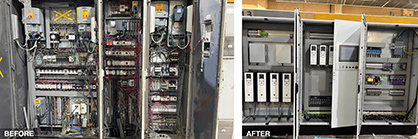
“We have successfully automated many makes and types of dyeing machine and found that the flexibility of PC-based controllers has allowed us to help customers in other parts of the dyeing and finishing plant as well, including with stenter frames and dryers,” says managing director Richard Armitage. “Our non-proprietary approach means that all this equipment can be monitored from a simple web-browser on the company network, while sophisticated integration and automation is going on in the background. Smart-coupling and joint-scheduling are standard features on these controllers, making it simple for supervisors and operators to run whatever batch sizes are needed.”
Longevity
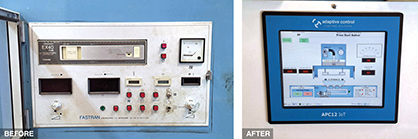
In a recent project, FTS Dyers, based in Langholm, Scotland, has had its existing radio frequency dryers fully rewired and equipped with new PLC control and sensors by Adaptive. Many of the original parts on these machines have been replaced over the years, with their longevity down to a skilled team of engineers. Now, howoever, they have been fully automated and connect with similarly upgraded dyeing vessels and controllers all linked to a central computer system.
“Many of the machines we have successfully upgraded date back to the 1970s and some of the very to as far back as the 1950s,” says Armitage.
Working with fellow BTMA member Roaches International, Adaptive also supplies software packages and control panels for the automation of autoclaves and curing ovens used in the manufacturing of advanced composites. Many companies in the field of Formula 1, marine and aerospace have benefited from these upgrades.
Unrivalled
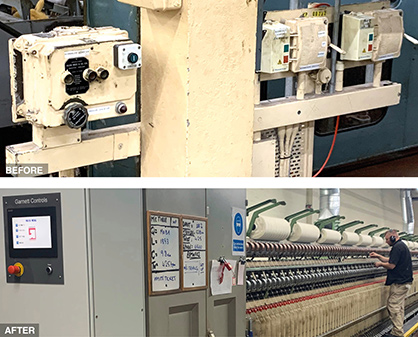
Garnett Controls has been a pioneer in the retrofit market since 1990, with an unrivalled number of installations in the fields of blending, carding, nonwovens and spinning. Well proven systems include the Microweigh XL and Rollaweigh weight control systems which have become industry standard.
In blending, the Lubric8 fibre lubrication system has been integrated into many existing blending plants to deliver the precise application of fibre lubricants, anti-static solutions and process additives.
The company also leads in the development and implementation of digital drive systems to replace conventional drives on textile and nonwoven machines, to achieve precise synchronisation with optimum energy efficiency. The latest retrofit drive systems come with sophisticated data collection to continually monitor and record performance whilst providing easily accessible historical information. The systems are supported both through a well-established network of agents and associates as well as directly via remote access.
“We’ve been installing the most advanced retrofit drive systems internationally for many years and we continue to develop our products as new technologies emerge,” says managing director Mark Baldwin. “Our retrofit systems are fully supported internationally by an experienced team and customers have reported achieving energy savings of up to 40% depending on the type of machine.”
Synchronous drive solutions
Tatham is another BTMA member offering retrofit services for OEM carding machines, crosslappers, needlelooms, blending systems, spinning frames and twisting and winding units.
The company’s TS Drive System is designed to run the motors at their optimum performance levels enabling considerable energy savings in the region of 30% to be achieved,
“TS Drive Technology is the most advanced product on the market for synchronous drive applications,” says director Tim Porritt. “It provides superior performance and accurate speed regulation even at low speeds.”
Moisture content
Moisture measurement and control systems which are retrofitted onto a wide range of production lines are the specialism of Streat Drycom. The Drycom system continually measures the moisture content of textiles and nonwovens during production and automatically controls the energy and/or speed of ovens and dryers in order to maintain the optimum moisture content.
“Moisture content is a critical factor in many sectors,” says managing director Alan Brydon. “Too much moisture in the product can result in processing issues which affect quality and can attract mildew. Too little moisture can damage fibres as well as being a significant and unnecessary cost of energy. Both affect true invoice weight which has a direct influence on profitability.”
Applications include ovens and dryers in the field of natural fibre scouring, cotton bleaching, latex curing in carpet backing, yarn setting lines and spray systems. Drycom is unique in that specific calibrations can be derived for different fibre types, additives and environmental conditions, thereby always providing optimum accuracy, efficiency and control.
“Most machines already in operation worlwide function flawlessly mechanically and BTMA members can offer many options via upgrades and automation to secure their production going forward, ensuring a sufficient margin of profit is retained by keeping them going,” says Kent in conclusion. “The cost-effective longevity of retrofitted machines makes sound and sustainable sense.”