[pageLogInLogOut]

#Recycling / Circular Economy

EURATEX and partners launch the new Horizon Europe innovation project on circular & sustainable textiles
© 2022 CISUTAC / EURATEX
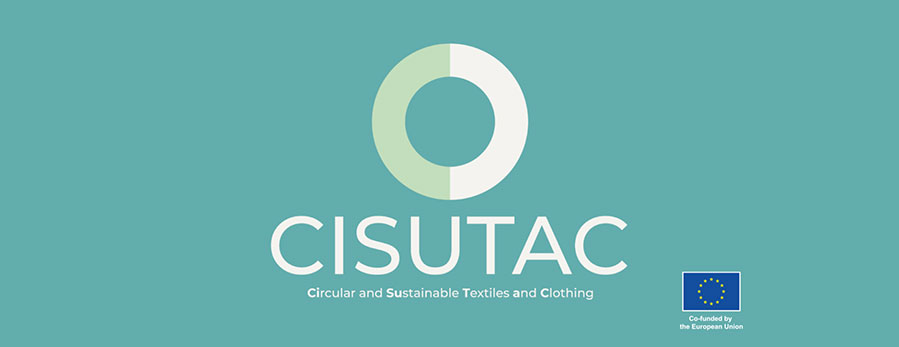
Launched today, the new Horizon Europe project CISUTAC will support the transition to a circular and sustainable textile sector. Launched today, the new Horizon Europe project CISUTAC will support the transition to a circular and sustainable textile sector. As part of a consortium of 27 partners working on the project, EURATEX will work towards facilitating the Circular Economy transition.

While the production and consumption of textile products continue to grow, so does the impact on the environment caused by a lack of reuse, repair and recycle of materials. Quality, durability, and recyclability are often not being set as priorities in the design and manufacturing of garments (EU Strategy for Sustainable and Circular Textiles, March 2022).

CISUTAC aims to remove current bottlenecks in order to increase textile circularity in Europe. The objective is to minimise the sector’s total environmental impact by developing new, sustainable and integrated large-scale European value chains.

The project will include most parts of the textile sector: comprising the 2 groups of fibres that represent almost 90% of all textile fibres (polyester and cotton/cellulose), and focusing on products from 3 sub-sectors experiencing most circularity bottlenecks (fashion garments, sports and outdoor goods, and workwear).

CISUTAC will follow an holistic approach covering the technical, sectoral and socio-economic aspects, and will perform 3 pilot phases to demonstrate the feasibility and value of:

  • Repair and disassembling
  • Sorting (for reuse and recycling)
  • Circular garments through fibre-to-fibre recycling and design for circularity


To realise these pilots, the consortium partners will:

  • Develop semi-automated workstations
  • Analyse infrastructure and material flows
  • Digitally enhance sorting operations (for reuse and recycling)
  • Raise awareness among consumers and the textile industry


As part of the CISUTAC consortium, EURATEX will facilitate the Circular Economy transition, liaise with other projects & initiatives, support the development of training and education material, including masterclasses and MOOC, raise awareness in Europe of the environmental impact of textile and provide input for policy, standardisation and certification to facilitate the transition to the Circular Economy.


More information on the CISUTAC project on its website:

http://www.cisutac.eu

EURATEX main contact: Cristina Gatti (cristina.gatti@euratex.eu)

More News from European Apparel and Textile Confederation (EURATEX)

#Europe

Level playing field at stake: Europe’s textile industry demands decisive action

Yesterday, the European Parliament took a welcomed and necessary step by voting a resolution calling for stronger market surveillance, reinforced customs controls and faster enforcement of the Digital Services Act in case of infringements. For Europe’s textile and clothing manufacturers, this is the first political acknowledgement that the system is broken — and that enforcement must finally match the scale of the problem.

#Recycling / Circular Economy

EURATEX calls for a competitive and harmonised Circular Economy Act For Textiles

EURATEX, representing Europe’s textile and clothing industry with over 200,000 companies and 1.3 million workers, has submitted its official position paper to the European Commission’s consultation on the upcoming Circular Economy Act (CEA). The association welcomes the Commission’s initiative to shape a framework that strengthens Europe’s circular economy while maintaining industrial competitiveness.

#Associations

European textile and clothing federations mobilize against ultra-fast fashion

On the occasion of the Première Vision trade fair in Villepinte, the leading European textile and clothing federations issued a solemn call for urgent action against the rapid rise of ultra fast fashion. This model, driven by major non-European e-commerce platforms, already accounted for 4.5 billion imported parcels in the European Union in 2024—representing 5% of clothing sales (20% online)—and continues to grow at a staggering pace.

#Associations

Joint statement by EURATEX and Danish Fashion and Textiles

EURATEX and its Danish member Dansk Mode & Textil are calling upon the Danish Presidency of the EU to bring back stability and transparency to the European agenda. These last few months we have seen major upheavals and turbulence in global markets, as well as uncertainty surrounding a number of regulatory initiatives. All this creates a climate of uncertainty for European industry and anxiety with the consumers. As a result, demand for textile and garments is low, and entrepreneurs are hesitant to make any further investment decisions.

More News on Recycling / Circular Economy

Latest News

#People

Happy Holidays!

Dear reader, the year 2025 is drawing to a close. We are entering what we hope will be a peaceful holiday season, spending time with our families and taking a moment to pause and reflect. We hope we have been able to support you once again this year with relevant news and articles, and we look forward to surprising you with many innovations in the coming year. Enjoy the festive season, stay healthy, and we wish you a happy and joyful holiday season.

#Weaving

Lindauer Dornier announces leadership transition in weaving machine business

After more than ten successful years at Lindauer DORNIER GmbH, Mr Wolfgang Schöffl will leave the family-owned company at the end of the year to enter well-deserved retirement.

#Heimtextil 2026

Texpertise Focus AI: Messe Frankfurt puts Artificial Intelligence centre stage at its international textile and apparel trade fairs

Under the banner 'Texpertise Focus AI, Messe Frankfurt will place a strong emphasis on Artificial Intelligence (AI) across its international textile and apparel trade fairs from 2026 onwards, setting a future-shaping signal for the industry. The initiative highlights the responsible use of AI along the entire textile value chain, from fibre production to the point of sale. The programme will launch at Heimtextil in Frankfurt in January 2026.

#Technical Textiles

Autoneum and Polestar set new benchmarks for passenger experience and sustainability

As the global market leader in sustainable acoustic and thermal management, Autoneum is a key supplier of interior and exterior components for the highly anticipated Polestar 5 model. The successful collaboration between Autoneum and Polestar marks a significant milestone in sustainable automotive engineering: the electric grand tourer sports car features several innovations in lightweight, fully recyclable polyester-based components that ensure a superior driving experience. Polestar 5 was revealed at the IAA Mobility 2025 in Munich and is available in 24 markets.

TOP