#Associations
Sweden’s ACG at 100: Still at the forefront of textile industry transitions with TMAS
Gustafsson’s license enabled his new company A C Gustafsson
to become one of Europe’s first leasing organisations, hiring out Reece buttonhole machines and receiving payment per sewn buttonhole stitch.
This business thrived for many decades and formed the basis for the entire ACG Group as it exists today.
A notable lunch
Forty years later, on September 2nd 1961 to be precise, Reimar Westerlind walked out of a restaurant after a long and enjoyable lunch with someone he’d never met before, having signed his intention to buy a company he knew nothing about on an improvised contract written on the back of a menu.
“What I didn’t know then was that my dining partner was the family lawyer of Carl Axel Gustafsson,” Reimar explains. “I had no money and knew nothing about the textile industry and I also quickly discovered the business was not doing so well at that time and tried to get out of the agreement, but he insisted I honour it. He told me he had money and would back me, but I’d have to work hard and pay him back in full.”
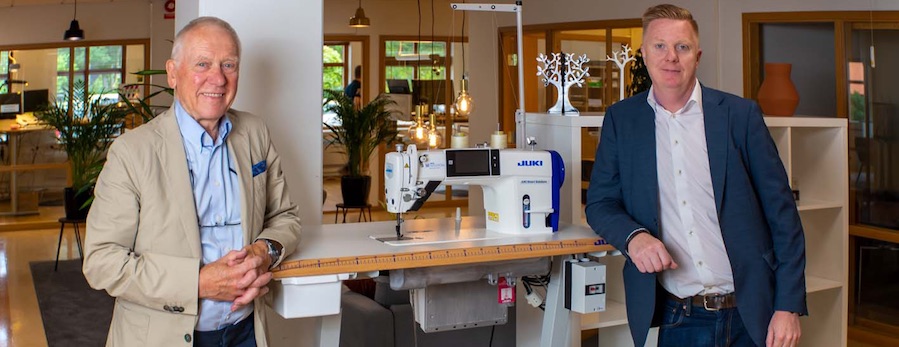
Reimar certainly took that advice, and at the age of 92 still travels to his office every day to oversee the operations of the diverse companies now operating under the ACG umbrella.
“I enjoy my work and being involved in new things every day makes me feel good, which is the meaning of life,” he says. “The average lifespan of a business company is eighteen years and we’ve lasted a hundred, based on having in place a simple plan for what we’ll achieve in the next ten years, which we move forward each year. Otherwise we don’t like to strategise too closely.”
This philosophy has held true throughout the two crises that have recently hit the textiles industry – the Covid-19 pandemic and the pronounced impact of online retail, he adds.
“Crises are part of life and something good always follows them. Companies with long-term vision survive and become stronger.”
Microfactories
For Thomas Arvidsson, CEO of ACG Nyström, both Covid-19 and online retail are already resulting in many new opportunities.
“We are a complete supplier of CAD/CAM solutions for adding value throughout the garment manufacturing processes – from product development, technical design and cutting to making up with sewing and other techniques, as well as refining with the help of embroidery and textile printing,” he says. “Our knowledge of technical production systems and processes, built up over many years of close collaboration with our customers, has given us a unique role as the link between the world’s leading machine manufacturers and our customers in the important garment assemby business.
“What we’re seeing now, especially in Western Europe, is the emergence of microfactories which are closer to the consumer, eliminate many of the transportation costs which have rocketed recently, and can produce on demand. Everything is now about digitalisation and automation and we’re very well placed to assist in this industry transition. We are already shipping the technology for a number of such microfactories and we are expecting a record year as a consequence.”
In September 2020, ACG Nyström also acquired fellow Swedish company Fyrtal, signficantly expanding it range of solutions for labelling and identification systems for a wide range of products.
Diversity
Although textiles remain the bedrock of the business, under Reimar Westerlind’s management, ACG Group has branched out into many other fields of activity over the past 60 years, and its diversity has also led to some highly unexpected developments.
The group, for example, owns the patent to the digital dental X-ray technology that is now standard in dental practices around the world, having identified a need and set its technologists and software developers onto developing a solution. Similarly, it holds a patent on the LED-based Exit signs now employed throughout public buildings, as well having developed the standard software and hardware for the RFID tagging and automatic transportation of hospital garments.
“There has been no other industry which has been responsible for so many technical breakthroughs and we’re proud to have been involved in many of them,” Reimar says. “Joe Gerber’s brush cutting marked the start of automation for the garment manufacturing industry, but other developments such as tensionless spreading and automatic thread cutting have also been small but very important changes we’ve been involved in developing.
Expansion
In addition to ACG Nyström, the ACG Group now consists of five other key companies in Sweden:
- ACG Accent, the developer of creative labelling and packaging concepts for the textile, sports and clothing industries.
- ACG Kinna Automatic, the manufacturer of textile machines for filled products such as pillows, quilts and mattresses, as well as filter systems.
- ACG Nyström AB, a complete supplier of CAD/CAM for embroidery and textile print, pattern design and cutting, sewing and welding and PLM solutions.
- ACG Pulse AB, providing automated management systems with associated RFID technology and software.
- Printing solutions supplier Eskils.
Like many other European manufacturers, ACG also began to expand beyond its traditional borders from the 1970s onwards – initially into the former Soviet Union and subsequently establishing subsidiaries in Estonia, Lithuania, Finland, the Ukraine and Denmark.
TMAS
Both ACG Nyström and ACG Kinna Automatic are members of TMAS, the Swedish textile machinery association.
“TMAS provides us both with valuable support in the promotion of our services around the world,” says Thomas Arvidsson. “There are many synergistic benefits from open discussions and co-operations with other Swedish textile technologists and TMAS members are all at the forefront to digitalisation and automation.”
“For me, the textile industry has been my kindergarten and ACG Group is now full of young people with great ideas who enjoy their jobs too,” Reimar Westerlind concludes. “We always develop our own software in-house, as well as the technologies, which can steer us in unexpected new directions, so for a small, family-owned company we are very well equipped for the next ten years, if not the next hundred.”