#Associations
Swedish machine builders set for Scandinavia’s Textiles 4.0 circular revolution
New manufacturers of regenerated cellulosic fibers as alternatives to cotton and synthetics, for example, have been gaining a lot of attention recently, as they scale up to meet demands for a circular approach to the manufacturing of textiles and garments.
These companies have, in turn, been embraced by major Scandinavian brands such as the Danish clothing company Bestseller, Finnish fashion house Marimekko, Norwegian outdoor brand Bergans and Sweden’s own H&M Group.
Fiber journey
From the field or the forest to the retail shelves, however, the journey of every single textile fiber is currently a long one, in which it passes through many hands and moves around the world. The good news is that many of these individual stages are now being greatly simplified by digitalization.
“Digitalization will lead to a significant reduction in garments that for one reason or another are never sold and end up in landfill,” says Therese Premler-Andersson, Secretary General of TMAS. “There will of course, be a huge ecological benefit.”
At the very center of any fiber’s journey, once it has become part of a knitted or woven fabric, are the dyeing and finishing stages of textile production. Dyeing and finishing currently involves many washing and drying process steps which add a huge burden to the overall carbon footprint of finished garments and textile products.
Coloreel expansion
Here is where the latest fully digital technologies of TMAS member companies are making a dramatic difference, such as the instant thread coloration technology, of Coloreel, which has just raised SEK 100 in new financing to support its market expansion and growth.
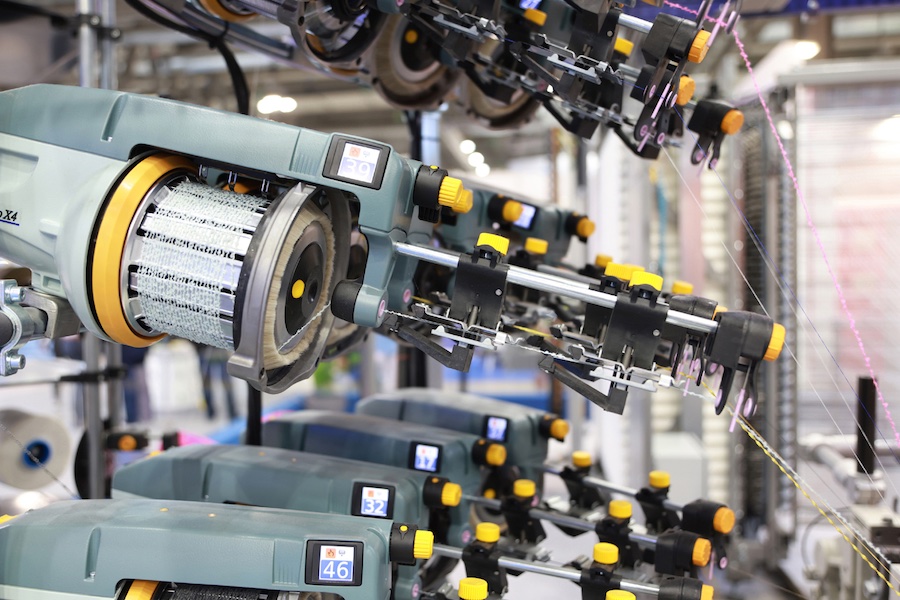
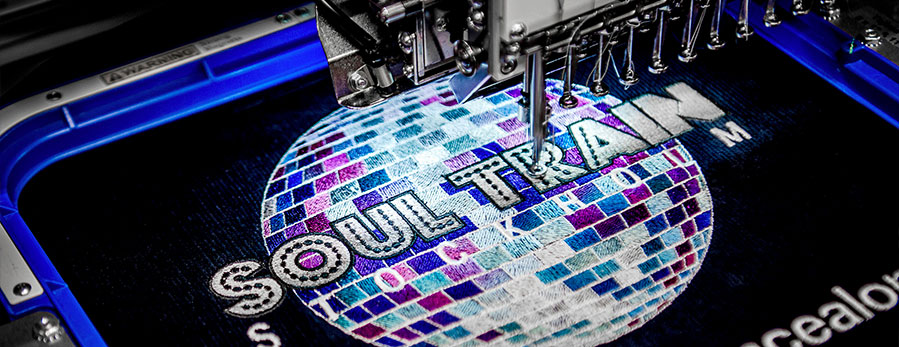
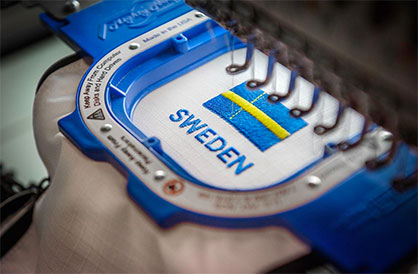
Initially targeting the embroidery market, Coloreel technology enables the high-quality and instant coloring of a textile thread while it is actually being used in production and can be paired with any existing embroidery machine without modification, while also making it possible to produce gradients in an embroidery for the first time.
Based on a CMYK ink system, Coloreel’s advanced rapid color formulation software and high-speed drive technology allow a single needle to carry out what previously required many multiples of them to do – and with much more consistent stitch quality,
In addition, existing thread dyeing plants can add a single solid color to a thread, but by instantly coloring a white base thread during production, Coloreel enables complete freedom to create unique embroideries without any limitations in the use of colors. Color changes along the thread can either be made rapidly from one solid color to another, or gradually, to make smooth transitions or any coloring effect desired.
This provides big benefits when it comes to sustainability. There is a significant reduction in wasted inks, while water usage is minimized, and production speeds are increased. The technology allows set-up and lead times to be reduced as well as significant flexibility in production schedules, while eliminating the need for large thread inventories.
“Our system is allowing customers to achieve color effects that have never been seen before – and at a new level of efficiency,” says VP of Sales and Marketing at Coloreel, Mats Sjögren. “We are setting the new benchmark for the embroidery industry.”
Despite the Covid-19 pandemic, Coloreel, has recently successfully delivered units to companies in Europe, the United States and Asia, and has also partnered with the world’s largest distributor of embroidery machines, American Hirsch Solutions, which has already installed the technology at a number of customers in the USA.
imogo
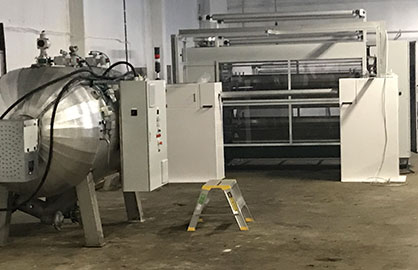
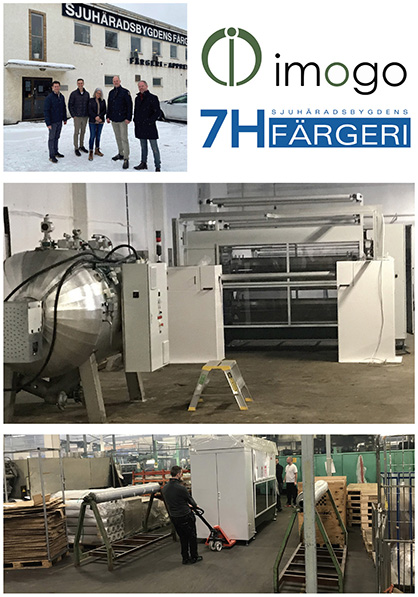
Another TMAS member achieving rapid progress is imogo, which is currently installing its first industrial scale Dye-Max spray dyeing line at the plant close to Borås of Swedish commission dyeing company 7H Färgeri – the Nordic region’s most complete dyeing and processing plant.
The new line has a working width of 1.8 meters with an operating speed of up to 50 meters for the reactive dyeing of cellulosic fiber-based fabrics. In addition, it can carry out the application of a wide range of fabric pre-treatments and finishing processes, providing the company with unbeatable flexibility in production.
A proven Mini-Max laboratory unit for pre-determining application volumes and color matching has also been installed at the 7H plant.
With the potential to slash the use of fresh water, wastewater, energy, and chemicals by as much as 90% compared to conventional jet dyeing systems, the DyeMax has gained considerable attention since the concept was outlined and a prototype machine constructed in 2019.
The application unit of the Dye-Max consists of a closed chamber containing a series of spray cassettes with precision nozzles for accurate and consistent coverage, in combination with the patented imogo Pro Speed valve that controls the volume to be applied.
“We are achieving an extremely low liquor ratio of around 0.5-1 liters per kilo of fabric and we fully control the pickup, applying precisely what is required to the specific fabric,” says imogo founding partner Per Stenflo. “Compared to traditional padders there is no contamination of the dyebath or dilution of the dye liquor to worry about.”
Fast changeovers with virtually no waste, together with a high production speed, enable a high productivity and unmatched production flexibility.
“The Dye-Max will be implemented in 7H daily production and producers and brands are welcome to visit when the Covid-19 situation allows. They are also welcome to do test productions at 7H to verify the performance on their fabrics.”
Perfect bridge
“Such new digital technologies from TMAS members represent the perfect bridge for sustainable new fibers on their route to the finished garments of responsible brands on the retail shelves,” concludes Therese Premler-Andersson. “There is now a real momentum building industry-wide for new circular manufacturing, and TMAS companies intend to be very much a part of it.”