[pageLogInLogOut]

#Associations

Unity is strength
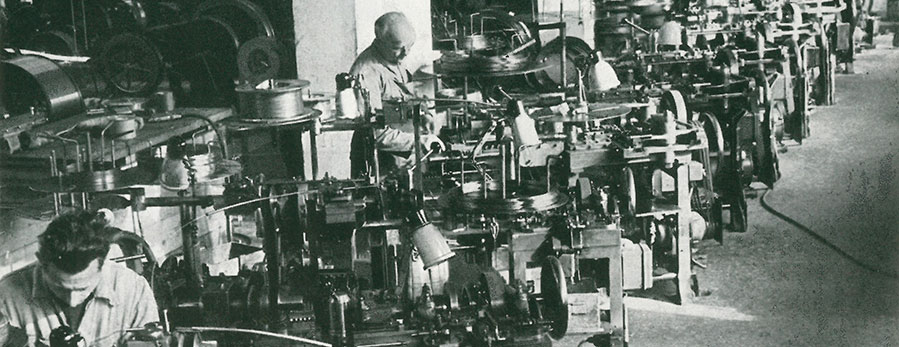
1940: Steelworks bending department in the year of the association’s foundation. (c) 2020 Swisstex Textile Machinery
When an organization reaches its 80th anniversary, there is a strong chance that it has survived several crises over those years. In the case of Swiss Textile Machinery, the association was actually born out of a crisis situation. Looking back over its history today inspires optimism that current and future challenges will be met with equal success. Past experience provides hope for the future...

The Swiss Textile Machinery Association has been crisis-proof for 80 years

In 1940, a year after the start of World War II, events far away from the battlefields began to impact on the local machinery industry in Switzerland. One problem was a lack of skilled workers – through military service call-ups – and another was a shortage of raw material, much of which was diverted to weapons production.

Solidarity grown out of a need for steel

Leaders of the textile machinery industry were increasingly concerned about their operations, especially the need for non-ferrous metals and high-quality steel. The situation became serious and some companies in the industry wanted to request the Swiss Government to secure the required raw material needed to maintain production. The established principle of ‘united we are strong’ led representatives from 22 companies to join forces in forming the first textile machinery group. This was the origin of what today has grown into the Swiss Textile Machinery Association.

The members of the new Swiss Association of Textile Machinery Manufacturers – including well-known brands such as Rüti, Sulzer, Rieter and Saurer – were not actually manufacturing machines from the start – but that was just another crisis to be overcome.

Machinery manufacturing as a self-help solution

Making textiles was good business for many companies in Switzerland, including the ones mentioned, before 1806. That was the year when the continental blockade imposed by Napoleon created major problems. Machines from Great Britain – the highly industrialized home of machinery development pioneers – were in high demand by Swiss textile manufacturing companies. But suddenly they were no longer available – and nor were the vital spare parts. 

Many Swiss textile companies responded by starting to produce the urgently needed machines and components for themselves. And soon it became apparent that the production and export of machines was far more lucrative than their previous textile manufacturing activities. The Swiss textile machinery industry was born.

Over the years, there were numerous periods of great difficulty for the industry: world wars, global economic slumps and other crises of varying degrees of seriousness followed one after another. The profile of the world textile industry also changed. Mass production has long since migrated to the East and South-East. Despite this, or perhaps precisely because of this, Swiss textile machinery today holds a leading position in the high-quality segment of special machines and top-quality materials.


Emerging stronger from another crisis

Who would have guessed that the year of the Swiss Textile Machinery Association’s 80th anniversary would see a pandemic crisis resulting in the biggest challenge of recent industrial history? “This crisis has hit the textile industry hard, and in my opinion the full impact will only become apparent towards the end of this year,” says Ernesto Maurer, President of the Swiss Textile Machinery Association. 
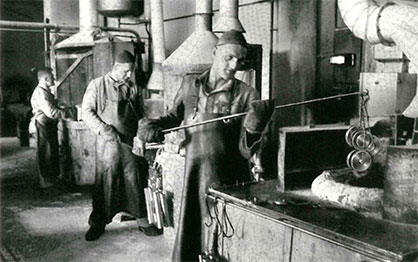
1945: Hardening processes at steel plant in the early days of the association. (c) 2020 Swisstex Textile Machinery


The required skills for the present situation are the same as previously: adaptability and flexibility. Experience through history provides grounds for some optimism for Swiss producers today. “On one hand, I rely on innovative solutions and the confidence that Swiss Textile Machinery members will emerge from the crisis stronger than ever. On the other hand, I am convinced that we will also pass this crisis in a Darwinian manner – just as we did when our association was founded,” says Maurer.

“Some of our members might choose to relocate abroad, while others could join larger groups. Maybe some companies or activities will not stay in the market. Still, I am sure that Swiss Textile Machinery will be successful and maintain its leading position in post-corona times, demonstrating that ‘united we are strong’ applies as truly today as ever.”
More News from SWISSTEX MACHINERY INC.

More News on Associations

#Associations

Joint Statement: Urgent clarification needed on scope of Textiles EPR for PPE and Medical Devices

EDANA, the voice of nonwovens, alongside fellow industry associations CIRFS (European Man-Made Fibres Association), EURATEX (The European Apparel and Textile Confederation), ESF (European Safety Federation), and EuroCommerce (Retail & Wholesale), has issued a joint statement raising critical concerns regarding the transposition of Directive (EU) 2025/1892, the targeted revision of the Waste Framework Directive.

#Associations

Young researchers recognised for cutting-edge work in recycling, fibre technology and textile mechanics

At the Aachen-Dresden-Denkendorf International Textile Conference held in Aachen at the end of November, Peter D. Dornier, Chairman of the Walter Reiners Foundation of the VDMA, honoured five successful young engineers. Promotion and sustainability prizes were awarded in the categories bachelor/project theses and diploma/master theses. Academic theses that develop solutions for resource-saving products and technologies, for example, are eligible for the sustainability awards.

#Europe

Level playing field at stake: Europe’s textile industry demands decisive action

Yesterday, the European Parliament took a welcomed and necessary step by voting a resolution calling for stronger market surveillance, reinforced customs controls and faster enforcement of the Digital Services Act in case of infringements. For Europe’s textile and clothing manufacturers, this is the first political acknowledgement that the system is broken — and that enforcement must finally match the scale of the problem.

#Natural Fibers

Better Cotton Initiative partners with Uzbek government agency to offset certification costs

The Better Cotton Initiative (BCI) has today announced a strategic agreement with Uzbekistan’s Light Industry Agency to increase financial support for cotton farming clusters adopting sustainable agricultural practices.

Latest News

#Recycled_Fibers

Recycling mixed-fibre garments becomes a reality: RadiciGroup, The LYCRA Company and Triumph take circular fashion a step forward

The process, which is both economically and environmentally sustainable, has enabled the production of an underwear set made from 100% recycled nylon and LYCRA® fibre in a closed-loop system.

#Spinning

First PA66 spinning plant with EvoQuench successfully commissioned

With the successful commissioning of a multi-digit PA66 spinning line for microfiber yarns, Chinese textile company Shandong Nanshan Fashion Technology Co., Ltd. has added yarn production to its textile value chain.

#Knitting & Hosiery

SHIMA SEIKI returns to ShanghaiTex

Leading flat knitting solutions provider SHIMA SEIKI MFG., LTD. of Wakayama, Japan, together with its Hong Kong and Chinese market subsidiary SHIMA SEIKI (HONG KONG) LTD., will exhibit at the ShanghaiTex 2025 exhibition (Booth No.: Hall N3, Booth A20) held in Shanghai, China this month. This marks the return of SHIMA SEIKI to ShanghaiTex after a 14-year hiatus, its last exhibit at the show having been in 2011.

#Research & Development

Fraunhofer CCPE presents the “Monomaterial Design Set” – Innovative solutions for circular product design

Composite materials made from different types of plastic often extend the lifetime of products but make recycling more difficult in the circular economy. That is why Fraunhofer CCPE has developed the “Monomaterial Design Set”. This new approach helps to reduce the variety of plastics used in durable products and offers circular solutions for designers and product developers.

TOP