[pageLogInLogOut]

#Associations

Revised AATCC test methods and procedures available

AATCC research committees work year-round to develop and update standards. The results are published twice per year—in the AATCC Technical Manual each January and in the Mid-Year Supplement each June. The 2020 Mid-Year Supplement is now available and includes nine revised test methods, one editorially revised test method, and one revised monograph for a total of eleven approved standards since publication of the 2020 AATCC Technical Manual.

These documents are available ONLY as downloadable PDFs for 2020. The 2020 Mid-Year Supplement will be discontinued at the end of 2020 and all standards contained therein will appear in the 2021 AATCC Technical Manual.

Revised Standards

The following AATCC test methods and procedures have been revised since publication of the 2020 AATCC Technical Manual. In accordance with AATCC M13, Rules of Procedure for AATCC Test Method and Technology Committees, all technical changes are unanimously approved by the responsible research committee and the Technical Committee on Research (TCR) before publication.

AATCC TM16.3-2020 Test Method for Colorfastness to Light: Xenon-Arc; Revised to update Options 1,2 & 3 flow charts.

AATCC TM26-2020 Test Method for Ageing of Sulfur-Dyed Textiles: Accelerated; Revised to clarify and align with prescribed AATCC style guidelines.

AATCC TM94-2020 Test Method for Finishes in Textiles: Identification; Revised to update the spectra, edit the text in existing sections, and to add new sections for clarity.

AATCC TM97-2020 Test Method for Extractable Content of Textiles; Revised to clarify safety requirements.

AATCC TM112-2020 Test Method for Formaldehyde Release from Fabric, Determination of Sealed Jar Method; Revised to update multiple sections for clarity and alignment to style guidelines.

AATCC TM133-2020 Test Method for Colorfastness to Heat: Hot Pressing; Revised to align with prescribed AATCC style guidelines.


AATCC TM169-2020 Test Method for Weather Resistance of Textiles: Xenon Lamp Exposure; Revised to add references standards, added Appendix B, and various editorial changes.

AATCC TM183-2020 Test Method for Transmittance or Blocking of Erythemally Weighted Ultraviolet Radiation through Fabrics; Revised to add references to verification fabric and UPF compilation, and to align format with AATCC style guidelines.

AATCC TM195-2017(e3) Test Method for Extractable Content of Textiles; Editorially Revised to reference LP1 and LP2 instead of M6 which has been removed

AATCC TM206-2020 Test Method for Free and Hydrolyzed Formaldehyde: Water Extraction; Revised to update multiple sections for clarity.

AATCC M12-2020 Style Guide for Test Methods and Procedures; Revised to include Designation and History sections, along with various updates and clarifications.




More News from American Association of Textile Chemists and Colorists

#Associations

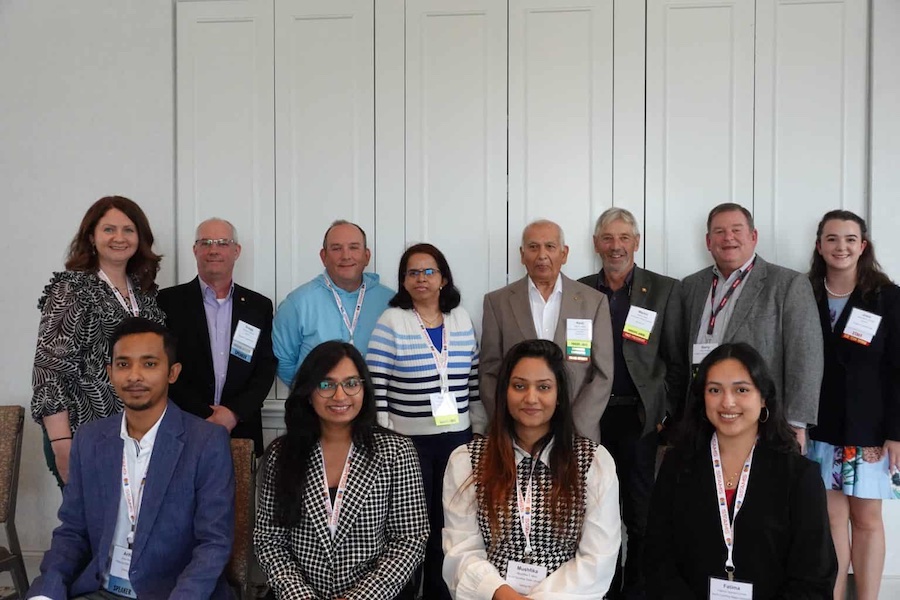
AATCC announces 2025 Herman & Myrtle Goldstein Graduate Student Paper Competition winners

The American Association of Textile Chemists and Colorists (AATCC) recognized the winners of the 2025 Herman & Myrtle Goldstein Graduate Student Paper Competition. Founded in 1982 to give student members the chance to conduct and present original research, the competition was renamed in 1994 in honor of Herman and Myrtle Goldstein, following their US$60,000 endowment. Their gift is a lasting remembrance of their dedication to young people in the textile industry.

#Research & Development

New funding available for textile research

The AATCC Foundation Student Research Support Grant Program provides financial assistance for undergraduate and graduate students pursuing textile-related projects. Students may submit proposals now for funding to be awarded January 2026. Applications must be submitted by October 1, 2025, to be considered.

#Recycling / Circular Economy

AATCC’s Circularity Conference approaches as organization continues 2025 Sustainable Textile Event series

The American Association of Textile Chemists and Colorists (AATCC) announces that registration is closing soon for its highly anticipated Circularity Conference, continuing this year’s sustainability event series that has delivered significant value to industry professionals.

#Associations

AATCC Textile Standards adopted by Colombian and Sri Lankan Governments

AATCC test methods and procedures are international standards, meeting the criteria set forth by the World Trade Organization and used around the globe. The standards gain additional recognition through Memoranda of Understanding with Colombia and Sri Lanka.

More News on Associations

#Associations

IVGT membership: expertise that pays off

For energy-intensive textile companies, government compensation mechanisms are an important economic factor. The IVGT successfully supports its member companies in applying for state aid and thereby regularly contributes to significant financial relief.

#Associations

Italian textile machinery orders show quarterly recovery in Q2 2026

In the period between April and June 2026, order intake for Italian textile machinery manufacturers showed mixed but encouraging signals for the second half of the year. The order index at constant prices stood at 46.6 points (taking 2021=100 as the base year), showing a slight decrease of 3% compared to the same quarter of 2025. This trend was largely due to the contraction recorded in the domestic market, which fell by 25% compared to the corresponding period of the previous year.

#Associations

Consolidation amidst difficult market conditions

The International Textile Manufacturer Federation has published its International Textile Industry Statistics (ITIS) on productive capacity and raw materials consumption in the short-staple organized (spinning mill-) sector in virtually all textile-producing countries in the world.

#Recycling / Circular Economy

ReSpin joins TMAS to advance textile recycling technology

Swedish textile recycling company ReSpin has joined the Textile Machinery Association of Sweden (TMAS) as a new member. The company develops a patented mechanical recycling technology designed to transform textile waste into new fibres suitable for yarn production.

Latest News

#Man-Made Fibers

Ministry of Industry Delegation visits NatureWorks’ second global manufacturing site at Nakhon Sawan Biocomplex

NatureWorks Asia Pacific Limited welcomed a high-level delegation led by Mr. Varawut Silpa-archa, Minister of Industry, to its manufacturing site at the Nakhon Sawan Biocomplex (NBC). The visit follows the successful inauguration of the site on April 29, 2026, and highlights the role of public-private collaboration in advancing Thailand’s sustainable industrial development and bioeconomy ambitions.

#Recycling / Circular Economy

Indorama Ventures advances circularity tthrough PETValue Philippines' “Zero Waste to Landfill Partnership” with Republic Cement

Indorama Ventures Public Company Limited, a global sustainable chemical company, is advancing the circular economy through a new Zero Waste to Landfill initiative at its recycling site PETValue Philippines, further demonstrating how collaboration across industries can maximize resource efficiency and reduce waste.

#Research & Development

Networking Day 2026: Industry stakeholders unite around textile recycling

In 2026, the Industry Research Group (IRG) Polymer Recycling once again brought together some of the key stakeholders in textile recycling for its annual Networking Day. This year, the event took place at EREMA’s premises in Ansfelden, Austria. It brought together key players from across the textile recycling value chain for a day of structured exchange and in-depth discussions.

#Knitting & Hosiery

The new RDJ 7/3 defines the design footprint of modern athletic shoes

Stylish, functional, and efficient to produce – spacer fabrics are the all-arounders among textile materials. These versatile fabrics are particularly in demand in the sports and casual footwear sector, as they combine comfort, breathability, and design freedom. At the same time, this industry is trend-driven, dynamic, and price-sensitive like few others. Innovations are therefore a decisive factor for success. With the RDJ 7/3, KARL MAYER offers a solution specifically tailored to these requirements. The particular strength of the new double raschel machine: its exceptional flexibility, thanks to its three jacquard bars.

TOP

