[pageLogInLogOut]

#Recycling / Circular Economy

EURATEX preliminary proposals for a new circular economy action plan for textiles
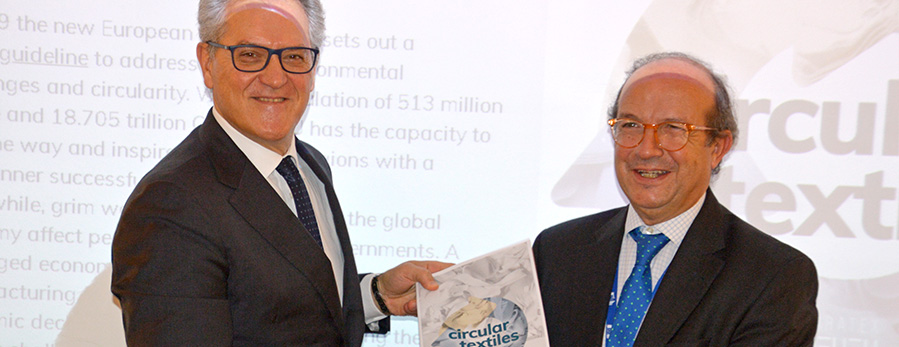
EURATEX President Alberto Paccanelli and Daniel Calleja Crespo, Director General of the European Commission DG Environment (c) 2019 EURATEX
Welcoming Mr. Calleja Crespo, Director General of the European Commission DG Environment at the Board of Directors meeting today, EURATEX is pleased to anticipate preliminary proposals for a new Circular Economy Action Plan for the Textile value chains to ensure sustainable resource use and tackle urgent environment, social and economic challenges.

The EURATEX strategy, Prospering in the Circular Economy 2019, elaborates on 12 key points, 6 conditions and 38 specific proposals under 9 actions.

The strategy is the result of an extensive, bottom-up consultation with EURATEX members, national and sector associations and more than 100 European companies and other stakeholders.

Furthermore, EURATEX anticipates voluntary commitments subscribed by 41 companies’ CEOs who welcome the ambitious goals of the EU Institutions to tackle urgent challenges, show insights of actions already undertaken to bring circularity in textiles, commit to keep pursuing sustainable resource use, and collaborate.

If properly supported, the European textile and clothing industry can make substantial contributions to achieve the Commission’s ambitious goals which were anticipated in the policy guidelines set out by the European Commission President Ursula von der Leyen. The Commission is expected to release a new Green Deal next week, and a new broad Circular Economy Action plan in early 2020.


The Director General, Mr. Calleja Crespo, opened his address by stressing Circular Economy must be an “opportunity to reconcile environmental, social and economic sustainability”.

The EURATEX President, Mr. Alberto Paccanelli, stressed; “EURATEX is proud to share its unique knowledge on textiles manufacturing, the lessons learned across the European value chain and its engagement. We look forward to being part of a broader collaboration between businesses, society and authorities and which, coordinated by the European Commission, can build up a breakthrough policy for circularity and let Europe lead the way in an urgently needed transformation.

Further information on the Action Plan for Circular Textiles will be shared on https://euratex.eu/circular-economy/ as of 2020.


More News from European Apparel and Textile Confederation (EURATEX)

#Associations

Towards pragmatic and harmonised labelling in the EU

EDANA, alongside 14 European associations, urges the European Commission and Member States to adopt a pragmatic approach for the future harmonised packaging labels, in line with the EU’s agenda for the EU Single Market, simplification and competitiveness. The system should rely on text-free pictograms, available in achromatic or monochromatic versions matching the packaging palette, with the possibility of using digital labelling as a core element. Our associations represent manufacturers of consumer goods across Europe.

#Associations

Textile PRO Forum calls for greater harmonisation of textile EPR systems across Europe

The Textile PRO Forum has published a new analysis highlighting the need for greater harmonisation of textile Extended Producer Responsibility systems across Europe. The document, Toward harmonised Textile EPR Systems in Europe: analysis and recommendations, presents the results of work carried out by Workstream 1 of the Textile PRO Forum, led by Dr. Eng. Viola Corbellini, Strategic Development and Innovation Expert at Erion Textiles, and Eng. Luca Campadello, General Director at Erion Textiles. The workstream focused on reducing administrative burden for textile producers by identifying areas where procedures could be better aligned across countries.

#Associations

Mario Jorge Machado re-elected President of EURATEX

The EURATEX General Assembly has re-elected Mario Jorge Machado as President of EURATEX, renewing its confidence in his leadership at a crucial moment for the European textile and clothing industry. The sector is facing rising costs, global competitive pressure and an increasingly challenging transition towards sustainability and digitalisation.

#Associations

Europe is losing its textile industry

EURATEX has released its latest Economic Update on the performance of the European textile and apparel industry in 2025. For the third consecutive year, the sector recorded negative results across all key indicators — production, turnover and employment — confirming a continued erosion of competitiveness across Europe.

More News on Recycling / Circular Economy

#Recycling / Circular Economy

Managed workwear services are providing a blueprint for the circular textile economy

Managed workwear service providers are demonstrating how commercial success and circularity can go hand in hand by extending garment lifespans through repair, laundering, reuse and recycling, according to “Managed workwear services—a circular textile economy ahead of the game”, a new 14‑page report from the global business information company Textiles Intelligence.

#Recycling / Circular Economy

Eco-design as the foundation of circular textiles

Based on the results of an extensive European analysis, the Erasmus+ project Skills4Circularity is currently developing three practice-based training modules covering recycling technologies, eco-design for the circular economy and sustainable manufacturing. This was preceded by a comprehensive company survey and a joint analysis conducted by the project partners under the leadership of IVGT. The results show that the greatest challenges lie not so much in a lack of technology as in skills gaps.

#Recycled Fibers

Usha Yarns secures growth equity investment from Fullerton Carbon Action Fund

Usha Yarns Limited (“Usha Yarns”), a producer of high-quality recycled yarns with advanced, well established production processes, announced a growth equity investment from the Fullerton Carbon Action Fund (“Fullerton”), a private equity strategy managed by Fullerton Fund Management that backs established mid-market companies across Emerging Asia to accelerate decarbonisation.

#Recycling / Circular Economy

German 'ZOLL' turns end-of-life uniforms into valuable raw materials

Together with CWS Workwear, the German Customs Administration is extending the life cycle of service uniforms through reuse, recycling and material recovery, demonstrating how circular economy principles can be successfully implemented in the public sector while delivering significant savings.

Latest News

#Functional Fabrics

PERFORMANCE DAYS announces new focus topic & forums for October 2026

With its upcoming October 13–14, 2026 edition, PERFORMANCE DAYS is placing the spotlight on one of the textile industry’s most important transformations: “Bio-Based Materials – From Fiber to Fabric”, a two-part Focus Topic exploring the future of bio-based innovation across the textile value chain. Part 1, presented in October 2026, will focus on fibers and next-generation material developments, while Part 2 at the March 2027 edition will shift the perspective toward dyeing, finishing, additives, and processing technologies.

#Nonwoven machines

MENANG rapidly resumes production with new ANDRITZ airlay line after major fire

MENANG, a Malaysian manufacturer of nonwoven automotive components, has resumed production after a major fire severely damaged its airlay line in mid-March 2026. A new airlay line supplied by ANDRITZ enabled production to restart within only four months.

#Exhibitions & Events

Febratex 2026 to be the largest edition of the leading textile trade fair in the Americas with 10 exhibition halls

Febratex 2026 will be the largest edition in the history of the leading textile trade fair in the Americas. Dedicated to the textile and apparel manufacturing industries, the event will take place from August 18–21, 2026, in Blumenau, Santa Catarina, Brazil, with a strong focus on technology, sustainability, and business generation.

#Raw Materials

Cotton Brazil Dialogues field trip brings international stakeholders closer to Brazil’s cotton production chain

How do you build trust across the global textile value chain? By opening the farm gates. This is the principle behind the Cotton Brazil Dialogues. At the end of July, the programme welcomed its first group of international participants for a five-day immersion into Brazilian cotton production, combining field visits with technical workshops to showcase the quality, sustainability, innovation and traceability behind one of the world’s leading cotton origins.

TOP