[pageLogInLogOut]
TRÜTZSCHLER SPINNING - THE NEW CARD

#Research & Development

Cetex goes Abu Dhabi
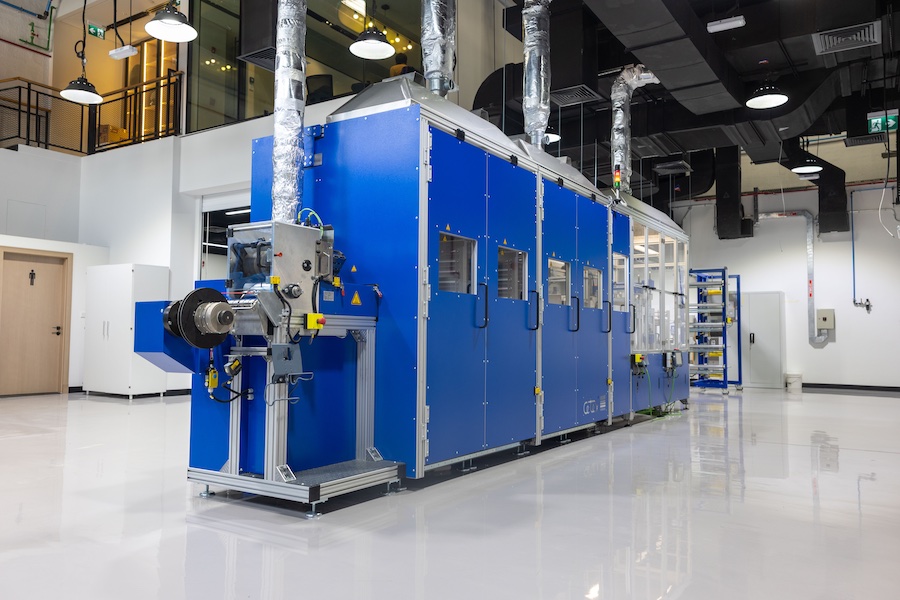
At the end of May 2025, the time had come - a coating system to produce spread and impregnated fibre tapes was installed and put into operation by Cetex Institut gGmbH in Abu Dhabi, 4600 km away from Chemnitz. The system allows the parallel production of up to 10 spread and impregnated fibre tapes.
Coating system after start-up (© 2025  / Source: Technology Innovation Institute Abu Dhabi)
Coating system after start-up (© 2025 / Source: Technology Innovation Institute Abu Dhabi)


The spreading of fibre rovings uses the principles of rope friction: as a result, the individual filaments spread out and the original roving width increases significantly, depending on the type of fibre. The focus of the installed machine is the processing of 12K carbon fibre rovings, which can be spread from 10 mm to more than 17 mm tape width with the technology used. The spread rovings are then impregnated with a thermoplastic dispersion. The drying module is designed for up to 450°C, so that PEEK dispersions can also be processed. The system speed is up to 10 m/min. The end product achieves a fibre volume ratio of up to 60% and a tape width of up to one inch in the doubled state, wound up as a disc spool.

The successful start-up marked the end of an exciting project, whereby the installation is only the beginning of a long co-operation.

Organisations interested in comparable coating systems have the opportunity to collaborate with the Cetex Institut gGmbH and carry out material testing on a modular prototype line available at the institute’s technical centre in Chemnitz.

For further information, please contact Marcel Hofmann (Technical Sales) at hofmann@cetex.de. 


More News from Cetex Institut für Textil- und Verarbeitungsmaschinen gemeinnützige GmbH

More News on Research & Development

#Research & Development

“Production is a product”

From technical textiles and AI-driven robotics to the limitations of textile circularity: Professor Dr Thomas Gries looks back on more than two decades of development at ITA Aachen. In the interview, he explains why production technology remains a decisive success factor, discusses international collaborations and innovation ecosystems, and shares his views on the transformation of production landscapes and the challenges facing an increasingly regulated industry.

#Research & Development

TCLF: Resilient value chains in times of crises

The textiles, clothing, leather and footwear (TCLF) industry was at the centre of the webinar “Resilient value chains in times of crises”, which took place on 28 April 2026. Global supply chains continue to face increasing pressure, raw material dependencies are growing and economic uncertainties are affecting the entire sector.

#Research & Development

Textile climate control system in workwear – exhibition at the 2026 SME Innovation Day!

Conventional protective workwear often reaches its limits during strenuous physical activity. In particular, the transport of sweat and excess body heat poses a problem. The German Institutes of Textile and Fiber Research (DITF) conducted research on flow-optimized, air-conducting textile structures that enable targeted climate control directly on the body. These structures can be integrated straight into protective work garments. The textile climate control system supports the body’s natural thermoregulation. This contributes to improved workplace safety and comfort.

#Research & Development

Elastic yarns to become more recyclable and environmentally friendly in future

On 29 April 2026, ITA student Tobias Dickmeiß was awarded a sponsorship prize by the Wilhelm Lorch-Stiftung for his innovative approach, to replacing conventional elastane with elastic yarns made from thermoplastic copolyester elastomers (TPC). Thanks to their thermoplastic nature and compatibility with typical polyesters used in the textile industry, elastic TPC yarns offer improved recyclability. Furthermore, the use of the melt-spinning process in yarn production eliminates the need for solvents that are harmful to the environment and human health.

Latest News

TOP