[pageLogInLogOut]

#Raw Materials

Stable global stocks in 2017/18
(c) 2017 ICAC
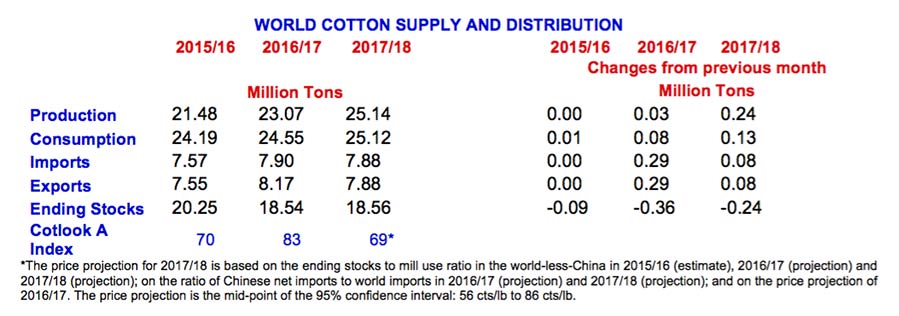
In 2017/18, world cotton production and mill use are estimated at 25.1 million tons, which would result in a 9% increase in output and 2% rise in consumption. World cotton stocks are projected to remain stable at 18.5 million tons at the end of 2017/18, and, the world stock-to-use ratio is expected to be essentially unchanged at about 75%, or nine months of mill use.

The Chinese government sold over two million tons from its national cotton reserve from May to August 2017, lowering the reserve to around 6.3 million tons at the end of August 2017. China’s cotton stocks are forecast to decrease another 16% to 8.9 million tons, which would account for 48% of world stocks in 2017/18. Ending stocks held outside of China in 2017/18 are expected to increase by 22% to 9.6 million tons in 2017/18.

In 2017/18, world cotton area is projected to expand by 9% to 31.9 million hectares, and the world average yield is projected to remain unchanged at 789 kg/ha. With output projected to increase by 4% to 6 million tons, India will remain the world’s largest cotton producer in 2017/18. After four seasons of decline, China’s cotton production is expected to rise by 7% to 5.2 million tons. Cotton production in the United States is forecast to increase by 20% to 4.5 million tons. However, the full impact of the recent hurricane in Texas, where around 45% of U.S. production occurs, is still under assessment. Pakistan’s cotton production is projected to increase by 17% to 2 million tons.

After falling by 2% in 2015/16, global cotton consumption rose by 1% to 24.5 million tons in 2016/17, as world economic growth strengthened. In 2017/18, world cotton mill use is projected to increase by 2% to 25.1 million tons. Mill use in China is expected to grow by 1% to 8.1 million tons while India’s cotton consumption is projected to recover by 3% to 5.3 million tons in 2017/18.

Mill use in Bangladesh is projected to remain stable at 1.4 million tons in 2017/18 tons as widespread flooding in August 2017 has damaged infrastructure and made it difficult to transport goods throughout the country and to run businesses.
More News from International Cotton Advisory Committee (ICAC)

#Natural Fibers

ICAC to collaborate with Uzbekistan and Bizpando on regenerative agriculture

The Government of Uzbekistan has allocated 55,000 hectares of land to implement a regenerative agriculture program for cotton as part of a collaborative project with the International Cotton Advisory Committee (ICAC) and Bizpando, a company with a a blockchain-based internet platform designed to ensure supply chain compliance.

#Natural Fibers

Bangladesh becomes World's largest importer in 2024/25 after China cuts imports by 65% to 1.1 million tonnes

As we prepare to turn the calendar on 2025, world cotton lint production currently is estimated to be about 25.4 million tonnes — roughly the same as the last season — surpassing the world cotton lint consumption by 392,000 tonnes.

#Natural Fibers

ICAC announces postponement of the 83rd Plenary Meeting in Tanzania

Due to unforeseen circumstances arising from the recent developments in Tanzania, the ICAC has announced that its upcoming 83rd Plenary Meeting has been postponed. Scheduled for Nov. 17-20 in Mwanza, the delay was recommended by Tanzania, and the decision was made out of an abundance of caution, prioritizing the safety and well-being of all participants.

#Natural Fibers

World Cotton Trade declined 4.1% in 2024/25, according to ICAC's 2025 World Cotton Trade Report

Washington, DC — The International Cotton Advisory Committee (ICAC) has released the 2025 World Cotton Trade Report, which covers trade developments in raw cotton since 1980. An annual publication, it provides analysis of world trade by region; import/export projections by country; matrices of trade flows; and seasonal estimates of export commitments to date.

More News on Raw Materials

#Natural Fibers

38th International Cotton Conference Bremen: Let´s Talk about Cotton!

The 38th International Cotton Conference Bremen, to be held on 25-27 March 2026 in Bremen’s parliament building on market square, once again sends a powerful signal for professional excellence and international dialogue. The focus is on the latest market trends and technical innovations throughout the entire value chain – from agriculture and quality assurance to processing and the circular economy. With its high-calibre speakers, the conference remains an indispensable forum for anyone involved in shaping the cotton industry scientifically, technically, or economically.

#Natural Fibers

Human Rights Day: Cotton made in Africa reinforces its commitment to ensuring respect for human rights in cotton production

The sustainable cotton standard Cotton made in Africa (CmiA) has always focussed on respect for human rights, including by prohibiting child labour and discrimination. With the new version of the CmiA standard coming into force, AbTF raises requirements for due diligence in the areas of human rights and risk management.

#Research & Development

How innovations drive BASF’s success

“Innovation has always been part of BASF’s DNA. Especially in these volatile times, it is crucial to leverage our innovative strength to develop competitive solutions that differentiate us as a company in our markets and give us a competitive edge,” said Dr. Stephan Kothrade, Member of the Board of Executive Directors of BASF and Chief Technology Officer, at the company’s Research Press Briefing held today. To achieve this, BASF implemented its “Winning Ways” strategy about a year ago with the clear goal of becoming the preferred chemical company to enable its customers’ green transformation.

#Natural Fibers

38th International Cotton Conference Bremen launches registration and unveils key topics

Participants can now register online for the 38th International Cotton Conference Bremen, which will be held on 25-27 March 2026 at the Haus der Bürgerschaft parliament building on market square. All visitors can look forward to a high-calibre conference programme, numerous additional meetings and a valuable exchange of knowledge and information. The comprehensive range of topics covering the entire value chain will provide practical expertise, address current developments, answer key industry questions, and provide new impetus for the future.

Latest News

#Heimtextil 2026

Mimaki demonstrates versatile, simple TRAPIS textile printing at Heimtextil 2026

Mimaki’s textile pigment transfer printing system, TRAPIS, is able to print on a diverse range of fabrics - unlike traditional processes - including natural fibres and synthetic fabrics. The full solution will be shown on Mimaki’s booth (Hall 3.0 Stand A97), as the company returns to Heimtextil to showcase its advancements in sustainable, high quality and efficient textile printing.

#ITM 2026

The Technology Hub for global denim trends: ITM 2026

The ITM 2026 International Textile Machinery Exhibition, to be held at the Tüyap Fair and Congress Center in Istanbul from June 9–13, 2026, brings together groundbreaking technologies in denim production. From smart production systems to eco-friendly raw materials, from digital washing solutions to laser effect technologies, innovations that will shape the future of denim will be showcased for the first time at ITM 2026.

#Recycled_Fibers

Leading fashion brands step up to unlock the next chapter of Circulose

Since 2024, under new ownership and leadership, Circulose has set a renewed strategic direction focused on securing long-term commitments with partner brands to bring CIRCULOSE® back to market at scale. This strategy has proven successful.

#Research & Development

More safety and comfort for protective clothing thanks to auxetic fabrics

When everyday materials are pulled, they stretch or elongate in the direction of the pull and become narrower in cross-section. We can also observe this property in two-dimensional textiles. Auxetic structures behave differently here. They have the striking property of not changing under tensile stress or even increasing their width or thickness. These properties are advantageous, for example, in protective textiles or textile filter media. The DITF are researching auxetic fabrics for various applications.

TOP