[pageLogInLogOut]

#Colloquia / Symposia

AACHEN-DRESDEN-DENKENDORF ITC calls for papers

The next AACHEN-DRESDEN-DENKENDORF INTERNATIONAL TEXTILE CONFERENCE will take place in Stuttgart on November 30 – December 1, 2017. Now the organizers are calling for papers for experts from the fields of Materials, Chemistry, Finishing & Functionalization, and Machines, Processes & Composites. The deadline for the submission of abstracts for oral presentations is March 31, 2017 and the deadline for poster presentations the August 31, 2017.
With the partner country USA, ADD ITC continues their tradition of offering a platform for new research co-operations and networks beyond Germany by involving annually alternating partner countries.

Aachen, Dresden and Denkendorf, together, lead the International Textile Conference into the Future

Since 2007 the textile research institutes of the regions of Aachen and Dresden have jointly organized the Aachen-Dresden International Textile Conference. Boasting over 700 participants most recently, this conference counts as one of the most important textile conference in Europe. Since 2016, the German Institutes of Textile and Fiber Research, Denkendorf (DITF) is also a co-organizer.

Thus, the Aachen-Dresden-Denkendorf International Textile Conference will take place on a yearly alternating basis at one of the three sites. Parallel to the International Textile Conference, the organizers respectively launch the German Textile Colloquium as a national pendant with changing special themes in the spring.
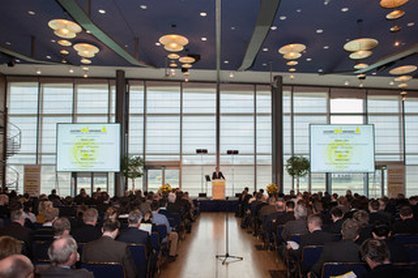
Pic: ADD ITC always attracts a lot of attendees

For further information please visit: http://www.aachen-dresden-denkendorf.de/en/itc/

Abstracts should refer to plenary sessions and special symposia in the areas of Development and production of high performance fibers and yarns
  • Potential of chemical and physical fiber modifications for the fiber industry
  • Market opportunities through new fiber types, processes and equipment (polymer synthesis, primary spinning, …)
  • Secondary spinning – new approaches for production
  • New impulses from the clothing industry, engineering and research for the development of sustainable fibers and yarns (bio-based fibers, new recycling strategies)
  • Fiber and technology developments for the optimization of the carbon fiber production
  • New developments and future trends of (high performance) fiber types (e.g. carbon fibers, polyaromatic fibers, ceramic fibers etc.)

Development and production of 3D system-integrated fiber compounds for automotive, construction and architecture

  • Insight into new advanced materials – simulation and testing systems
  • Potentials of polymer matrix materials and functionalization
  • Bionic structures – new developments in building component construction
  • Shaped fiber compounds – new approaches and developments
  • Technologies for applications in the automotive industry and construction
  • New developments in process technology

Medical textiles / Medical technologies

  • Drug delivery: Functionalization of fiber-based medical devices for the specific support of healing processes
  • New polymeric biomaterials for implantation and regenerative medicine
  • Resorbable polymeric implants for the support of regenerative processes
  • Monitoring and control of healing processes with sensory and actuatory medical devices
  • Textile-based solutions in personalized medicine for support in therapy
  • Fiber-based cell scaffolds for tissue engineering
  • Nonwovens for wound treatment and hygiene
Transfer Session ”From Idea to Practice“
  • Presentation of innovations (e.g. products, technologies, processes) transferred into the industry from research co-operations, especially by IGF/ZIM

More News from TEXDATA International

#Texprocess 2026

Texprocess 2026: Automation, digitalisation and AI reshape textile processing

Investment decisions in textile processing have become increasingly complex. Rising energy prices, labour shortages and geopolitical uncertainties are forcing companies to prioritise technologies that deliver measurable improvements in efficiency and process stability. This applies not only to apparel production, but also to the processing of technical textiles and high-performance materials. Modernisation projects are therefore being evaluated more selectively – but the pressure to upgrade production systems continues to grow. Texprocess 2026 reflects this tension between cautious investment behaviour and increasing technological demand.

#Techtextil 2026

Textile Chemicals & Dyes: Innovation in Textile Chemistry moves into focus at Techtextil 2026

From PFAS-free finishes and water-saving dyeing technologies to advanced coatings and recycling-compatible formulations, innovation in textile chemistry is accelerating across the industry. Reflecting this development, Techtextil 2026 introduces Textile Chemicals & Dyes as a dedicated product segment, highlighting the growing role of chemical solutions in shaping the next generation of technical textiles.

#Recycling / Circular Economy

textile.4U publishes special edition “Top 100 Textile Recycling Companies 2025”

With a comprehensive 176-page special edition, textile.4U is dedicating its latest issue entirely to one of the most dynamic and influential topics in today’s textile industry: textile recycling. The new issue, published exclusively in high-quality print, presents the Top 100 textile recycling companies researched and selected by TexData – organizations that already play a key role in the transition to circular textiles or are expected to have a significant impact in the near future.

#Recycling / Circular Economy

Responsible Textile Recovery Act of 2024 signed by Governor

Senator Josh Newman (D-Fullerton) is proud to announce that Senate Bill 707 (SB 707), the Responsible Textile Recovery Act of 2024, has been signed into law by the Governor of California, Gavin Newsom. This groundbreaking legislation establishes the country’s first Extended Producer Responsibility (EPR) textile recycling program, marking a significant step forward in the state’s efforts to combat waste and promote sustainability.

More News on Colloquia / Symposia

Latest News

#Techtextil 2026

Gebr. Otto highlights versatility at Techtextil with regional supply chains, yarn innovations and new hygiene segment

At this year’s Techtextil, Gebr. Otto places its versatility at the center of its presentation. In addition to spinning, twisting and dyeing – traditionally focused on fine cotton – textile processors will also find a competent development partner for technical specialty solutions. The Dietenheim-based spinning mill has now built up a decade of experience in the production of technical yarns, particularly from aramids. A new hygiene segment has also been established, where yarns for medical and hygiene products are currently being produced. In the future, this department could also develop textile products for the food sector. Gebr. Otto will once again be present at the BW-i joint stand, booth D81, hall 12.1. What is wound onto the spool is determined by the customer: Gebr. Otto develops according to specific customer requirements and transforms its own ideas into yarn innovations.

#Europe

Commission presents proposal for EU Inc. - unlocking the full potential of the Single Market for Europe's entrepreneurs

Today, the European Commission presented its proposal for EU Inc., a new single set of corporate rules, building the cornerstone and starting point for the EU's 28th regime. EU Inc. is an optional, digital-by-default European corporate framework. It will make it easier for businesses to start, operate and grow across the EU – incentivising them to stay in Europe, and encourage those who once looked elsewhere to return.

#Man-Made Fibers

OnceMore® from Södra brings end-to-end traceability for circular Man-made Cellulosic Fibers (MMCF) using TextileGenesis

OnceMore® from Södra, the world’s first large-scale process for recycling blended fabrics into high‐quality dissolving pulp, will begin using TextileGenesis, a Lectra company, to strengthen traceability from raw material to retail across the value chain. OnceMore® produces dissolving pulp made from blended textile waste and wood sourced from responsibly managed Swedish forests. By integrating TextileGenesis, OnceMore® supports the growing need for verified data and secure, transparent tracking throughout increasingly complex supply chain.

#Sustainability

Experts publish APAC policy priorities

Cascale today announced the publication of its APAC Policy Priorities Paper, developed by the Asia-Pacific (APAC) Policy Member Expert Team (MET) to identify key regional sustainability challenges and provide practical, aligned recommendations for policymakers and industry stakeholders across Asia-Pacific.

TOP