[pageLogInLogOut]

#Sustainability

Global Organic Textile Standard (GOTS) grows, celebrates five years

The Global Organic Textile Standard (GOTS) turned five years old in 2011, adding 80 new companies and another country (Kyrgyzstan) to the list of those with GOTS‐certified facilities, expanding particularly in developed countries, accrediting a 14th certification organization, and receiving formal recognition by the U.S. Department of Agriculture (USDA).

+New participants, production regions, and GOTS representatives in 2011

By year’s end, 2,714 facilities in 57 countries around the world were certified to the organic apparel and textile standard including 450 dyeing facilities, more than 220 spinning, knitting, and weaving units, and approximately 160 printing and manufacturing facilities.

The Top Twenty countries in terms of GOTS‐certified facilities include India, Turkey, China, Pakistan, Germany, Italy, Japan, Korea (South), Bangladesh, United Kingdom, France, United States (U.S.), Hong Kong, Greece, Peru, Switzerland, Austria, Netherlands, Belgium, and Portugal. While the top four countries remained the same, Austria and Switzerland were new to the top rankings. Overall, the ten countries with the greatest increase in facilities gaining GOTS certification in 2011 were: Germany, India, U.S., Austria, Bangladesh, Switzerland, Greece, France, Belgium, and Denmark. GOTS is the stringent voluntary global standard for the entire post‐harvest processing (including spinning, knitting, weaving, dyeing and manufacturing) of apparel and home textiles made with organic fiber (such as organic cotton and organic wool), and includes both environmental and social provisions. Key provisions include a ban on the use of genetically modified organisms (GMOs), highly hazardous chemicals (such as azo dyes and formaldehyde), and child labor, while requiring strong social compliance management systems and strict waste water treatment practices.

As all fiber certified to GOTS must be certified organic, GOTS certification means consumers are purchasing items certified organic from field to finished product.

A milestone in the increasing recognition and acceptance of GOTS was reached on May 20, 2011, when the USDA released a Policy Memorandum explicitly confirming that textile products produced in accordance with GOTS may be sold as ‘organic’ in the U.S. It further clarified that the use of U.S. National Organic Program (NOP)‐certified fibers and third party certification of the textile products is a prerequisite for use of the term ‘organic’ in labeling of such products.

The USDA memo will also be useful internationally. “Explicit recognition of GOTS and its labeling system is the best way governments can regulate the organic textile sector,” said Herbert Ladwig, GOTS International Working Group IWG) Coordinator. “The U.S. model is our recommendation and goal in negotiations with regulators in this sector.

” The GOTS IWG is made up of the Organic Trade Association (U.S.), Japan Organic Cotton Association, International Association Natural Textile Industry (Germany), and the Soil Association (UK). In addition to the five regional representatives worldwide appointed in 2010 to drive an increase in the awareness of and certification to GOTS, a new representative, Stuart McDiarmid, was appointed in 2011 to focus on growing awareness of GOTS in Australia and New Zealand. Sumit Gupta was appointed as the representative for India in March, 2012.

For more information on the Global Organic Textile Standard, please see www.global‐standard.org. A trailer for the short film “The Global Organic Textile Standard – Ecology and Social Responsibility” is available at http://global‐standard.org/information‐centre/gotsfilm.html and copies in different languages can be ordered there by textile companies, educational institutions, and relevant organizations at no cost.


More News from TEXDATA International

#ITM 2026

ITM 2026: The new geography of textile production

New production hubs are emerging across North Africa and Central Asia, while Türkiye is accelerating its transformation toward higher-value, technology-driven and more sustainable textile manufacturing.

#Research & Development

“Production is a product”

From technical textiles and AI-driven robotics to the limitations of textile circularity: Professor Dr Thomas Gries looks back on more than two decades of development at ITA Aachen. In the interview, he explains why production technology remains a decisive success factor, discusses international collaborations and innovation ecosystems, and shares his views on the transformation of production landscapes and the challenges facing an increasingly regulated industry.

#Knitting & Hosiery

“We need to move away from the price trap and return to a value-driven mindset.”

With its new Textile Innovation Center, KARL MAYER is sending a strong signal for innovation, collaboration, and the future of textile applications. In this interview, Karl Josef Mayer discusses new opportunities in warp knitting, the processing of staple fibres, recycling, the changing role of machinery manufacturers, and why the textile industry must once again focus more strongly on the value of textiles. by Oliver Schmidt

#Associations

“Innovation, resilience and international experience remain the great strengths of the Swiss textile machinery industry”

Geopolitical uncertainty, growing competitive pressure from China, new free trade agreements and the shift towards a circular economy are currently reshaping the global textile industry. In this interview, Cornelia Buchwalder discusses the current mood within the Swiss textile machinery sector, the industry’s distinctive innovative strength, new market opportunities in India and Asia, and the technological trends that could shape the upcoming trade fair cycle leading up to ITMA 2027.

More News on Sustainability

#Associations

Results of the 38th ITMF Global Textile Industry Survey

The global textile industry appears to be turning a corner, but this is more likely a fragile and possibly temporary improvement than the start of a durable recovery. According to the 38th ITMF Global Textile Industry Survey, conducted worldwide during the second half of May 2026, business sentiment, order intake, order backlogs and capacity utilization all improved versus March — yet every indicator remains weak by historical standards, and rising costs cast doubt on how long the upturn can last.

#Sustainability

Closing the Footwear Loop reveals challenges and opportunities for circular footwear

The footwear industry faces one of the most complex circularity challenges in the fashion sector. A new Phase 1 report from the Fashion for Good initiative Closing the Footwear Loop, developed together with Circle Economy, provides new insights into the composition, condition and recycling potential of post-consumer footwear waste.

#Man-Made Fibers

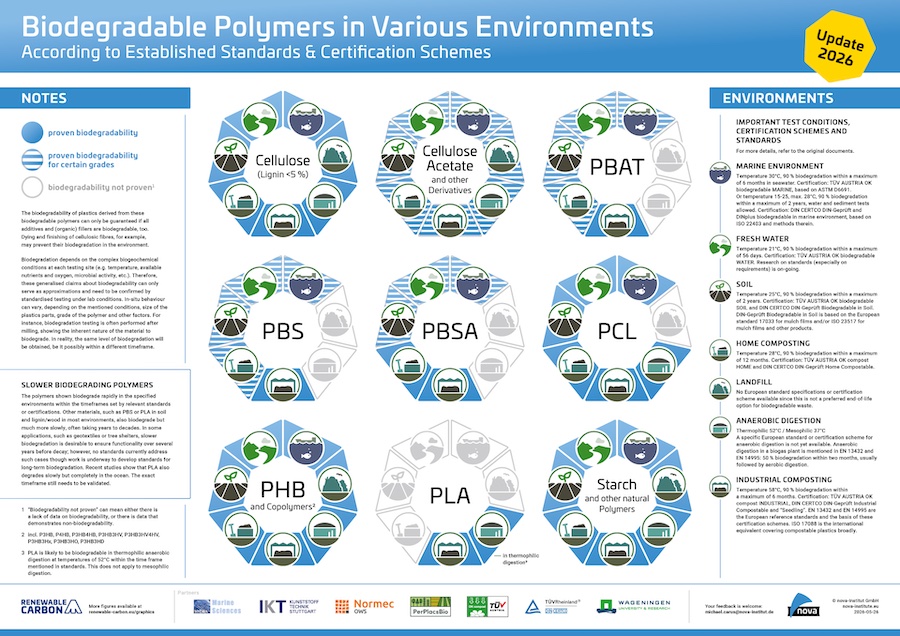
The updated poster on biodegradable Polymers in various environments has been released

As part of the PerPlacsBio project, nova-Institute has updated its popular poster on the biodegradability of polymers in different environments. The updated version reflects current standards, certifications and the latest scientific findings. The poster can be used to assess biodegradable alternatives for use in agriculture and forestry, and it is now available in German for the first time.

#Sustainability

A new standard to combat plastic waste in forests

With DIN SPEC 35808 “Tree Shelter for Forestry Applications,” the testing and research service provider Hohenstein, in collaboration with Rottenburg University of Forestry, as well as forestry authorities and industry partners, has established a clear framework for bio-based and fully biodegradable tree shelters. The pre-standard defines requirements and practical testing methods designed to reduce plastic waste in forests and strengthen the long-term protection of soil and the environment.

Latest News

#Associations

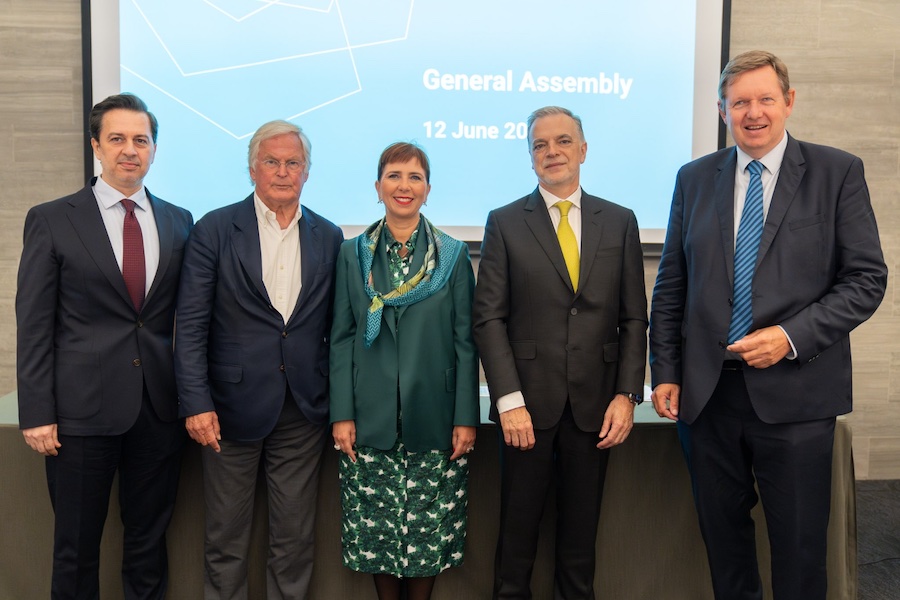
Mario Jorge Machado re-elected President of EURATEX

The EURATEX General Assembly has re-elected Mario Jorge Machado as President of EURATEX, renewing its confidence in his leadership at a crucial moment for the European textile and clothing industry. The sector is facing rising costs, global competitive pressure and an increasingly challenging transition towards sustainability and digitalisation.

#ITM 2026

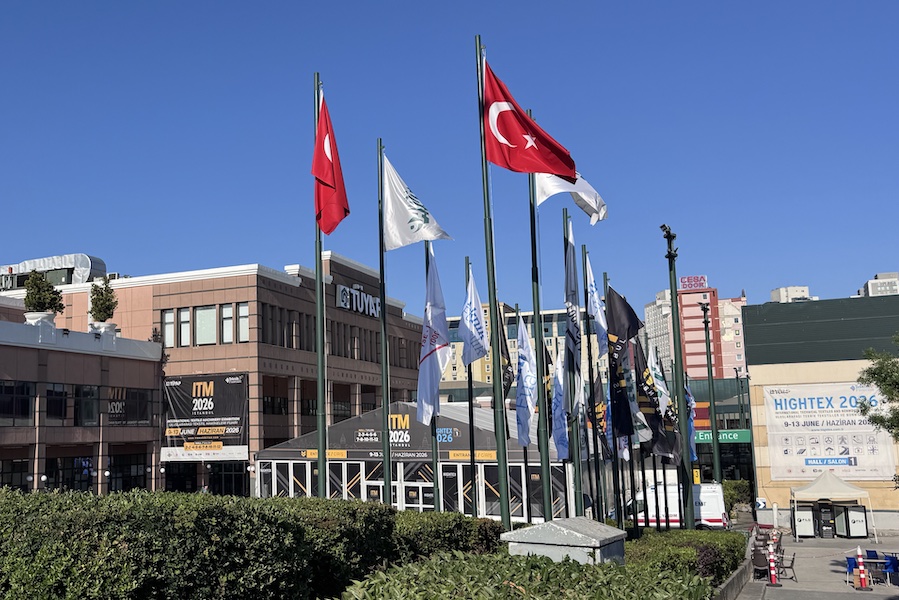
ITM 2026 makes happy participants with its international and qualified visitor profile

ITM 2026 International Textile Machinery Exhibition, one of the most prestigious meeting points of the textile machinery sector, attracted attention in its first three days, particularly with its diverse international visitor numbers. Industry professionals from all over the world had the opportunity to closely examine the latest technology machines and solutions displayed in operation. Thousands of visitors from approximately 100 countries, primarily Egypt, Pakistan, India, Uzbekistan, Syria, Turkmenistan, Tajikistan, Morocco, Algeria, and Tunisia, met at the Tüyap Fair and Congress Center for new investment and cooperation opportunities.

#ITM 2026

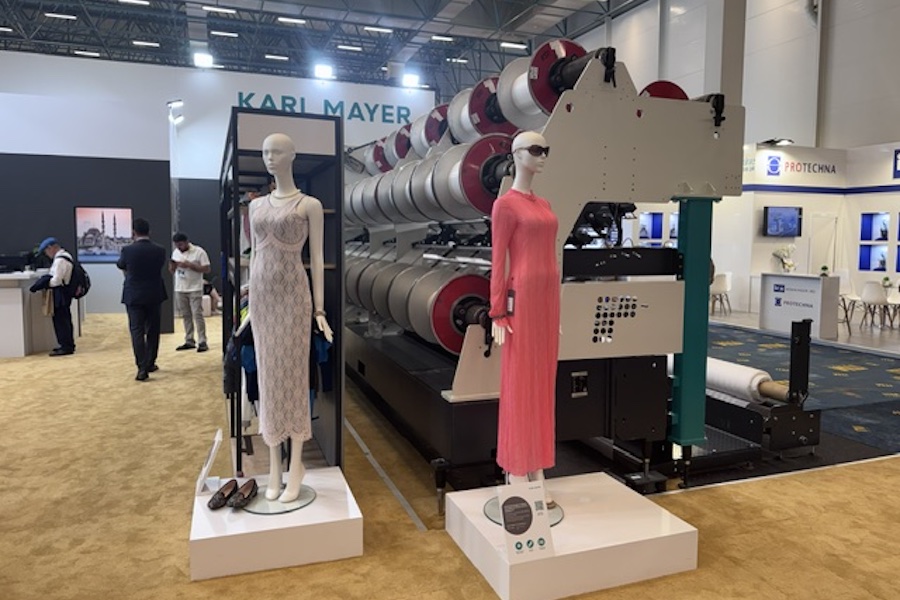
KARL MAYER presents a textile TEXTRONIC® innovation at ITM 2026

With highly efficient machines and continuous textile innovations, KARL MAYER underscores its role as a reliable partner for discerning top-tier customers. Just in time for ITM 2026 in Istanbul, the industry leader is introducing a true innovation: an eyelash lace with its characteristic fringed look – combined with a previously unattainable 4-way stretch. While the established fabric could until now only be produced as rigid version or with one-dimensional stretch, the new elasticity in both dimensions expands the possibilities for cross-band panel fabrics.

#Raw Materials

Better Cotton Initiative welcomes new and returning Council members

The Better Cotton Initiative (BCI) has confirmed a series of appointments and reappointments to its Council, the multistakeholder board responsible for BCI’s strategic direction.

TOP