[pageLogInLogOut]

#Raw Materials

Stocks outside China are projected to grow in 2017/18

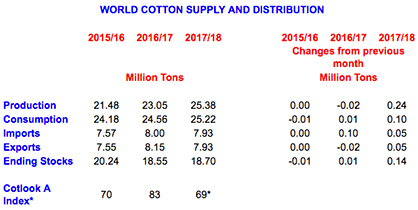
World cotton production is projected to increase by 10% during 2017/18 reaching 25.4 million tons. Higher cotton prices during 2016/17 and better cotton price ratios to other competing crops during 2017 planting campaign resulted in expansion of cotton area by an estimated 3 million hectares to over 32 million hectares. During 2017/18 the largest gain in production of 23% to 4.6 million tons is projected in the USA. Production is projected to increase in all other major producing countries during 2017/18, including India, China, Pakistan, Brazil, Francophone Africa and Turkey.

Global cotton mill use is projected to increase at an improved growth rate of 2.7% during 2017/18 reaching 25.2 million tons. In comparison, during 2016/17 world cotton mill use grew by 1.6%. Mill use in China is projected to grow by 1.5% to 8.1 million tons. Cotton mill use is also projected to grow moderately in India, Pakistan, Turkey, Bangladesh, Vietnam and Brazil.  

In 2017/18, world trade is projected stable at 8 million tons and USA will remain the largest exporter accounting for 40%, or 3.1 million tons of world shipments. Bangladesh will remain the largest importer in 2017/18 accounting for 18%, or 1.4 million tons of world imports. 

Because world production is projected to edge over mill use during 2017/18, world ending stocks could increase moderately and reach 18.7 million tons with stocks to use ratio remaining little changed at 75%. However, ending stocks in China are projected to decline by 1.7 million tons during 2017/18, while outside China stocks are projected to increase by 1.85 million tons.
(c) 2017 ICAC
(c) 2017 ICAC

*The price projection for 2017/18 is based on the ending stocks to mill use ratio in the world-less-China in 2015/16 (estimate), 2016/17 (projection) and 2017/18 (projection); on the ratio of Chinese net imports to world imports in 2016/17 (projection) and 2017/18 (projection); and on the price projection of 2016/17. The price projection is the mid-point of the 95% confidence interval: 58 cts/lb to 84 cts/lb.

(Press releases are available via e-mail. For further information, please contact us at Publications@icac.org)

More News from International Cotton Advisory Committee (ICAC)

#Raw Materials

Global production expected to decline in 2026/27 as policy shifts and weak demand reshape trade

Early projections for the 2026/27 season indicate that global cotton lint production will decline by 4% to 24.9 million tonnes, while world consumption is expected to remain stable at approximately 25 million tonnes, according to the April 2026 issue of Cotton This Month.

#Raw Materials

The 83rd Plenary Meeting: Reports from the ICAC Secretariat

Every year, one of the most anticipated sessions at the International Cotton Advisory Committee's (ICAC) Plenary Meeting is the Reports from the Secretariat — and the 83rd edition in Bremen, Germany, did not disappoint.

#Raw Materials

ICAC projects slight decline in production, relative stability for consumption

Global cotton production is projected to decline by 4% in the 2026/27 season to 24.8 million tonnes, while consumption is expected to remain relatively steady at 25.0 million tonnes, according to the March 2026 edition of Cotton This Month.

#Europe

ICAC to support European Commission on pending PEF legislation

The International Cotton Advisory Committee (ICAC) is proud to announce that it has been included as a member of the European Commission’s Technical Advisory Board (TAB) on the Product Environmental Footprint methodology. The Commission developed the Product Environmental Footprint (PEF) to assess and communicate the life cycle environmental performance of products and organizations.

More News on Raw Materials

#Raw Materials

Fiber traceability - A vehicle to ensure sustainability or injustice?

The Bremen Cotton Exchange is making a new paper available for download. In this paper, analyst Veronica Bates Kassatly and statistician Terry Townsend examine the justifications behind this approach and assess the consequences for textile and apparel sustainability claims and global legislation.

#Man-Made Fibers

Lenzing commissions 14 MW power‑to‑heat facility, strengthening grid stability and heat management

The Lenzing Group has successfully commissioned a new power‑to‑heat (P2H) facility with an electrical capacity of 14 megawatts. The installation converts renewable electricity directly into process heat, is fully integrated into the existing heat network at the industrial site, and represents a key building block for a fossil‑free heat supply. As project partner, VERBUND was responsible for the energy‑market integration and will operate the facility for balancing energy marketing, enabling it to respond flexibly to short‑term fluctuations in the power grid.

#Raw Materials

Kraig Biocraft reaches next step in production growth

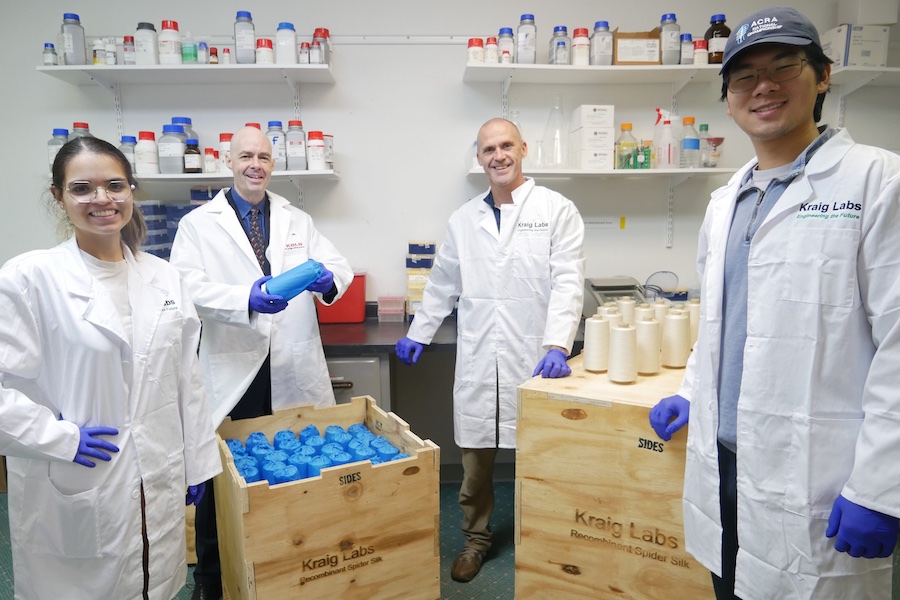
Kraig Biocraft Laboratories, Inc. (OTCQB: KBLB) (“the Company”, “Kraig Labs”, or “Kraig’s”), a world leader in spider silk technology*, today announced that it has produced more than 1.3 metric tons of recombinant spider silk cocoons in a single month. This is a new world record and shatters the Company’s previous production record by a factor of five. Today marks a pivotal step forward in the transition of spider silk from laboratory innovation to an industrial-scale material platform.

#Raw Materials

New study shows low environmental impact by Cotton made in Africa Organic Cotton from Tanzania

Today, the Aid by Trade Foundation (AbTF) is announcing the results of a comprehensive life-cycle analysis (LCA) for cotton produced in Tanzania under the Cotton made in Africa Organic (CmiA Organic) standard. The study emphasises the small ecological footprint of CmiA Organic verified cotton. This can largely be traced back to the absence of synthetic pesticides, artificial fertilisers, and artificial irrigation. Consequently, CmiA Organic cotton can help the textile industry meet regulatory requirements as well as science-based targets. The results also show that the consequences of climate change threaten the livelihoods of these cotton farmers, even though the type of agriculture they practise barely contributes to climate change.

Latest News

#Textile chemistry

Officina39 expands in South Asia with dual trade show presence and new low-impact dyeing innovation

Officina39 reinforces its strategic expansion in South Asia by announcing its participation in two key textile industry events in Bangladesh and India, alongside the launch of a new solution designed to reduce the environmental impact of reactive dyeing.

#Research & Development

ITA spin-off Solid Air (SA) Dynamics reaches the semi-finals of the Rice Business Plan Competition

The ITA spin-off SA Dynamics has been nominated for the semi-finals of this year’s Rice Business Plan Competition (RBPC), one of the world’s most prestigious start-up competitions, held at Rice University in Houston, Texas.

#Knitting & Hosiery

“We Believe in the Value of Textiles”: Successful Opening of the KARL MAYER TEXTILE INNOVATION CENTER

KARL MAYER inaugurated its new, state-of-the-art TEXTILE INNOVATION CENTER (TIC) with a four-day opening week from April 21 to 24. The highlight of the week was the grand opening on Thursday, which drew a strong turnout from the international textile industry: around 220 customers, brands, and partners from across the textile value chain came to the company’s headquarters in Obertshausen for a first-hand look at the new high-tech development environment and lively exchange with industry peers.

#Techtextil 2026

Speed and connectivity: Techtextil and Texprocess provided market-ready solutions for industries under pressure

With more than 36,000 visitors and 1,700 exhibitors from a total of 112 countries, Techtextil and Texprocess 2026 demonstrated how innovation comes into industrial use. The convergence of research, industry and application proved to be a breeding ground for new material solutions, manufacturing and processing technologies. Natural fibres, performance apparel, connected systems and AI-driven processing technologies emerged as key growth and future markets.

TOP