[pageLogInLogOut]

#Yarn & Fiber

Hermann Bühler AG are certified to OEKO-TEX® Standard 1000 and OEKO-TEX®

The Swiss Hermann Bühler AG produce yarn for the most discerning customers at the facility in Wintherthur and in a subsidiary factory in Jefferson/USA. The company, whose tradition goes back 200 years, set standards with regard to innovative products, first-rate quality and perfect customer service. Beyond this the yarn manufacturer has had the environmentally friendly and socially responsible production conditions certified to OEKO-TEX® Standard 1000 since 2007 and is also entitled to mark the products with the OEKO-TEX® Standard 100plus label.

Tradition and innovation Tradition and innovation are closely linked at Hermann Bühler AG. ‘The striving for high-quality products has characterised us from the beginning and still remains the key to our successful work. The basis is high and reliable product quality, but uncompromising implementation of new technologies and innovative ideas are an absolute must,’ explains Martin Kägi, CEO. The company have specialised in the processing of American extra long fibre staple Supima® cotton which – mainly due to its high fibre strength – offers ideal preconditions for further processing into products of the highest quality. The fibres used for the production of Micro Modal® Edelweiss and Micro Tencel® yarns are produced by the Austrian company Lenzing AG using exclusively FSC (Forest Stewardship Council) certified wood. These are the finest among all cellulose fibres, featuring versatile functional properties such as perfect moisture management. Yarn mixtures from selected materials such as silk and Micro Modal® Edelweiss allow the production of sophisticated and extra fine yarn for the most beautiful creations. These are used wherever highest quality and exclusivity are required, e.g. in high-quality shirts and blouses, exclusive underwear and nightwear or fine bed linen. Quality and responsibility 3,300 tons of the extensive yarn range are produced by 145 employees in the Swiss canton Zuerich. The 145 employees in the US state Georgia spin 3,700 tons. Numerous yarn qualities which the company supply to many international circular knitting mills, weaving mills and knitting mills are the basic material for a great variety of swiss+cotton® textiles. The yarn range of the company meets the highest requirements not only where product quality is concerned, though, but also in terms of production ecology. As one of the very first companies, Hermann Bühler AG have been documenting the human ecology optimisation of their yarns according to OEKOTEX ® Standard 100 since 1993. Furthermore the company were additionally certified to OEKO-TEX® Standard 1000 in 2007 to confirm the environmentally friendly and  socially responsible production conditions. The OEKO-TEX® Standard 100plus product label gives the company the opportunity to advertise the human ecology optimisation of their products according to OEKO-TEX® Standard 100 as well as their environmentally friendly production processes according to OEKO-TEX® Standard 1000 to their customers with just one test label. These certifications reflect the comprehensive commitment in the areas of environmental protection and sustainability which is firmly rooted in the company philosophy of Hermann Bühler AG. Martin Kägi is convinced that the future belongs to ecologically sound textile products: ‘Products which are harmless from a human ecology point of view are a must today. Manufacturers as well as end customers want safety. They expect the textiles to be tested for harmful substances and certified by an independent authority. That is why nearly all customers in Europa require certification to OEKO-TEX® Standard 100 today. We have even seen an increasing popularity of the OEKO-TEX® Standard in countries overseas such as the USA. Our American subsidiary has been certified to OEKO-TEX® Standard 100 since 2012. ’
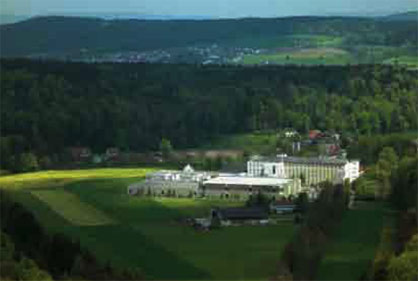
Pic: 145 employees at the Sennhof factory produce around 3,300 tons of yarn each year within the framework of an extensive product range

Sustainability in all areas The concept of sustainability can be seen in all areas and activities of Hermann Bühler AG: ‘It starts with the selection of the fibres used by us and continues with the use of renewable energy sources all the way to short transport routes of the products to our customers in Europe,’ Martin Kägi explains. ‘Beyond this our machinery is constantly being monitored and optimised with regard to yarn quality and productivity. For years we have been employing the revolutionary AirJet spinning method by Rieter which significantly increases the yarn output while reducing energy consumption by up to 30%.’

Hermann Bühler AG are one of the pioneers in the organic cotton business and have been producing yarn from American extra long fibre staple cotton from certified organic farming (kbA) since 1994. The production of the kbA cotton range ‘SwissCotton® Organic’ is completely CO2 free as it uses no fossil fuels. Electricity for this is generated in company-owned, small local hydroelectric power stations which supply around 10 per cent of the total required energy from this regenerative resource. The Rainbow technology developed in-house furthermore allows dyeing without adding salt or sodium carbonate, meaning these substances can be omitted. Martin Kägi is convinced by the many advantages of the technology: ‘Our Rainbow dyeing process noticeably reduces the strain on the environment. The significantly higher dye yield also lets us reduce the required amount of dyestuff, making optimised waste water treatment possible as well. What is more, Rainbow items can be dyed using conventional machines, chemicals and dyes with excellent results.’

With the introduction of the Micro Modal® Edelweiss and Micro Tencel® fibres, Hermann Bühler AG have additionally set standards for environmentally friendly production processes. The Edelweiss technology developed by Lenzing allows chlorine-free, CO2 neutral production from cellulose to fibre. 85 per cent of the energy required for fibre production is generated from the wood waste from cellulose production. Another factor in the positive environmental balance is the renewable raw material (European beechwood) used and a high cellulose yield per area without use of irrigation, fertiliser and pesticides. Bühler is the very first spinning mill to process the new Micro Modal® Edelweiss fibre. The manufacturing process of the Micro Tencel® fibre at Lenzing is also environmentally friendly and economical as it is based on a unique closed circuit of the solvent used. It is recovered to nearly 100 % and the very low remaining emissions are broken down in biological purification plants. For Martin Kägi it is only logical to focus on sustainable measures in production: ‘For consumers it is the high quality of the end product from our yarn that counts, because in the end clothing that lasts longer is also more sustainable.’
Pic: The yarn range of the company meets the highest requirements not only where product quality is concerned but also in terms of production ecology

More News from Oeko-Tex® Association

#Sustainability

OEKO-TEX® chooses TextileGenesis to advance digital traceability for organic cotton

OEKO-TEX® today announced a full collaboration with TextileGenesis, a Lectra company, to digitally trace and authenticate organic cotton, strengthening fraud prevention across the supply chain. This announcement follows a successful pilot and brings together OEKO-TEX®’s certification expertise and closed testing system with TextileGenesis’ digital traceability platform to deliver a secure, end-to-end solution for managing certified organic cotton flows.

#Sustainability

OEKO-TEX® - New regulations 2025

Fostering trust within the textile and leather industry remains the mission of OEKO-TEX®. Since trust relies on consistently high standards, the OEKO-TEX® Association has released the updated testing criteria, limit values and guidelines for its certifications, based on the latest scientific research and legal developments.

#Sustainability

OEKO-TEX® Annual Report 2023/2024 mentions 50,000+ valid certifications

The international OEKO-TEX® association has continued to demonstrate positive business growth, highlighting the critical role of close collaboration and shared commitment in accelerating sustainable change. More than 35,000 textile and leather companies depend on the certificates and product labels issued by OEKO-TEX®’s independent testing institutes. OEKO-TEX® issued more than 50,000 certificates and labels between July 1, 2023, and June 30, 2024 – an increase of 22% over the previous financial year.

#Sustainability

OEKO-TEX® New regulations 2024

Creating trust within the textile and leather industry and for its customers is the mission of OEKO-TEX®. Since trust is based on consistently high quality, the OEKO-TEX® Association is again publishing updates to the applicable test criteria, limit values and guidelines for its certifications. Based on new scientific findings and legal developments, the OEKO-TEX® Association has published the annual updates to its test criteria, limit values and guidelines.

More News on Yarn & Fiber

#Research & Development

GenuTrace client advisory: Is your cotton supply chain UFLPA ready?

U.S. Customs and Border Protection has released updated operational guidance (CBP Publication No. 5560-0526) expanding its forced labor enforcement framework. The guidance supersedes the original 2022 UFLPA Operational Guidance and now covers all forced labor enforcement authorities — UFLPA, CAATSA, and WROs/Findings — in a single unified document. For cotton importers, the enforcement posture has not softened. It has become more structured, more documented, and more demanding. Learn more about UFLPA.

#Spinning

"We will become a recycling powerhouse"

The textile industry is now in its fourth consecutive year of crisis, while automation, artificial intelligence and recycling are reshaping the rules of the game. In this interview, Rieter CEO Thomas Oetterli discusses the first signs of a market recovery, reflects on his first three years at the helm of the company, explains the integration of Barmag, outlines Rieter’s vision of the fully automated spinning mill and highlights the strategic importance of recycling. In doing so, he explains why the new Rieter Group aims to play a leading role in transforming the textile value chain into a circular economy.

#Man-Made Fibers

ROICA™ launches new global brand identity and digital experience

ROICA™, the premium stretch fiber developed by Asahi Kasei, today announced the launch of its new global brand identity, including a new key visual and a fully redesigned website. This milestone initiative marks the beginning of a new phase in ROICA™’s evolution as a global brand.

#Man-Made Fibers

DYNEEMA® and NP Aerospace advance personal protection for military servicewomen

Dyneema®, owned by Avient Corporation, an innovator of materials solutions, is supplying its high-performance unidirectional (UD) materials to world-leading armor manufacturer NP Aerospace, enabling the production of armor systems designed specifically to fit the female body. With 2,000 new armor systems, including 4,000 plates, made in the United Kingdom (UK) and delivered in June 2026, this collaboration addresses a long-standing lack of high-quality personal protection specially built for female defense and security personnel.

Latest News

#Carpets

DOMOTEX Hannover 2028 off to a strong start with expanded portfolio

Preparations for DOMOTEX 2028 are already gaining strong momentum. Following its successful repositioning as the Home of Flooring & Interior Finishing, around 100 international manufacturers have already secured their place during the initial registration phase.

#Knitting & Hosiery

STOLL: Agreement signed for the divestiture of selected assets

In early 2025, KARL MAYER announced its strategic decision to focus on its core business areas of WARP KNITTING, WARP PREPARATION, and TECHNICAL TEXTILES. As part of this move, the flat knitting machine business under the STOLL brand was discontinued and the production site in Reutlingen was closed in October 2025.

#Research & Development

TERNAfil wins first place at PitchMiUp Night 2026 in Minden

The RWTH spin-off TERNAfil has developed MAXCarbon, a new high-performance hybrid fibre that combines the mechanical performance of carbon with the temperature and corrosion resistance of ceramic materials. For this development, TERNAfil was awarded first prize at the PitchMiUp Night in Minden on 21 May 2026.

#Nonwovens

Lenzing Group highlights scalable, bio-based nonwovens solutions at leading global industry fairs

From CIDPEX in China to Techtextil in Frankfurt and INDEX in Geneva, the Lenzing Group showcases ready-for-market, bio-based nonwoven solutions and receives industry recognition for LENZING™ Nonwoven Technology.

TOP