[pageLogInLogOut]

#Yarn & Fiber

RGE provides second annual update on USD 200 Million commitment in next-generation textile fibre innovation and technology

Royal Golden Eagle (RGE) has released its 2021 progress report on its commitment to invest USD200 million in next-generation textile fibre innovation and technology over a ten-year period which started in 2019.

The annual report provides an update on the activities undertaken by RGE and its business groups (Sateri, APR, APRIL, Bracell) involved in the fashion value chain to advance its ambition towards closed-loop, circular and climate-positive cellulosic fibre.

Bey Soo Khiang, Vice Chairman, RGE said, “Our achievements this year underscore our commitment to continuous improvement in clean production and resource utilisation efficiency. We will continue to pursue manufacturing excellence and invest in best-in-class technologies for all our facilities as part of our commitment towards closed-loop and cleaner production.”

In 2021, Sateri achieved full compliance with the emission limits set out in the European Union Best Available Techniques Reference Document (EU-BAT BREF) for all of its five viscose mills in China, two years ahead of schedule. Bracell completed construction of the world’s largest and greenest new generation pulp mill in São Paulo which uses cutting-edge technology for fossil fuel-free generation.

Amid the COVID-19 pandemic continuing to restrict travel and collaboration, RGE persisted in building upon existing partnerships, while entering into new agreements. Sateri strengthened its strategic collaboration with Infinited Fiber Company, participating in the company’s EUR30 million funding round, which attracted new and existing investors such as H&M Group, Adidas, BESTSELLER and Zalando.

New partnerships formed by RGE included a five-year textile recycling research collaboration with Nanyang Technological University Singapore, and a three-year strategic partnership with the Textile and Fashion Federation Singapore which seeks, among others goals, to advance research and innovation in circular economy approaches to fashion waste in Asia. 


RGE’s in-house R&D team has made good progress in advancing its textile-to-textile project, focusing on producing quality viscose using recycled cotton textiles as feedstock. To support plans to build a textile recycling facility in Indonesia, and as part of commercial feasibility analysis, studies examining the availability of textile waste and textile recycling landscapes in China, Indonesia, Sri Lanka and Bangladesh were completed.

Sateri remains on track in developing a product with 50 per cent recycled content by 2023, and to reach 100 per cent by 2030. It also aims for 20 per cent of its feedstock to contain alternative or recycled materials by 2025. In this similar vein, APR will source 20 per cent of its feedstock from alternative or recycled materials by 2030.

RGE is the world’s largest viscose producer, through its business groups Sateri and APR, with strong presence in Asia where textile demand growth intersects with the textile production hub, giving the company a unique opportunity to lead change all across the industry.

Download RGE 2021 Next-Generation Textile Fibre Innovation & Technology Progress Report:

https://issuu.com/rgei/docs/rge_next_gen_textile_fibre_report_2021

More News from TEXDATA International

#ITM 2026

ITM 2026: The new geography of textile production

New production hubs are emerging across North Africa and Central Asia, while Türkiye is accelerating its transformation toward higher-value, technology-driven and more sustainable textile manufacturing.

#Research & Development

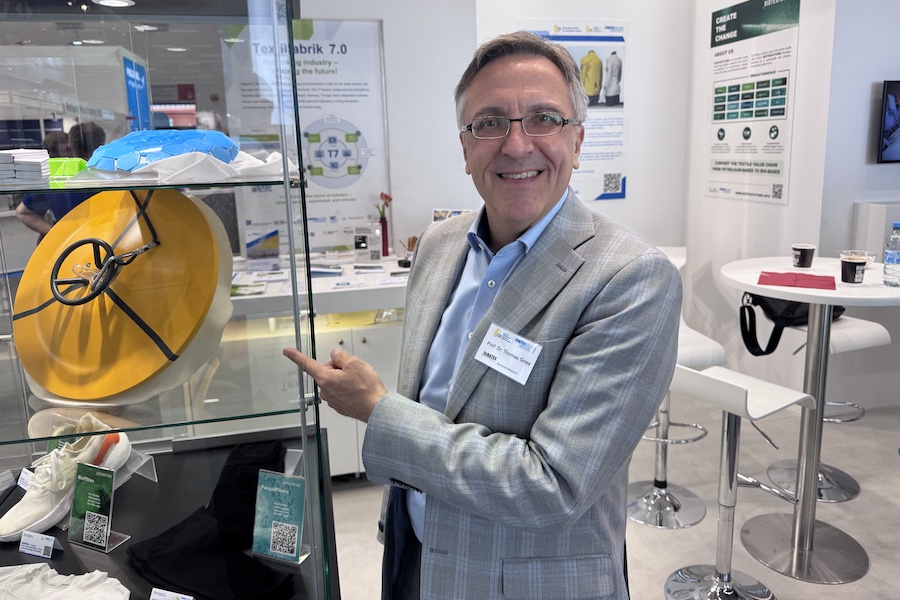
“Production is a product”

From technical textiles and AI-driven robotics to the limitations of textile circularity: Professor Dr Thomas Gries looks back on more than two decades of development at ITA Aachen. In the interview, he explains why production technology remains a decisive success factor, discusses international collaborations and innovation ecosystems, and shares his views on the transformation of production landscapes and the challenges facing an increasingly regulated industry.

#Knitting & Hosiery

“We need to move away from the price trap and return to a value-driven mindset.”

With its new Textile Innovation Center, KARL MAYER is sending a strong signal for innovation, collaboration, and the future of textile applications. In this interview, Karl Josef Mayer discusses new opportunities in warp knitting, the processing of staple fibres, recycling, the changing role of machinery manufacturers, and why the textile industry must once again focus more strongly on the value of textiles. by Oliver Schmidt

#Associations

“Innovation, resilience and international experience remain the great strengths of the Swiss textile machinery industry”

Geopolitical uncertainty, growing competitive pressure from China, new free trade agreements and the shift towards a circular economy are currently reshaping the global textile industry. In this interview, Cornelia Buchwalder discusses the current mood within the Swiss textile machinery sector, the industry’s distinctive innovative strength, new market opportunities in India and Asia, and the technological trends that could shape the upcoming trade fair cycle leading up to ITMA 2027.

More News on Yarn & Fiber

#Man-Made Fibers

Ministry of Industry Delegation visits NatureWorks’ second global manufacturing site at Nakhon Sawan Biocomplex

NatureWorks Asia Pacific Limited welcomed a high-level delegation led by Mr. Varawut Silpa-archa, Minister of Industry, to its manufacturing site at the Nakhon Sawan Biocomplex (NBC). The visit follows the successful inauguration of the site on April 29, 2026, and highlights the role of public-private collaboration in advancing Thailand’s sustainable industrial development and bioeconomy ambitions.

#Man-Made Fibers

Sorona® and WGSN announce top bio-based material trends of 2027

Sorona®, the partially bio-based polymer from Covation Biomaterials (CovationBio™), and global trend forecasting authority WGSN today release the material trends shaping the textile industry through 2027 and beyond following a comprehensive examination of bio-based functional fiber applications and global data.

#Sustainability

The first widely accessible Life Cycle Assessment study for cashmere production published by Textile Exchange.

Crucial new data to better understand, measure, and address the impacts of cashmere production has been made available to the fashion, textile, and apparel industry through a new Life Cycle Assessment (LCA) published by Textile Exchange.

#Yarn & Fiber

R-Evenge chooses Q-NOVA® yarn by Fulgar for its line of technical socks dedicated to wellness

Q-NOVA®, Fulgar’s sustainable polyamide 6.6 yarn, has been selected by R-Evenge for the development of its collection of technical socks dedicated to wellness, fitness, and water-based activities.

Latest News

#Recycling / Circular Economy

Indorama Ventures advances circularity tthrough PETValue Philippines' “Zero Waste to Landfill Partnership” with Republic Cement

Indorama Ventures Public Company Limited, a global sustainable chemical company, is advancing the circular economy through a new Zero Waste to Landfill initiative at its recycling site PETValue Philippines, further demonstrating how collaboration across industries can maximize resource efficiency and reduce waste.

#Associations

IVGT membership: expertise that pays off

For energy-intensive textile companies, government compensation mechanisms are an important economic factor. The IVGT successfully supports its member companies in applying for state aid and thereby regularly contributes to significant financial relief.

#Research & Development

Networking Day 2026: Industry stakeholders unite around textile recycling

In 2026, the Industry Research Group (IRG) Polymer Recycling once again brought together some of the key stakeholders in textile recycling for its annual Networking Day. This year, the event took place at EREMA’s premises in Ansfelden, Austria. It brought together key players from across the textile recycling value chain for a day of structured exchange and in-depth discussions.

#Knitting & Hosiery

The new RDJ 7/3 defines the design footprint of modern athletic shoes

Stylish, functional, and efficient to produce – spacer fabrics are the all-arounders among textile materials. These versatile fabrics are particularly in demand in the sports and casual footwear sector, as they combine comfort, breathability, and design freedom. At the same time, this industry is trend-driven, dynamic, and price-sensitive like few others. Innovations are therefore a decisive factor for success. With the RDJ 7/3, KARL MAYER offers a solution specifically tailored to these requirements. The particular strength of the new double raschel machine: its exceptional flexibility, thanks to its three jacquard bars.

TOP