[pageLogInLogOut]

#ITMA 2019

Textechno celebrates its 70th birthday at ITMA Barcelona
(c) 2019 Textechno
Founded in April 1949, Textechno Herbert Stein GmbH & Co. KG, Germany, looks back at 70 years of innovation in textile testing. Today, the Textechno Group consists of Textechno and its Austrian subsidiary Lenzing Instruments and is world market- and technology leader in the field of testing equipment for man-made fibres and yarns.

At ITMA 2019 in Barcelona, Textechno will exhibit its well-proven STATIMAT series – the most complete series of automatic tensile testers for yarns world-wide, ranging from the finest Spandex (STATIMAT MEL+) to the coarsest and strongest Aramids and UHMWPEs (STATIMAT 4U).

The world standard equipment for static crimp and shrinkage tests, TEXTURMAT ME+, as well as its dynamic counterpart, DYNAFIL ME+, will be shown in Barcelona. Moreover, the fully-automatic evenness tester COVAMAT, which was shown as a prototype at ITMA 2015, is now in series production and fulfils all requirements of an effective and reliable quality control on POY, FDY, and IDY.

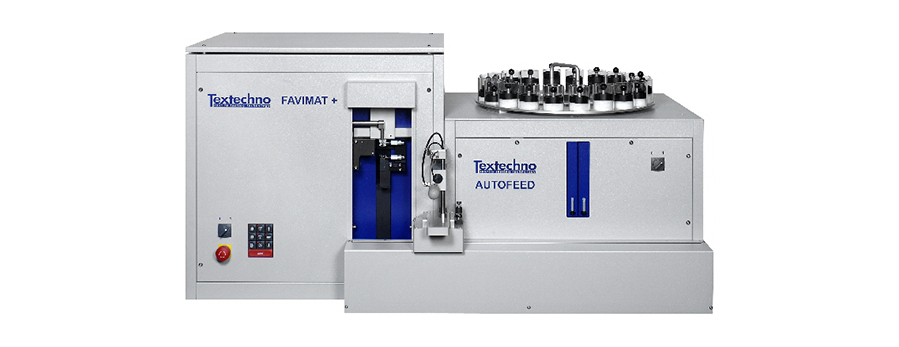
Textechno has developed the world’s first single-fibre tensile testers in the early 50ies. By now Textechno offers the sixth generation of single fibre testing instruments and combines it with the highest degree of automation. FAVIMAT+ AUTOFEED fetches single fibres from the floc and measures linear density, tensile, and crimp properties including crimp number.
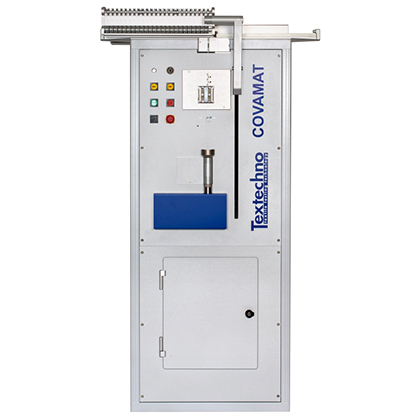
Covamat (c) 2019 Textechno


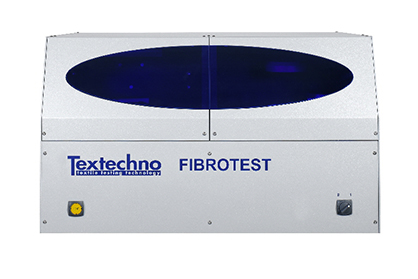
Fibrotest (c) 2019 Textechno


Since FAVIMAT+ is suitable for all kinds of fibres, it has also successfully entered the market of reinforcement fibres such as glass- or Carbon fibres. The award winning FIMATEST system measures fibre/matrix-adhesion and now also the contact angle and is a great addition to Textechno’s FAVIMAT+ in the field of composite testing.

At ITMA 2007 Textechno has started a range of instruments for natural fibres and spun yarns, which is now complete: Textechno's Fibre Classifying System FCS and MDTA 4 determine the quality and spinnability of both cotton- and synthetic fibres. At this ITMA the focus will be on the enhanced fibre bundle length and strength tester FIBROTEST, the new micronaire tester FIBROFLOW, the new trash and colour tester OPTOTEST, as well as the fibre length-, impurity- and spinnability tester MDTA 4.

Visit the joint booth of the Textechno Group – Textechno and Lenzing Instruments: Hall UL (Under linkway), booth C105.



More News from TEXTECHNO Herbert Stein GmbH & Co. KG

More News on ITMA 2019

Latest News

#Sustainability

Ying McGuire becomes new CEO of Cascale

Cascale today announced the appointment of Ying McGuire as Chief Executive Officer, effective June 1, 2026.

#Technical Textiles

Sustainable, lightweight, and sound absorbing: Polyester-based front trunk solution for BEVs

As car manufacturers look to further reduce their carbon footprint, Autoneum has developed an innovative front trunk solution for battery electric vehicles (BEVs), made entirely from polyester-based textile. The Ultra-Silent Frunk offers significant weight reduction, improved acoustic and thermal insulation, and uses up to 70 percent recycled material, supporting sustainable and efficient vehicle design. Autoneum, global technology leader in acoustic and thermal management for vehicles, has already received orders for the new frunk from three major OEMs in Asia and Europe to be built in three BEV models. Series production for two BEVs has been underway in China and Germany since last year.

#Raw Materials

Modern testing methods for raw cotton

The 38th International Cotton Conference Bremen will take place from 25 to 27 March 2026 at the Bremen Parliament. This conference has traditionally stood for in-depth expertise and international exchange. The program will focus on technical innovations, market trends, and regulatory frameworks across the entire value chain – from agriculture to the circular economy. With high-profile speakers, the conference is regarded as the key meeting point for the global cotton industry. Today’s focus: Cotton quality and testing methods.

#Spinning

Rieter responds to higher raw material prices

Global political and economic developments have been leading to rising raw material and energy costs for some time. The textile machinery industry is also affected by this trend. Rieter machines and components consist to a large extent of steel, copper, aluminum and electronics. These materials in particular have seen higher demand and higher prices in recent months.

TOP
