[pageLogInLogOut]

#Yarn & Fiber

TENCEL™ fibers for more comfort through Micro technology
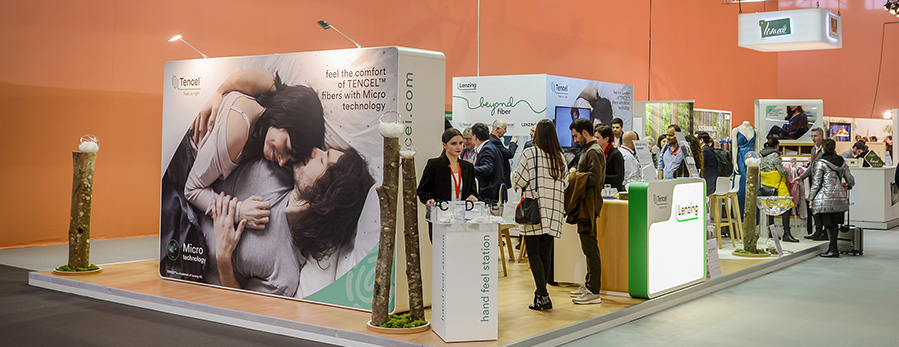
Lenzing booth at Premère Vision in Paris (c) 2019 Lenzing
At the Première Vision Lenzing presents TENCEL™ branded lyocell and modal fibers with Micro technology for enhanced comfort. Lenzing is with its fine fiber portfolio an expert in producing and marketing of Microfibers for the textile industry and gives this specialty fiber category a new boost.

Consumers want more comfort

An increasing number of consumers are choosing clothing for its feel-good factor. Comfort plays a key role. The parameters of the softness, lightness and smoothness of textiles are critical for the wearer’s well-being. With its fine fibers based on wood, Lenzing offers the solution for fashion with lots of comfort.

Specialist in fine fibers

Lenzing’s fiber portfolio boasts a wide range of fine fibers for the textile and fashion industry. Light and smooth fabrics can be designed with these fibers which are a major contributor towards the comfort of the clothing and the wearer’s well-being. TENCEL™ Lyocell and Modal fibers are produced in titers of 1.00 – 0.80 dtex using Micro technology and processed to lightweight fabrics. “The trend is clearly towards greater comfort. Our fibers produced with Micro technology are the ideal solution and support this trend. Textiles of fine TENCEL™ Lyocell and Modal fibers feel like a second skin. The fibers are frequently used in lingerie and luxurious homewear”, explains Andreas Dorner, Commercial Director Textiles Europe & Americas.

Softness, smoothness, lightness, more drape

Fine fibers ensure a silky and pleasant feeling on the skin. A clothing of TENCEL™ Lyocell or Modal fibers, produced with Micro technology, is light on the skin and has a flowing drape. It is defined by feel-good properties like silkiness, softness and long lasting suppleness. Softness is one of the determining parameters for well-being. The finer the fibers used in the textiles are, the softer they become. With TENCEL™ Lyocell and Modal fibers with Micro technology, comfort is supported in different products.
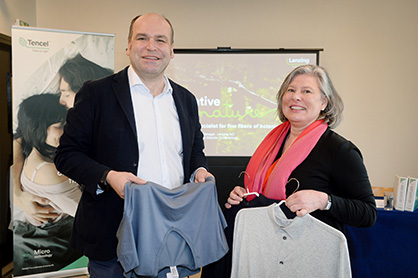

Andreas Dorner, Regional Commercial Director Textiles Europe & Americas and Claudia Mommer, Product Manager, Business Management Textile (c) 2019 Lenzing

Furthermore TENCEL™ Lyocell and Modal fibers with Micro technology are naturally smooth and supple as tests1 confirm. The combination of smoothness and softness is crucial for textiles that are gentle on the skin. Another characteristic of textiles made out of Lenzing’s fine fibers is a flowing drape, which gives an attractive appearance.

Lenzing’s fine fibers result in the finest of yarns which can be processed to very light knitted and woven fabrics. They are so light that one can barely feel the clothing.

Tested and retested

As softness is key for a comfortable textile, Lenzing is investigating in this parameter to prove this characteristic, which is going to make Lenzing an expert for softness assessments in textiles, applying instrumental as well as human hand feel panel with trained experts. The Lenzing panel, which consists of Lenzing employees with different expertises, provides precise evaluation of textile hand feel parameters such as softness, smoothness and drape. The panel is supported by physical measurement methods and comparative external expert and consumer evaluations. One of these panels can be seen at the Première Vision at the Lenzing booth.
More News from Lenzing

#Nonwovens

Lenzing Group highlights scalable, bio-based nonwovens solutions at leading global industry fairs

From CIDPEX in China to Techtextil in Frankfurt and INDEX in Geneva, the Lenzing Group showcases ready-for-market, bio-based nonwoven solutions and receives industry recognition for LENZING™ Nonwoven Technology.

#Yarn & Fiber

Lenzing AG appoints Georg Kasperkovitz as Chief Executive Officer

The Supervisory Board of Lenzing AG has appointed Georg Kasperkovitz, Member of the Management Board and Chief Operations Officer, as Chief Executive Officer (CEO) of Lenzing AG with effect from June 1, 2026.

#Denim

TENCEL™ Lyocell - HV100 achieves global denim availability in six months; Vol. 2 debuts at Kingpins Amsterdam

When TENCEL™ Lyocell - HV100 debuted at last year’s Kingpins Amsterdam in October, 17 mill partners across five countries presented fabrics featuring the new fiber. Just six months on, participation has more than doubled, evolving into a global network that spans nine countries and four continents, signaling both strong industry momentum and growing demand.

#Techtextil 2026

Lenzing unveils three-tier cellulosic fiber portfolio for next generation protective wear

The Lenzing Group, a leading supplier of regenerated cellulosic fibers for the textile and nonwovens industries, today introduces Lenzing Solutions for Protective Wear. This integrated three-tier portfolio is anchored by LENZING™ FR fibers at the highest protection tier for inherent flame resistance and brings together complementary solutions including TENCEL™ Lyocell fibers, both EU Ecolabel-certified² and derived from certified or controlled wood sources³, within a unified protective wear architecture for the first time. The launch marks the most significant expansion of Lenzing’s protective wear business since the company pioneered inherently flame-resistant cellulosic fiber in 1977, and comes as the global personal protective equipment (PPE) market accelerates toward an estimated USD 130 billion by 2033⁴.

More News on Yarn & Fiber

#Yarns

Yarn Expo Shenzhen 2026 closes doors, advancing sustainable and innovative sourcing in South China

Yarn Expo Shenzhen 2026 served as a strategically positioned mid-year sourcing platform for the Greater Bay Area, highlighting Shenzhen’s role in connecting regional demand, supply and innovation exchange across the textile value chain. During the three-day fair, over 20,000 visits were drawn from 74 countries and regions[1], as exhibitors and buyers engaged with new developments in greener, performance-led, and value-added yarn and fibre solutions. Held in conjunction with Intertextile Shenzhen Apparel Fabrics and PH Value, the fair underscored the benefits of closer synergy and new materials across yarn, fabric and apparel platforms for the South China market.

#Yarns

Yarns and technologies in symbiosis: Biella Yarn presents Fall/Winter 2027/2028 collection “New Romance_”

Biella Yarn, the flat knitting brand of Suedwolle Group, launches new Fall/Winter 2027/2028 collection, inspired by the symbiosis of yarns and technologies – elements that blend, adapt and evolve together, forming something new without losing their origin. The name “Neu Romance_” reflects the emotional and neurological dimension of the yarns: a connection that engages the senses, experienced through material, touch and interaction. The collection is further brought to life through design collaborations, featuring selected yarns used in different design approaches.

#Recycling / Circular Economy

The textile industry in transition

Recycling, traceability, eco-design and digitalisation are among the key future challenges facing the European textile industry. The Erasmus+ project Skills4Circularity, involving 21 partners from twelve countries, is investigating the skills required to address these challenges. As the German industry partner, the Industry Association for Finishing – Yarns – Fabrics – Technical Textiles (IVGT) is bringing the industry’s perspective to the project.

#Research & Development

GenuTrace client advisory: Is your cotton supply chain UFLPA ready?

U.S. Customs and Border Protection has released updated operational guidance (CBP Publication No. 5560-0526) expanding its forced labor enforcement framework. The guidance supersedes the original 2022 UFLPA Operational Guidance and now covers all forced labor enforcement authorities — UFLPA, CAATSA, and WROs/Findings — in a single unified document. For cotton importers, the enforcement posture has not softened. It has become more structured, more documented, and more demanding. Learn more about UFLPA.

Latest News

#Spinning

Ibrahim Fibres and Trützschler: A strong partnership enters its next phase with the TC 30Si

For more than two decades, Ibrahim Fibres and Trützschler have grown side by side, driven by a shared ambition to continuously improve spinning performance, strengthen technology leadership and set new benchmarks in the textile industry. Today, Ibrahim Fibres is a leading yarn and polyester staple fiber manufacturer in Pakistan. The company operates the largest number of Trützschler cards in the country, with more than 200 machines running across its mills in Faisalabad, and plays an important role in one of Asia’s largest textile industries.

#Digital Printing

USColorworks expands digital platform with Kornit Atlas MATRIX and Atlas MAX PLUS solutions

Kornit Digital Ltd. (NASDAQ: KRNT), a global pioneer in sustainable, on-demand digital fashion and textile production, today announced that USColorworks, a North Carolina-based apparel decoration and fulfillment company specializing in custom and on-demand printing for retail and promotional markets, has expanded its Kornit digital production platform with the addition of Atlas MATRIX and Atlas MAX PLUS systems to deliver high-quality, on-demand apparel across cotton, blended fabrics and polyester.

#Functional Fabrics

CovationBio introduces two new bio-based innovations at Functional Fabric Fair New York

Covation Biomaterials LLC (“CovationBio®”) is showcasing its two new bio-based innovations, Xatryx® and Sorona® elasterell-p fiber, at this year’s Functional Fabric Fair in New York City, July 7–9, 2026. Attendees can visit CovationBio at Booth #404 to explore this next generation of bio-based performance materials.

#Research & Development

Geotextiles made from recycled materials: GREEN leads the way into the industry

For the industry, recycled materials are creating new opportunities in geotextile production. In the GREEN project, the Fraunhofer Cluster of Excellence Circular Plastics Economy CCPE demonstrates that recycled polypro-pylene (PP), polyethylene terephthalate (PET), and high-density polyeth-ylene (HDPE) can be processed into nonwovens, fibers, and membranes that meet industrial requirements. This creates opportunities for use in existing production lines and new value chains in the geotextile market.

TOP