[pageLogInLogOut]

#Weaving

Tremendous interest shown in CREALET’S products during ITMA 2015 in Milan

ITMA 2015, the world’s leading trade show for textile machinery, exceeded all records in Milan this year. With more than 123,000 visitors from 147 countries, the show was busier than ever. The CREALET booth was bustling throughout the show with guests gathering information on the latest products and services.
CREALET – exhibitor of warp let-off and cloth take-up systems – is excited about the future.

A broad portfolio of innovative solutions such as warp thread feeding, narrow and wide weaving machines, and warp knitting machines were presented.Items of particular interest to both visitors and the media were the innovative CS2 Selvedge Thread Let-off and the conversions from mechanical to electronic let-off for narrow weaving machines.

These new technologies replace conventional systems using a new independent control option. With these new innovations, users are given greater flexibility and can optimize their weaving processes more efficiently.

Visitors were also excited to learn about CREALET’s portfolio of products for wide weaving machines. These include conversion possibilities for Projectile Weaving Machines as well as the possibility of additional warp beam frames that can be placed behind either weaving or warp knitting machines.

Walter Wirz, General Manager of CREALET, was very positive about this year’s ITMA: “We had a highly successful ITMA 2015 with very positive feedback on the presented CREALET novelties. We have had very qualified discussions with numerous visitors and made many new contacts, thus strengthening our position as an innovative and competitive company.”
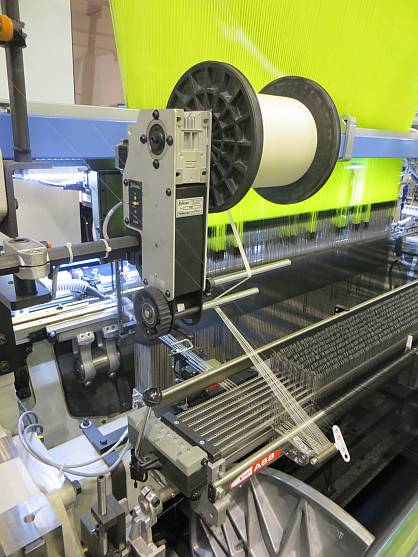
Pic: CS2 Selvedge Thread Let-off (c) 2015 CREALET

More News from Crealet AG

More News on Weaving

#Weaving

"Dynamic markets do not only create uncertainty – they also create opportunities."

Volatile markets, increasingly complex materials and growing demands for flexibility are changing the weaving industry. At the same time, new opportunities are emerging in technical textiles, filtration, composites and many other specialised applications. Since taking over as Head of DORNIER's Weaving Machines Product Line at the beginning of 2026, Yvonne Schuberth has been helping to shape this development. In this interview with TexData, she explains why process stability and customer proximity remain the foundation of innovation, how digitalisation is transforming weaving mills, and why she believes the future belongs to technologically demanding applications.

#Weaving

More patterns, less effort: the MULTI-MATIC® at Rohleder

Rohleder is one of Europe’s most modern weaving mills. For over 80 years, the family-owned company has been developing and manufacturing premium fabrics for brands, retailers and private customers – 100% Made in Germany. This success is made possible by a consistent focus on design, quality, and functionality, as well as by continuous investment in state-of-the-art production facilities. Rohleder also relies on innovative technologies in warp preparation and has been collaborating with KARL MAYER for many years. As recently as 2023, a MULTI-MATIC® was delivered to the company’s headquarters in Konradsreuth.

#Knitting & Hosiery

Groz-Beckert at Igatex 2026

From October 15 to 18, 2026, Groz-Beckert will present its latest innovations and solutions across the product areas of Knitting, Weaving, Sewing and Spinning at Igatex in Pakistan (Hall 1, Booth A-1-08).

#Composites

Fewer pores, greater impact tolerance: Peter Dornier Foundation Prize 2026 honours material research on fibre-reinforced composite components for aerospace industry

Microscopically small pores that form during manufacture, or barely visible impact damage, can severely impair the load-bearing capacity and service life of fibre-reinforced composite components. Two young researchers have presented groundbreaking work in this field and will both be awarded the 2026 Peter Dornier Foundation Prize: Dr.-Ing. Benedikt Neitzel from the Technical University of Ilmenau for his doctoral thesis on pore minimisation in the RTM process, and Johanna Buschmann, M.Sc., for her master’s thesis, completed at the German Aerospace Centre, on the improved impact tolerance of 3D fabrics compared to 2D laminates.

Latest News

#Raw Materials

Brazil sets new cotton export record and consolidates global leadership

Brazil ended the 2025/26 commercial year with a new record, consolidating its position as the world’s largest cotton exporter. Between August 2025 and July 2026, the country shipped 3,373,941 tonnes of the fiber, 19% more than in the previous cycle, and reached record revenue of US$5.3 billion. The result represents a milestone in Brazil’s expansion in the international market and reinforces the country’s role as a strategic supplier to the global textile industry.

#Raw Materials

Better Cotton Initiative partners with Avalo in AI plant breeding for climate-resilient cotton

The Better Cotton Initiative (BCI) has partnered with agriculture solutions company Avalo, whose platform accelerates the speed at which plants with key resiliency traits may be developed.

#Man-Made Fibers

The LYCRA Company expands its co-creation vision through an immersive Lifestyle District at Intertextile Shanghai.

The LYCRA Company, a global leader in fiber and technology solutions for the apparel industry, is reimagining the trade show experience at Intertextile Shanghai Apparel Fabrics Autumn Edition, which opened today in China. Building on the success of last year's ALL IN concept, the company has expanded its co-creation vision into a 356-square-meter Lifestyle District featuring partners Jingzili New Material, JYT Textile, Lianxingfa Knitting, and Trend Textile. The district is part of a larger 895-square-meter pavilion showcasing a total of 19 co-exhibitors. Together, they demonstrate how innovations in fiber, fabric, and garments can be combined to create compelling solutions for both work and play.

#Natural Fibers

Plastic-free stretch technologies drive new direction for denim innovation

As the denim industry looks for ways to reduce its reliance on synthetic fibres, plastic-free stretch technologies are gaining momentum. Developments based on mechanical fabric construction and natural rubber are demonstrating that comfort and stretch can be achieved without conventional elastane, supporting both recyclability and circular product design.

TOP