[pageLogInLogOut]

#Weaving

State Secretary Dr. Patrick Rapp and Member of the State Parliament Katrin Schindele visit Lindauer DORNIER in Esseratsweiler
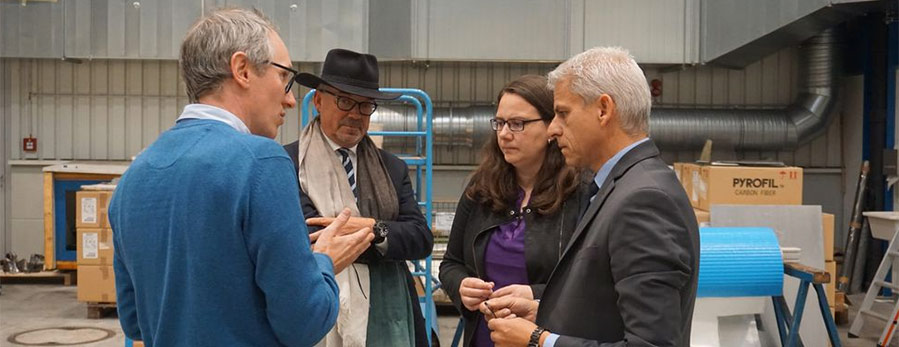
High-performance fabrics for the production of fiber composites are produced on Lindauer DORNIER machines and systems. © 2023 Lindauer DORNIER
Last Friday, Dr. Patrick Rapp, State Secretary in the Ministry of Economics, Labour and Tourism of the State of Baden-Württemberg, and Katrin Schindele, Member of the State Parliament and Deputy Chairwoman of the Committee for Economics, Labour and Tourism, visited the Esseratsweiler plant of Lindauer DORNIER GmbH located in the district of Ravensburg. Both appreciated the many efforts of DORNIER to strengthen the sustainability and future viability of the location.

On site, Schindele and Rapp witnessed the results of the latest investments at the Baden-Württemberg site of the internationally active machine and plant manufacturer. These include a new photovoltaic system on the roofs of the production halls where DORNIER manufactures innovative solutions for manufacturers of films and fibre composites. Since this year, the 4,000 square meter solar plant not only supplies the factory itself with renewable energy, but also feeds electricity into the public grid. "The fact that DORNIER is investing here in Esseratsweiler on a large scale in CO2 reduction and sustainability proves the future orientation and loyalty to the location of the traditional family business," said Patrick Rapp during his visit. State Secretary Rapp was also pleased that DORNIER continues to manufacture its machines and lines, which are exported to customers all over the world with an export share of over 90 percent, completely in the Esseratsweiler and Lindau plants despite the difficult general conditions. Of particular interest to the guest were the film production lines, up to 150 meters long, on which customers of Lindauer DORNIER produce films for food packaging, pharmaceutical products and special films for solar modules and capacitors.

Automotive suppliers could serially produce lightweight components on DORNIER systems

A visit to the Composite Systems Division's technical centre was also made on site. Here DORNIER develops and builds modern plants for the production of fibre composites. The lightweight components, which are produced on the machines by hidden champions all over the world, some of them highly specialized, can be found in aircraft and high-performance passenger cars. In the medium term, the traditional automotive supply industry could also use these machines for large-scale production. "Automotive suppliers could use them to mass-produce fibre composite components on demand for OEMs or TIERs – with the desired geometry, the right mix of fibres and matrix, and individual mechanical properties," said Dr Josef Klingele, head of the Composite Systems product line, during the tour. Because electric cars require fewer precision parts made of metal than petrol cars, Klingele said, capacities are freed up at medium-sized suppliers – these could be absorbed by the production of fibre composite components. "An automotive supplier that today turns injection nozzles or lasers sheet metal parts could in future increasingly produce fibre composite components on our systems," stated Klingele. This would preserve the distribution that has proven itself over decades: OEMs produce the large-scale series, while medium-sized companies with an affinity for development optimise the car components in terms of geometry, performance and costs. "Whether it's an electric car, a transport drone or a flying taxi – with our machines and systems we want to enable suppliers to creatively produce lightweight applications using standardised materials" said Klingele.


The topic was of particular interest to Katrin Schindele, a member of the state parliament who also worked as a development engineer at an automotive supplier before her political career. "It never ceases to fascinate me what you get to see in terms of creativity and performance when you visit family businesses in our region," said Schindele.
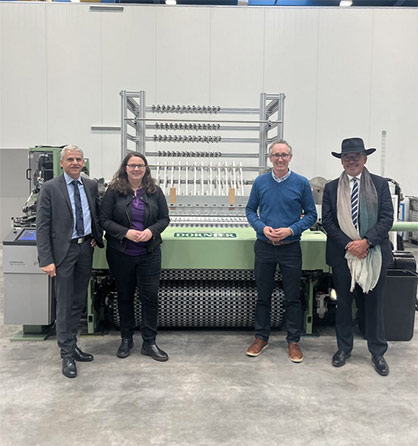
Dr Patrick Rapp and Katrin Schindele together with Dr Josef Klingele and Peter D. Dornier (from left to right) during their visit to the Composite Systems Business Unit's technical centre. © 2023 Lindauer DORNIER


Largest investments in recent company history?

In the coming years, the family-owned company plans to continue investing massively in sustainability, energy efficiency and digital transformation. Franz-Peter Matheis, Commercial Managing Director at DORNIER, said during the tour: "We are currently making the largest investments in our recent company history in order to make our Esseratsweiler and Lindau sites even fitter for the future." In addition to the investments in the company's own power supply from renewables, he said, further ones are planned for the modernisation of the machinery, the optimisation of logistics and digitalisation. Andreas Kückelmann, Technical Managing Director at DORNIER: "With these measures we aim to navigate DORNIER through the current and future challenges." Because this also includes securing young talent, DORNIER held the DORNIER Talents Day at the Lindau site for the first time at the end of September. More than 200 young people and interested adults came to get an overview of the company's wide range of training opportunities, from industrial clerks to machining and construction mechanics to dual study programs.
More News from Lindauer DORNIER GmbH

#Weaving

Lindauer Dornier announces leadership transition in weaving machine business

After more than ten successful years at Lindauer DORNIER GmbH, Mr Wolfgang Schöffl will leave the family-owned company at the end of the year to enter well-deserved retirement.

#ITMA Asia + CITME Singapore 2025

DORNIER celebrates its anniversary at ITMA Asia + CITME

To mark its 75th anniversary, machine and plant manufacturer Lindauer DORNIER will be presenting the latest developments in its rapier and air-jet weaving machines at ITMA Asia + CITME in Singapore (Hall 2, Stand B401) from 28 to 31 October 2025. The focus will be on energy-efficient weaving technologies, new IoT solutions for networked textile production and systems for the series production of modern fibre composite components.

#Weaving

From the Venus flytrap to foldable aircraft wings: Peter Dornier Foundation Prize 2025 honours bionic research on 3D weaving technology

Long wings with foldable tips have the potential to reduce aircraft fuel consumption and make aviation more sustainable. An interdisciplinary research team has now developed a new solution based on the Venus flytrap: Freely movable wingtips made of fibre composites which are produced using innovative 3D weaving technology. For this pioneering combination of textile technology, aviation and bionics, researchers Patrick Meyer (TU Braunschweig) and Michael Vorhof (TU Dresden) were awarded the Peter Dornier Foundation Prize 2025 in mid-July.

#Weaving

Pattern-controlled “pic-a-pic” setting of rapier release timing on right-hand side

DORNIER PIRO enables the operator to set the timing of the rapier release on the right-hand side of the machine “pic-a-pic” and pattern-controlled. For applications with weft yarns of different fineness or elasticity, the optimum timing can be set for each weft channel. This offers great potential for reducing weft waste on the right-hand side.

More News on Weaving

#Weaving

Itema America acquires Palmetto Loom Reed, strengthening local manufacturing and service in the U.S.

Itema America, the U.S. subsidiary of Italy-based Itema Group, has acquired – through an Assets Purchase Agreement – Palmetto Loom Reed, a Greenville, South Carolina-based manufacturer of weaving reeds and one of the last remaining domestic producers of these precision components in the United States.

#Weaving

Stäubli demonstrates how innovation translates into real benefits for weaving mills at SITEX 2026

One of India’s most prominent textile industry events, SITEX 2026, is held from February 21 to 23 in Surat. Committed to empowering Indian weaving mills with state‑of‑the‑art solutions tailored to regional needs, Stäubli will present a selection of solutions designed for performance, reliability, and power efficiency. Through its weaving preparation, cam and dobby shedding solutions and Jacquard technologies, Stäubli highlights its global expertise tailored to the specific needs of the local market.

#Weaving

Itema exhibits the two best-selling high-end rapier weaving machines of the Region, R9500EVO and Galileo-RX at SITEX 2026

Following the opening of its new Surat Service Center in November, Itema will exhibit at SITEX (Stand 286) from February 21st to 23rd at the Surat International Exhibition and Convention Centre (SIECC). Surat has long been one of Itema’s most strategic markets, a role further reinforced by the inauguration of the Surat Service Center last November. Equipped with an advanced electronic repair center, a weaving machine behavior simulator, and a local spare parts warehouse, the new facility strengthens Itema’s presence in the region while bringing the company even closer to its Customers.

#Composites

Breaking new ground in Technical Textiles: Stäubli at JEC World 2026

Stäubli, a global leader in industrial and mechatronic solutions, will showcase its cutting-edge weaving machinery solutions for technical textiles at JEC World 2026, from 10 to 12 March in Paris-Nord Villepinte.

Latest News

#Techtextil 2026

DIENES at Techtextil 2026: Flexible pilot lines for bio-based fiber development

The growing relevance of bio-based materials in technical textiles is accompanied by increasing demands for reproducibility, high-quality data, and scalable process routes. Especially when working with cellulose and its derivatives, chitosan, lignin-based approaches, or bio-based PAN as a carbon-fiber precursor, R&D teams face variable feedstock quality, tighter process windows, and the need for reliable comparability across trials. This calls for flexible, data-driven experimental setups that can be reconfigured efficiently when recipes, solvents, and raw-material batches change.

#Texprocess 2026

Gunold showcases embroidery product range and services at Texprocess

At Texprocess 2026, GUNOLD will present numerous hands-on examples related to embroidery in Hall 8, Booth E20. The focus is on creative embroidery designs as well as the extensive product range of threads, nonwovens, and accessories for embroidery and embellishment. “Trade visitors can once again look forward to many new and creative embroidery designs. Of course, we will also showcase the matching products required to bring these ideas to life,” announces Marketing Manager Stephan Gunold.

#Nonwovens

EDANA and more than 70 industry organisations call for consistent exemptions in EU packaging regulation

EDANA, together with more than 70 industry associations and organisations, has issued a joint statement commenting on the European Commission’s Delegated Act under Article 29 of the Packaging and Packaging Waste Regulation (PPWR).

#Raw Materials

A Powerful Opening: Global thought leaders launch the International Cotton Conference Bremen

The International Cotton Conference Bremen will open on 25 March 2026 in the Parliament building of the Free Hanseatic City of Bremen with a keynote session of exceptional calibre. Distinguished international experts will set the stage for the conference by offering incisive perspectives on the most pressing challenges and the defining trends shaping the future of the global cotton trade. Their insights will span a broad spectrum — from geopolitically driven disruptions affecting global supply chains to the opportunities emerging from innovation-led agriculture capable of supporting a growing world population. Together, these opening keynotes will frame the dialogue of the conference, highlighting both the complexity of today’s market environment and the pathways toward a resilient and forward-looking cotton sector.

TOP